 Guide On Map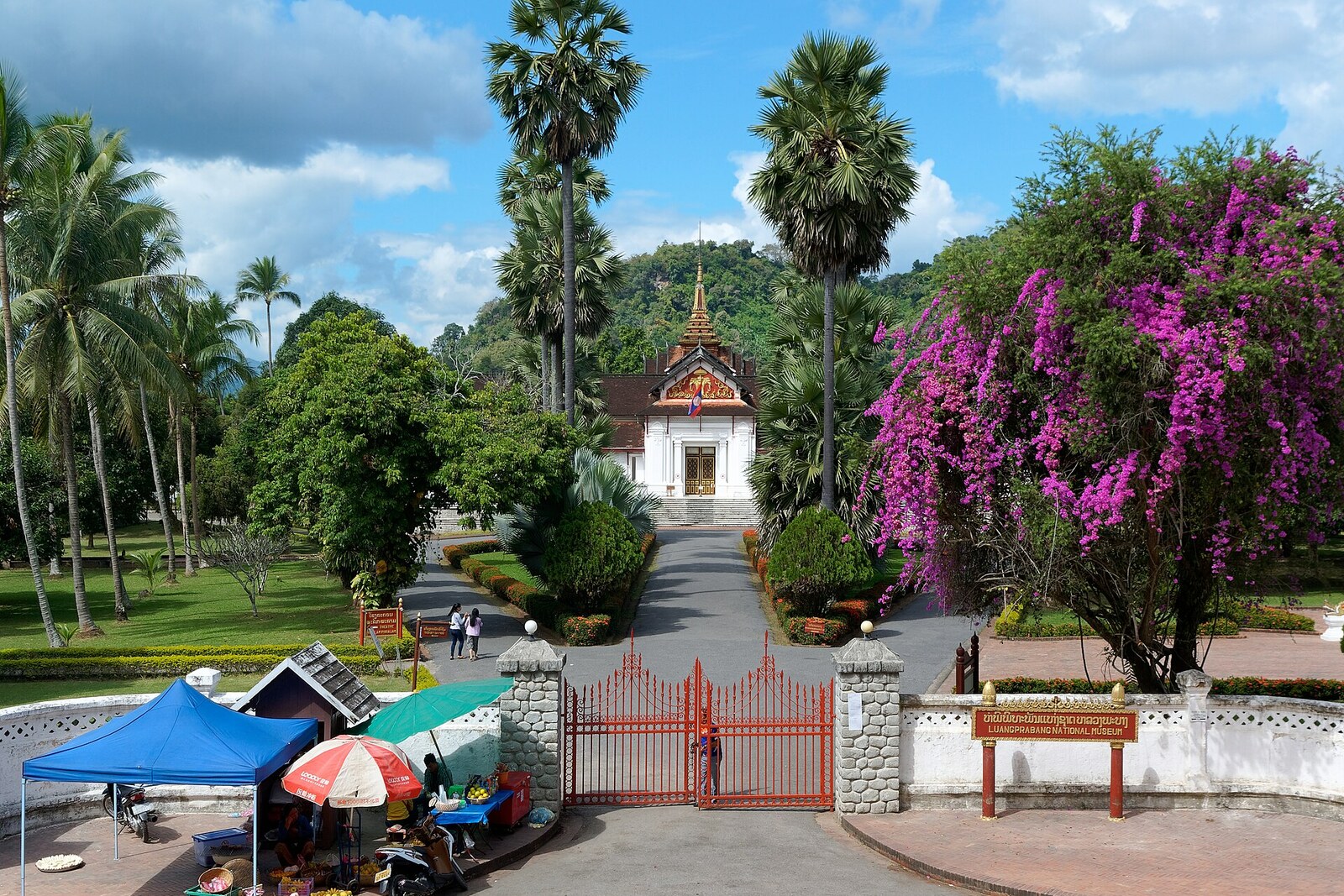
Look around first
What to notice
- Facade of Haw Kham
- Throne room
- Residential wing
- Haw Pha Bang pavilion
The story of the place
Behind the facade of Haw Kham, the reception rooms, throne room, and residential wing of the former royal residence have survived. After the Pathet Lao victory, the last king abdicated, and the palace was handed over to the state. In nineteen seventy-six, the National Museum of Luang Prabang opened here. Once, this entire house, with its halls and living rooms, served as a place of imprisonment.
Haw Kham, the “Golden Palace,” was built by the French colonial administration for King Sisavang Vong. Work continued from nineteen oh four to nineteen oh nine. The site was chosen between the main street and the Mekong: official guests could disembark from a boat at the palace riverbank and go straight to an audience. Here the king lived, received ambassadors, and conducted state affairs.
In nineteen forty-five, Japan removed the French administration of Indochina and secured from Sisavang Vong a declaration of Laos’s independence. A few months later, Japan surrendered. The king decided to restore the French Protectorate of Laos; his throne was preserved together with the French.
Prince Phetsarath, the hereditary viceroy and prime minister, opposed this. He sought to keep the declared independence in force and to bring the scattered Lao lands under a single government. The king stripped him of both offices. With a single order, Phetsarath lost the prime minister’s cabinet and his hereditary position as the second-ranking person at court.
Then Phetsarath’s supporters created a new government in the capital, Lao Issara — “Free Laos” — and declared the king deposed. On November tenth, thirty armed fighters entered this palace. The guards put up almost no resistance. Sisavang Vong and his family were kept here under house arrest.
Having seized the king, the Lao Issara government soon discovered that without him it was harder to demand obedience from the provinces. It lacked money and weapons, while French units were approaching from the south. In the spring of nineteen forty-six, the recent prisoner was returned to the throne as a constitutional monarch. This did not save Lao Issara: the French occupied Vientiane, then Luang Prabang, and Phetsarath fled to Thailand. Sisavang Vong remained king and in nineteen fifty-three became the head of an already independent Laos.
Thirty years later, royal life here came to an end. Sisavang Vong’s son, the last king, Sisavang Vatthana, abdicated after the victory of the Pathet Lao movement and handed the palace over to the state. On March thirteenth, nineteen seventy-six, it became the National Museum of Luang Prabang.
Inside, the reception rooms, throne room, and residential wing have survived. There was no separate room here for the arrested king: in November nineteen forty-five, the entire palace served as the place of imprisonment.
Useful on site
Daily 08:00–11:30 and 13:00–15:30; ticket office until 11:00 and 15:00; last Thursday of the month — cleaning and closure
Checked: date not specified. Check the official source before visiting.Follow the museum rules and local photography restrictions. If you cannot get inside, compare the palace entrance, the river, and the separate Pha Bang pavilion from outside.