 Guide On Map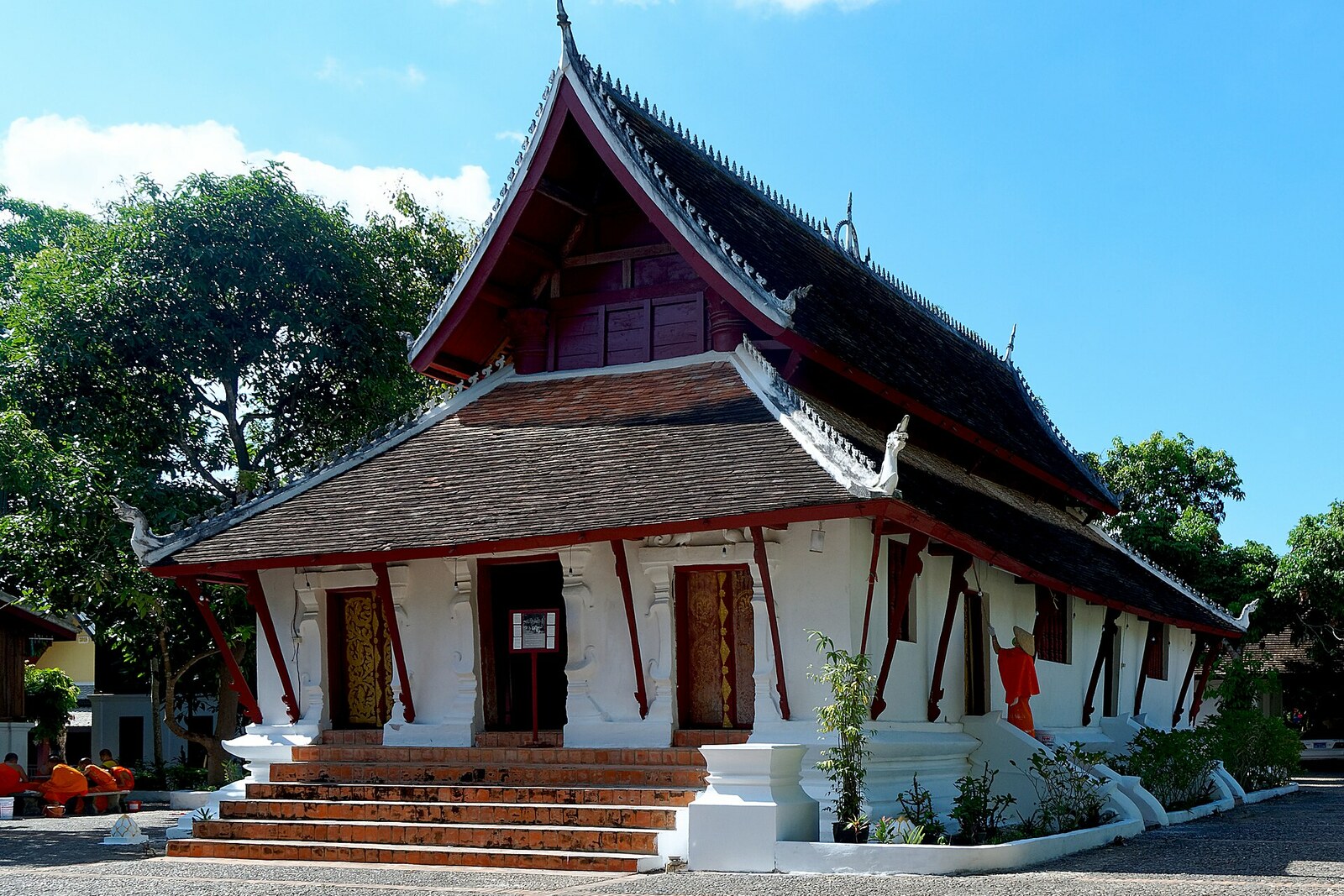
Look around first
What to notice
- The sim of Wat Pak Khan
- The mouth of the Nam Khan
- The Mekong
- The Khone Khai Pha rock
The story of the place
Before the main boat races, the rowing teams first gather at the very mouth of the Nam Khan. Here, beside the Khone Khai Pha rock, they leave rice, eggs, and other food, asking for the rowers to be protected from illness and accidents, and village children from dying in the river. In the dry season, the rock rises above the water. According to local legend, it is home to Ai Thong Kuang—a naga, a river spirit in the form of a snake.
The legend explains why the ceremony begins here. An unnamed king of Luang Prabang remained human for seven days, then for the next seven turned into a naga and hid behind seven curtains. His two wives were forbidden to enter at that time, but they wanted to see their husband. The women pulled aside all the curtains and found him asleep as a snake. After that, the king could no longer take human form. He slithered through the palace pond into the Mekong and settled at the mouth of the Nam Khan.
The wives searched for him on the bank. According to the same legend, the ruler of the nagas knocked both women into the river with a blow of his tail. The elder became the White Lady and ended up in one whirlpool of the Mekong; the younger became the Black Lady—in another. The husband and both wives remained separated by water.
Before the races, people bring this family together again for one day. In a ceremony recorded by ethnographers, two boats set out from the village on the opposite bank: one with a crew in white, the other in black. Each carried twelve women and two men dressed as women. First, the rowers took two figures made from banana-palm peel—a person and a snake—to the whirlpools of the White Lady and the Black Lady. In this way, the wives were given back the image of their husband in both his forms at once. The boats then crossed the Mekong and brought food to the Ai Thong Kuang rock.
After the offerings, the white and black boats staged the first race. Its outcome was decided in advance: the boat of the elder wife, the White Lady, had to win. Only after that did the real competition between the village teams begin. The custom survives: the white and black boats still arrive first at the river mouth with gifts, and the white boat still wins its ceremonial heat.
In the time of the kings, the ruler and his retinue also came here by boat. He left an offering at Khone Khai Pha, then went up the Nam Khan to Phamsai Pavilion behind Wat Pak Khan and watched the races from there. The monastery stood beside the place where the ceremony began and where the boats gathered.
The temple itself appeared in seventeen thirty-seven. Its founder, Phagna Chanthep, established the monastery beside a trading stop: river merchants halted at the convenient confluence and supported the temple, hoping to gain merit and good fortune in trade. Its name preserved their address. “Pak Khan” means “the mouth of the Khan”—the very place below the monastery where gifts are still brought first today, and only then does the race begin.
Useful on site
The exterior and riverbank are accessible during daylight hours; no reliable daily schedule for the inner hall has been published
Checked: date not specified. Check the official source before visiting.Choose a stable spot away from the riverbank edge, especially after rain or in high water. Entering the temple is not necessary to complete the route: the main sight here is the confluence itself.