 Guide On Map
City of London: from the Tower of London to Saint Paul the Apostle
From London Wall at Tower Hill through Bank and Guildhall to the cathedral
Guide On Map on your phone
Open the walk like a regular app
It takes about 10 seconds to install. No app store needed.
The whole path
Route map
About the walk
You will cross the City of London from east to west: from London Wall at Tower Hill to St Paul's Cathedral. First, the route curves around the fortress and enters the narrow streets of the old city. Then come a roofless church, a column on the site of a vanished church, a covered market, the Bank of England, the town hall yard, and Roman ruins beneath it.
This is not a walk through grand royal London. You will take the City of London apart layer by layer—in red paving, demolished buildings, an erased line, and a dark arc in the street. The stories rest on private decisions: someone will not dare cross a gutter, someone will bring a candle barefoot, someone will order shots fired to save a building. Every detail has its turn.
By the end, you will be able to read the City of London as a place where new power builds over old power again and again, but does not always erase its traces.
Why this order
The route begins at the eastern edge of Roman Londinium: the neighboring Tower of London shows how the Crown set its own fortress and palace beside the old city wall. From the Tower of London, the route enters the City of London, toward the parish church of St Dunstan-in-the-East—from royal power to the life of a city parish. Next, The Monument links the damaged church to the fire that changed the whole neighborhood. From the monument, the route goes to Leadenhall—from destruction to the place where the city authorities kept a food reserve. Trade then leads to the Bank of England, and from there to Guildhall: first the financial, then the municipal power of the City of London. Beneath the town hall yard, the Roman layer that began at the wall appears again. The final walk to St Paul's Cathedral brings the route together: the fire already marked by The Monument destroys Old St Paul's Cathedral and the book market in this story, while the present dome completes the journey through the rebuilt City of London.
Those who have already seen Westminster and want to understand the City of London Lovers of urban archaeology and visible traces of rebuilding Those who care about human decisions rather than a list of dates
Those expecting a walk through royal interiors Those who do not enjoy dense historical storytelling Those looking for an easy route through London’s best-known postcards
Before you go
The main story can be followed outdoors, so the route will not fall apart without tickets. Decide in advance which interiors you truly want to add: a full visit to the Tower of London or the cathedral noticeably changes the pace, climbing The Monument means 311 steps, and London's Roman Amphitheatre is inside Guildhall Art Gallery. Treat the Bank of England Museum as a separate visit as well. Before you set out, check access to the interiors you choose and any possible restrictions caused by services, events, or security measures; for older buildings, check accessibility separately if stairs may be an obstacle.
When to go
For an outdoor walk with stops at each story, set aside a substantial part of the day. One short interior can fit in along the way; the Tower of London or a detailed visit to St Paul's Cathedral is better treated as a major addition, and you should not try to combine both with an unhurried route.
Backup plan
If paid or underground spaces are closed, stay with the outdoor line: look at the wall masonry, the towers of the Tower of London, the open arches of St Dunstan-in-the-East, the column of The Monument, the roof structure of Leadenhall Market, the Bank Junction ensemble, the amphitheatre outline marked in paving, and the dome of St Paul's Cathedral. In rain, linger beneath the market roof and shorten pauses in open squares. If time is short, do not rush through all eight stories: follow the full route with brief stops, and save interiors for a separate visit.
Route conditions
Elevation. Ascent — 51 m; descent — 29 m
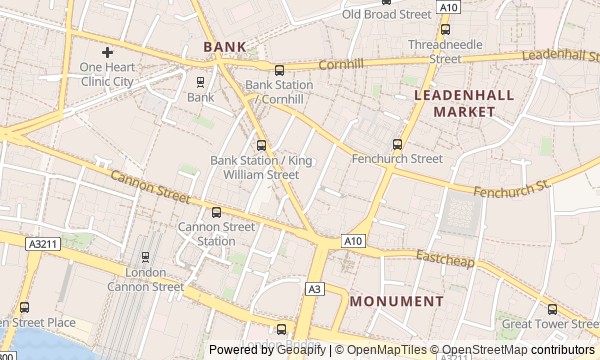
OpenStreetMap extract of June 18, 2026: database data, not a check on the ground. Data © OpenStreetMap contributors, ODbL licence
Walk plan
Open in maps ↗- 1
London Wall at Tower Hill
Here you will learn to distinguish Roman masonry from later additions and see how an old monument became building material. - 2
The Tower: a palace behind fortress walls
The fortress matters here as a former royal palace, where the same rooms served both ceremony and imprisonment. - 3
St Dunstan-in-the-East
The ruins show how the parish returned the church to service after violence, and how the church later became a garden. - 4
The Monument to the Great Fire of London
This stop preserves in stone the trace of how the city assigned and then withdrew blame. - 5
Leadenhall Market
The market will show how the city authorities turned a private estate into a food reserve. - 6
Bank Junction and Bank of England
Here, the City’s financial center becomes a place of choice between former popularity and the Bank’s protection. - 7
Guildhall Yard and London's Roman Amphitheatre
This stop returns to the route’s Roman layer and shows how it was preserved beneath a new art gallery. - 8
St Paul's Cathedral
The finale will bring together the Great Fire of London, the fate of the book trade, and the present cathedral.
Route features
Everything you need stays in the browser
Progress, saves and your trip plan are stored on this device.
Add Guide On Map to your home screen so the walk opens outside the browser.
How we handle sources, maps and corrections: our editorial standards