 Guide On Map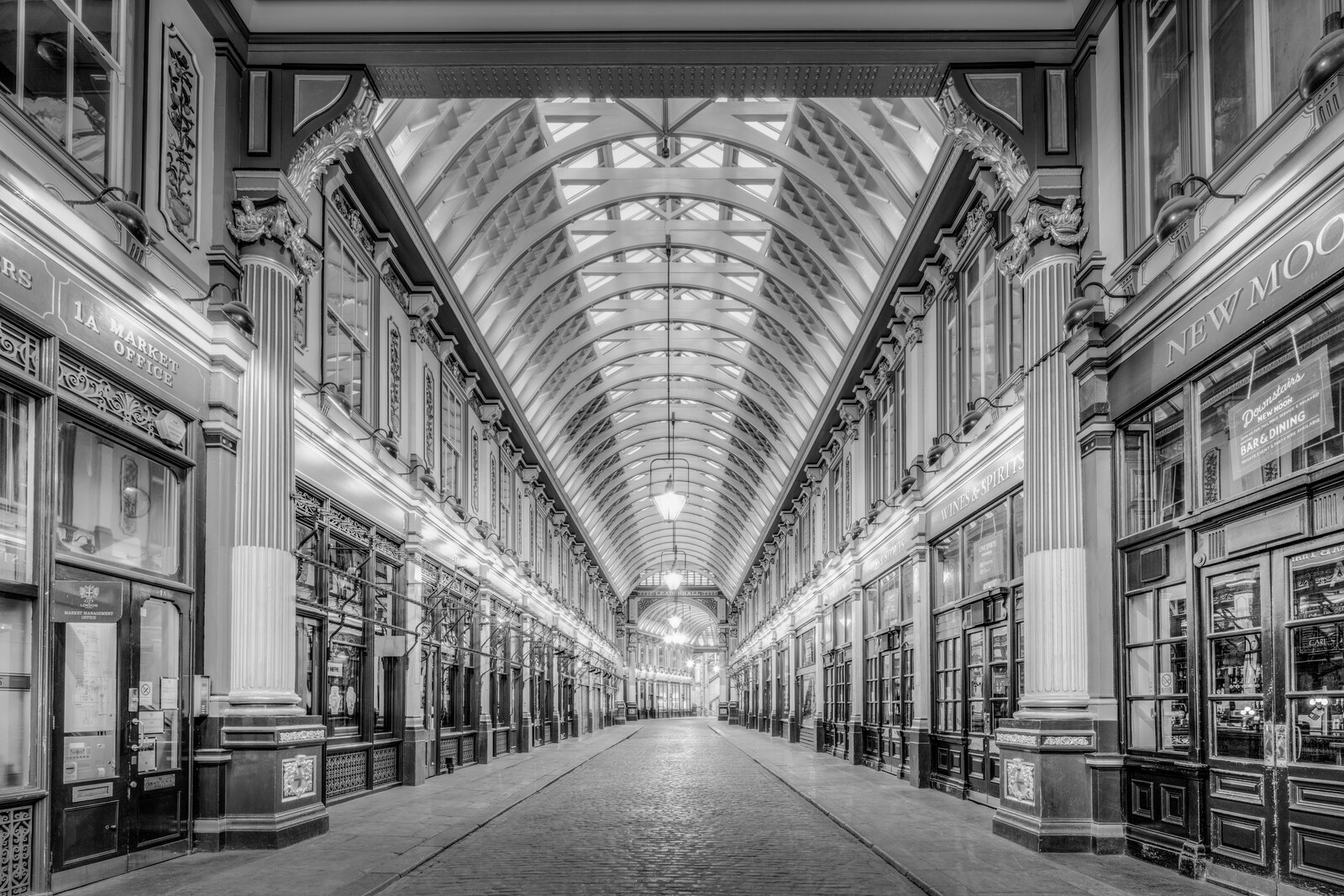
Look around first
What to notice
- Cast-iron columns
- Glass roof
- Uneven cross of covered arcades
- Permanent shops
The story of the place
People still pass through this market not only to shop: long-established city passageways cross the site, so the covered arcades meet here at a crossroads. In eighteen eighty-one, Horace Jones covered them with glass and installed permanent shops along the sides for poultry traders. Cast-iron columns support the roof where a granary once stood; not a single wall remains of the old stone building. Shops, bars, and restaurants now stand side by side beneath the roof, while the market’s name recalls the lead roof of a house that vanished long ago.
Leadenhall originally referred not to a market but to a large private house from the thirteenth century. Its roof was covered in lead, and that is how the building got its name. By thirteen twenty-one, trade was already taking place in the courtyard. The poultry market on Cheapside could not accommodate all the sellers, so traders from beyond the city boundaries moved here; later, they were also allowed to sell cheese and butter here.
At the beginning of the fifteenth century, the estate passed to the city corporation. London was already trying to store grain for years of poor harvests: commercial wealth did not save city residents when bread suddenly became expensive and disappeared. Simon Eyre, a draper who made money from the cloth trade, decided to invest his own capital in a communal granary. He paid for the main part of the construction himself, and became Lord Mayor at the height of the work.
By fourteen fifty-five, a stone quadrangle stood here. Poultry, eggs, butter, cheese, and grain were sold below, under the arcades facing the courtyard. The two upper floors were occupied by sacks containing the city’s reserve. The floors were reinforced to bear their weight, and windows closed with wooden shutters were opened for ventilation. There were no lower windows on three outer sides: the reserve was protected in case of unrest. After the work was completed, the city declared Leadenhall a public food market. The money Eyre had earned from cloth became a place where the same commodity could be sold today and stored until future high prices.
Eyre’s stone market has not survived to the present day. In eighteen eighty-one, the city commissioned its architect Horace Jones to house poultry traders here again. Jones covered the old passageways with glass and installed permanent shops along them. He could not straighten the layout: long-established routes ran through the site, used by people who had no business at the market. That is why the present-day arcades form an uneven cross rather than a regular grid.
Shops, restaurants, and bars now operate beneath the glass roof, and people still pass right through the market. Not a single wall remains of Eyre’s granary: Jones’s cast-iron columns stand in its place. The name Leadenhall preserves an even earlier object—the lead roof of the vanished house in whose courtyard trade began.
Useful on site
The passageways and businesses operate on different schedules; check the market’s official website and the hours of individual tenants.
Checked: June 26, 2026. Check the official source before visiting.It is easier to take in the architecture without rushing and without blocking the entrances to businesses that are open. Access to individual shops depends on their own schedules.