 Guide On Map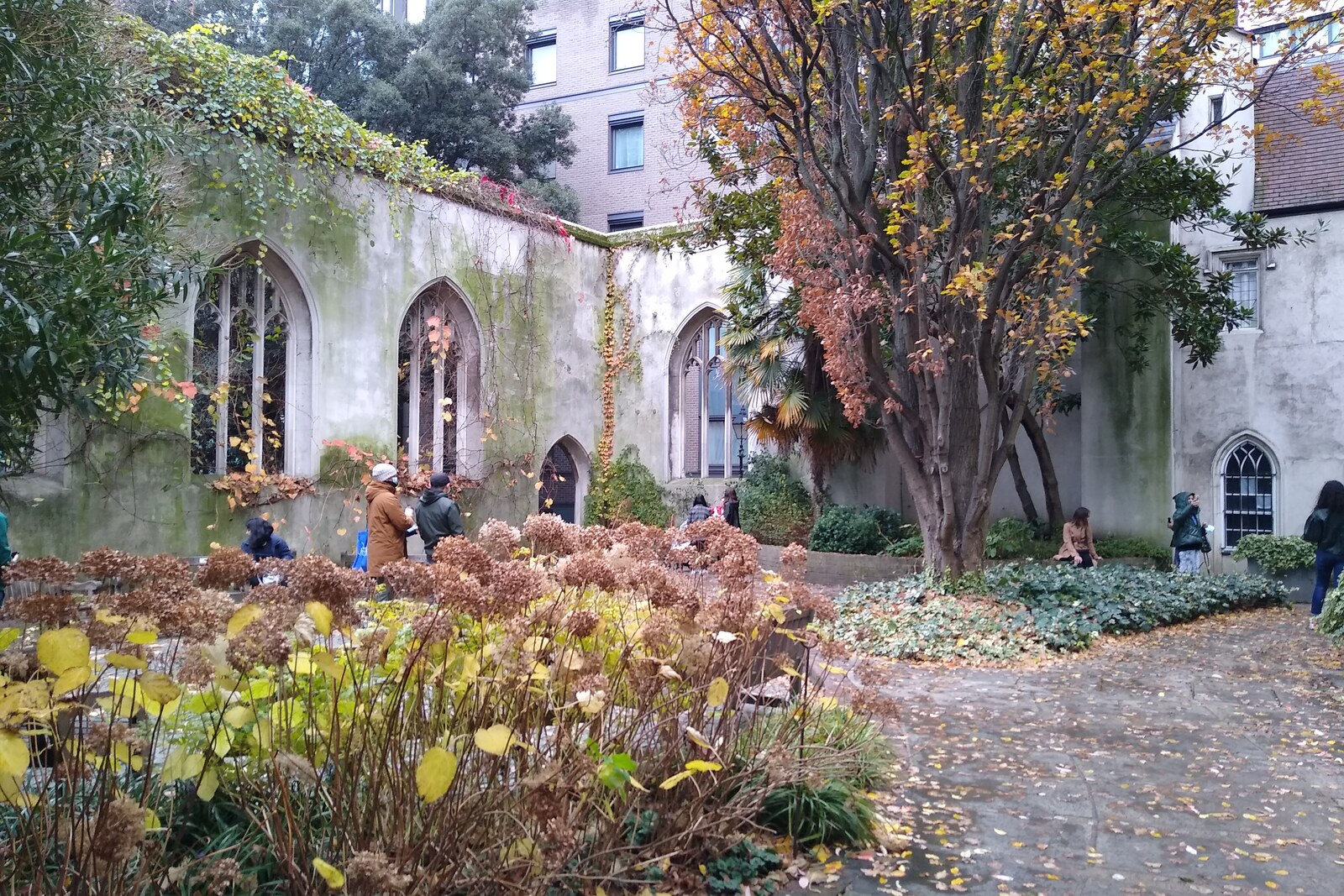
Look around first
What to notice
- Gothic window openings
- Christopher Wren's tower
- The lawn inside the former nave
- The low fountain
The story of the place
A low fountain stands in the grass of the former nave, while Gothic windows and Christopher Wren's tower rise above it. St Dunstan-in-the-East served for many centuries as the parish church of the eastern part of the City. The church was established around the turn of the eleventh and twelfth centuries and was named for Saint Dunstan, the Archbishop of Canterbury venerated in medieval England. The suffix in its name distinguished it from another church of the same saint at the western boundary of the City.
On Easter Sunday in fourteen seventeen, a daytime sermon was being held here. Among the parishioners was Thomas Petwarden, a fish merchant who managed the river wharf of Sprott's Key. His income depended on cargoes hauled ashore from the River Thames.
During the sermon, two noblewomen quarrelled—the wives of Lord Strange and Sir John Trussell. The chronicler did not record what they argued about or what they wanted to achieve. Each woman's husband joined her, and the quarrel turned into a general brawl. Several people were injured. Petwarden tried to separate the fighters and was killed inside the church.
Lord Strange and Sir John were taken to the city prison on Poultry. Services here ceased: spilled blood was considered a defilement of a consecrated building. The Archbishop of Canterbury had to establish who was guilty and return the parish church to service. The church investigation placed the main responsibility on Lord Strange and his wife; the lord was publicly excommunicated.
On the first of May, the couple came to the old St Paul's Cathedral for their assigned penance. Their servants set out from here wearing only shirts, following the rector of St Dunstan's. The lord walked bareheaded and carrying a lit candle; his wife walked barefoot. The procession ended here, in the church where Petwarden had died. During the reconsecration, Lady Strange personally filled the church vessels with water and gave the parish an expensive ornament; her husband donated a silver vessel for consecrated wafers. After that, services resumed.
By then, the church's name was already several centuries old. Saint Dunstan was a tenth-century Archbishop of Canterbury, an adviser to English kings and one of the most venerated saints of medieval England. The church, established on this site around the turn of the eleventh and twelfth centuries, was dedicated to him. The suffix “in-the-East” distinguished it from another church of Saint Dunstan at the western edge of the City, St Dunstan-in-the-West.
The medieval building where the brawl took place is gone. Christopher Wren built the tower after the Great Fire of London, while the walls with Gothic window openings were built by the architect David Laing in the early nineteenth century. In nineteen forty-one, bombing destroyed the church's roof and interior, but the tower and outer walls remained standing.
After the war, leaders of the Church of England decided not to rebuild the church and joined its parish to All Hallows-by-the-Tower. In nineteen sixty-seven, City councillors handed the shell over to the Corporation's architects: inside the former nave, they laid out a lawn, planted trees, and installed a low fountain. The garden was opened to everyone in the early nineteen seventies; the united parish still sometimes holds open-air services here.
The chronicle does not name the exact place where Thomas Petwarden was fatally wounded. All that is known is that it lay inside the former church—in the space now occupied by the lawn and fountain.
Useful on site
Usually daily 08:00–19:00 or until dusk; the City of London may issue temporary notices.
Checked: June 26, 2026. Check the official source before visiting.Speak quietly inside the garden and keep the passageways clear: this is a small, popular place. If the entrance is closed, you can view the tower and part of the ruins from the street.