 Guide On Map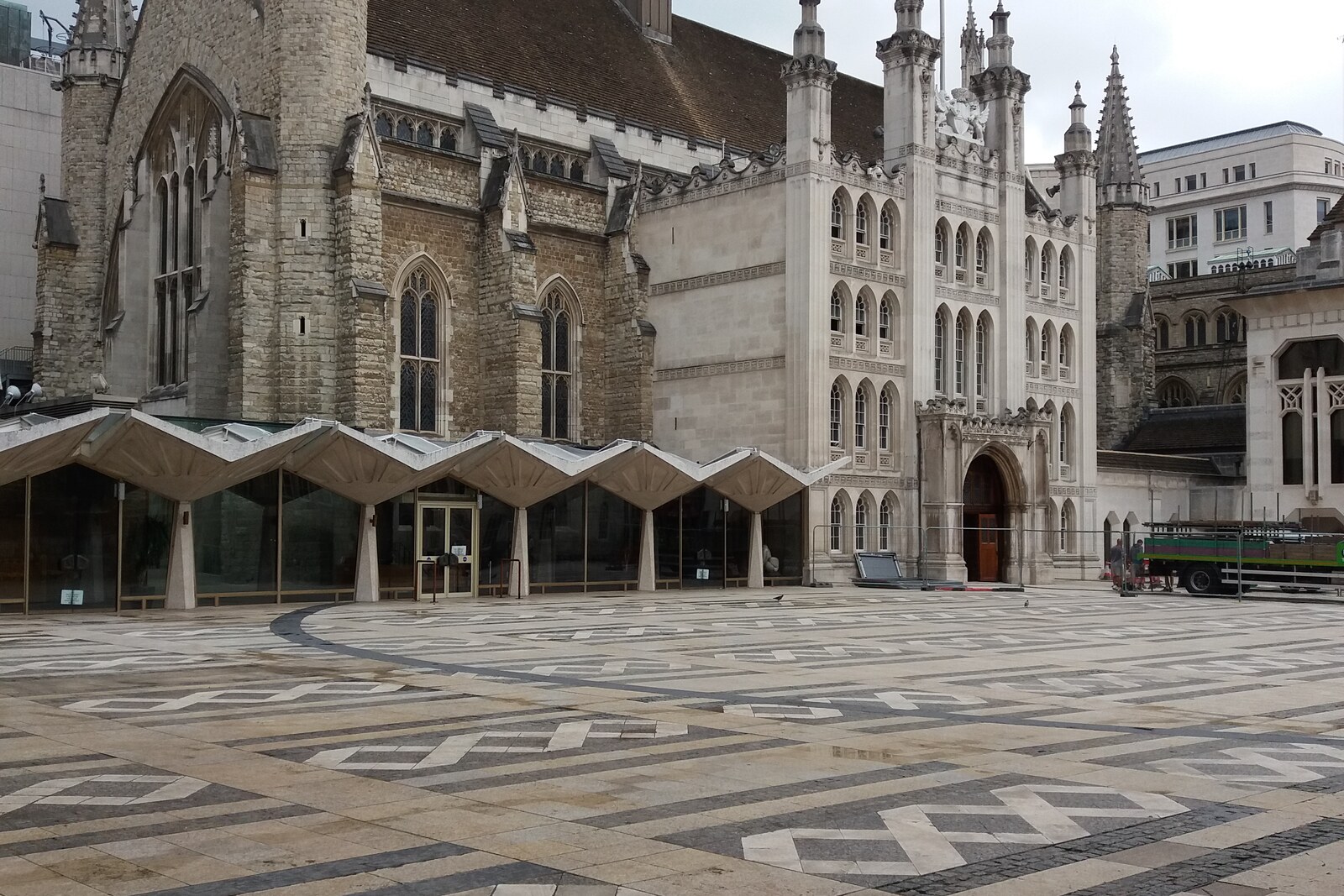
Look around first
What to notice
- The dark arc in the pale paving
- The Gothic façade of the Guildhall
- Roman masonry in the underground hall
- The amphitheatre’s eastern entrance
The story of the place
Guildhall Yard lies at the center of a large Roman amphitheatre, and the dark arc in the pale paving follows the edge of its ancient oval. The low, damp site was unsuitable for housing, but an arena was dug out of it and wooden seating for spectators was raised on embankments; later, the most important walls were reinforced with stone and tile. The oval, more than one hundred meters long, held up to seven thousand people: gladiators, convicts, and animals were brought here, and contests, executions, religious ceremonies, and military ceremonies were held. The eastern passage led into the arena past a small cage with a lifting grille, while wooden drains beneath it carried water away from the damp ground.
In February nineteen eighty-eight, archaeologist Nick Bateman was trying to fit together several Roman walls uncovered in different excavations near the Guildhall. Bateman directed the site: his team had to investigate the ground before construction began on a new art gallery. The builders were waiting, but the walls stubbornly diverged at strange angles. Then the archaeologists cleared an arc. It did not suit an ordinary building; before them was the inner wall of an arena.
The find settled a dispute that had lasted more than a century. Archaeologists had assumed that Londinium, Roman London, must have had an amphitheatre, but no one knew where to look for it. It was hardly expected here: such structures were usually built outside the city limits, while this one stood beside a military fort and later ended up inside London Wall. The low, damp site was poorly suited to housing. But the ground could be dug out for an arena, while wooden seating for spectators could be raised on embankments.
The first amphitheatre was built around the year seventy. In the early second century, Roman builders enlarged it and reinforced the most important walls with stone and tile. The oval, more than one hundred meters long, held up to seven thousand spectators. Organizers sent gladiators, convicts, and animals into it, and held contests, executions, religious ceremonies, and military ceremonies. Gladiatorial fights to the death probably happened less often than people tend to imagine: trained fighters cost money and travelled to perform in cities across the empire.
Bateman’s team found the eastern entrance through which participants entered the arena. Beside it was a small chamber. Grooves for a wooden grille remained in the stone threshold: attendants could raise it from above and release an animal while remaining outside the cage themselves. Beneath the passage lay wooden drains. The damp soil that had prevented the Romans from building homes here preserved the wood for almost two thousand years.
This find collided with a city decision that had already been made. The City of London intended to bring thousands of paintings back from storage: the previous gallery had burned down during an air raid in May nineteen forty-one. Offices were also planned above the excavation. After the amphitheatre was discovered, the state placed the ruins under protection, proceedings began, and construction stopped for several years.
The masonry could not be moved. Nor could a one hundred-ton drilling rig be placed on it: it would have crushed the walls. Engineers assembled a temporary steel platform above the excavation and set its supports in the gaps between the Roman remains. From this platform, they drilled permanent piles forty-one meters deep, then transferred the weight of the gallery and offices onto them. The architects removed the cloakroom from the original design and created an amphitheatre hall in its place. The art gallery opened in nineteen ninety-nine, and the ruins another three years later.
The Gothic hall opposite still serves as the City of London’s town hall. The name “Guildhall” is usually derived from the Anglo-Saxon word “gild,” meaning payment: this was where townspeople paid dues and gathered for civic affairs.
The dark arc among the pale paving slabs of Guildhall Yard marks the wall of the Roman arena. The yard itself occupies most of its former site, while the eastern entrance found by Bateman lies about six meters lower, beneath the art gallery. Medieval builders laid out the neighboring streets around the buried oval, and the middle of the arena has not been built over since at least the fourteenth century.
Useful on site
Amphitheatre / Guildhall Art Gallery: Mon–Sun 10:00–17:00, last entry 16:45; free, special closures and events may occur.
Checked: June 26, 2026. Check the official source before visiting.The outline of the amphitheatre is visible in the open square. The surviving walls and drainage are inside the art gallery, whose access should be checked separately.