 Guide On Map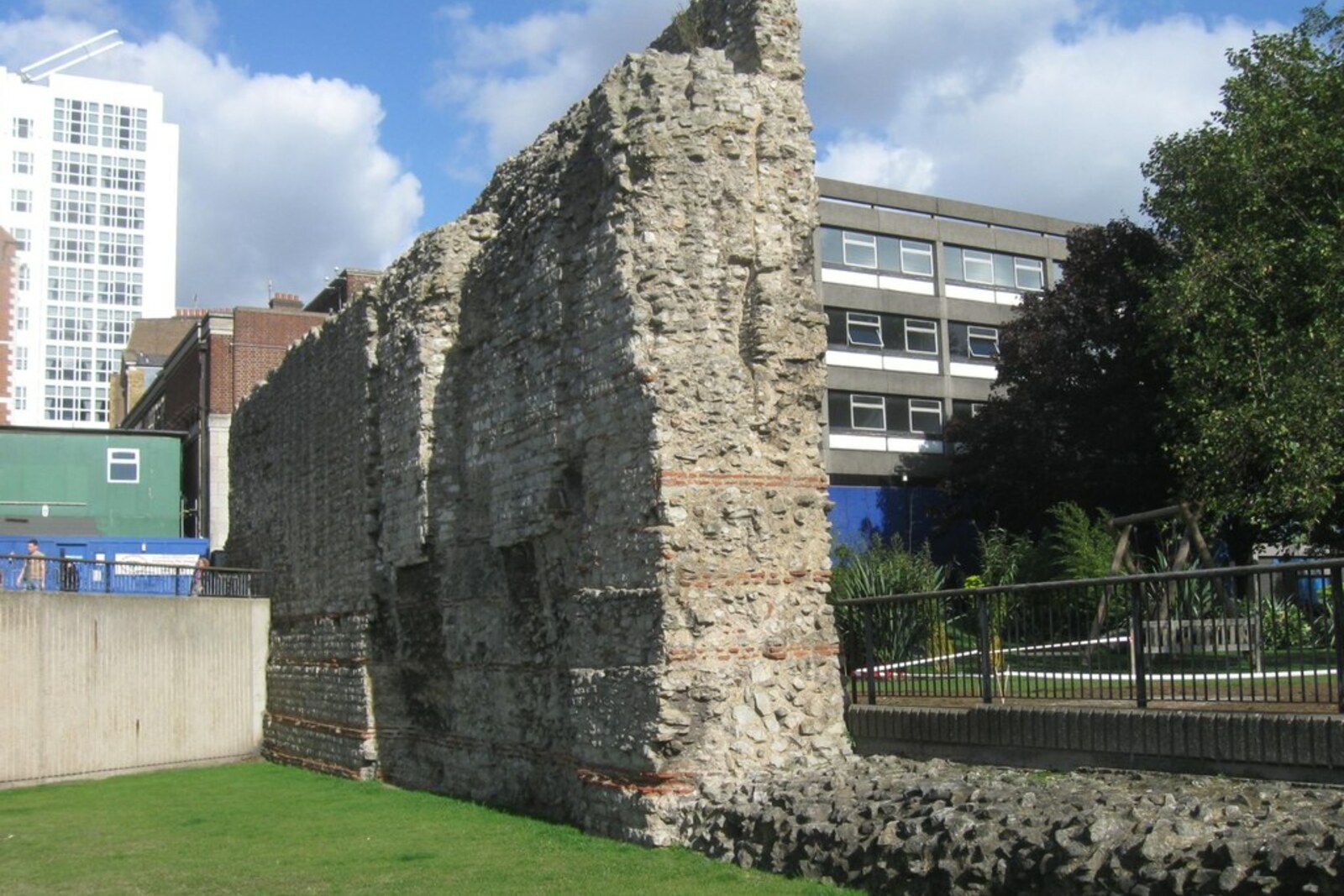
Look around first
What to notice
- Horizontal bands of red tile
- Gray stone masonry
- Bronze figure of the emperor
- White slab with a Latin inscription
The story of the place
From the River Thames to the northern gates of Londinium ran a city wall that separated the Roman city from the land. Four meters of gray Kentish stone with even layers of red tile survive at the bottom, while medieval builders later raised this section to more than ten meters. The Romans first fortified the landward edge of the city, leaving the river open for movement and trade.
The bronze figure in front of the wall bears the name of Emperor Trajan. He ruled from ninety-eight to one hundred seventeen, while the inhabitants of Londinium built this wall roughly a century later. The statue was placed here in the twentieth century as a sign of the Roman past; Trajan had nothing to do with the construction of the wall.
Roman masonry occupies the lower four meters. It is recognizable by horizontal bands of red tile between courses of gray Kentish stone. Everything above was added in the Middle Ages, so the surviving section rises more than ten meters. The eastern boundary of Londinium ran here: from the bank of the River Thames, the wall went north toward the city gates. At first, the Romans enclosed only the landward side. They built unhurriedly, laid even courses, and left the river open; the inhabitants had concerns beyond defense alone. The wall marked where the principal city of Roman Britain began.
The man genuinely connected with this section is named on the white Latin slab nearby. Gaius Julius Alpinus Classicianus arrived in Britain in sixty-one, when the wall did not yet exist and Londinium lay burned. The city had been destroyed by participants in the revolt of Boudica—the queen of the Iceni, ancient Britons, who herself sought liberation from the Romans after confiscations and violence against her family. The Roman governor Suetonius Paulinus defeated the rebels and continued the punitive campaign. His soldiers devastated tribal lands, and famine began after the war.
Classicianus was the procurator of the province—a financial administrator responsible for the taxes and property of Emperor Nero. His predecessor fled Britain: financial abuses by the Roman administration were one of the causes of the revolt. Classicianus was tasked with remedying the consequences, but Paulinus intended to suppress resistance further. Continuing the campaign would mean more devastated lands and disruption to the work for which the procurator was answerable to the emperor.
Classicianus went against the victorious commander. Among the tribes ready to surrender, he spread the message that they should wait for another governor, who would not treat them as a defeated enemy. He then sent a report to Rome: as long as Paulinus commanded the troops, the war would not end.
Nero sent the authorized official Polyclitus to inspect the province and reconcile the two leaders. Paulinus was not removed immediately. But after he lost several ships along with their crews, the emperor handed the army over to a new governor. The new governor ended the attacks; the tribes likewise did not resume hostilities. Classicianus achieved a change of course, although he still had to serve for some time alongside the man he had accused before Nero.
Around sixty-five, Classicianus died in service. His wife Julia Pacata had a stone tomb erected for him in the form of a large altar, taller than a person. The inscription named the deceased man's office and stated who had commissioned the monument. Where the tomb originally stood is unknown.
About a century and a half after Classicianus's death, the inhabitants built the city wall. Later still, in the fourth century, builders added semicircular fortifications on the outside. For one of them, located immediately north of here, they dismantled old gravestones. Large blocks from the monument to Classicianus were laid in the bottom row of the bastion. It appears that the fortification was built in haste: the name of the man who had once stopped a punitive campaign was used as ordinary building stone.
The first fragment of the inscription was found here in eighteen fifty-two. New pieces appeared during the construction of the Underground railway in eighteen eighty-five and during building work in nineteen thirty-five. The recovered blocks were joined to other parts of the tomb; the original is now in the British Museum.
A copy of the inscription remains on Tower Hill. It marks not Classicianus's grave, but the section of bastion from which the builders of the new London removed, piece by piece, the monument to him and Julia Pacata.
Useful on site
Free; English Heritage states that access is available during reasonable daylight hours.
Checked: June 26, 2026. Check the official source before visiting.The stop takes place entirely outdoors: get as close as the barrier allows and compare the levels of the wall.