 Guide On Map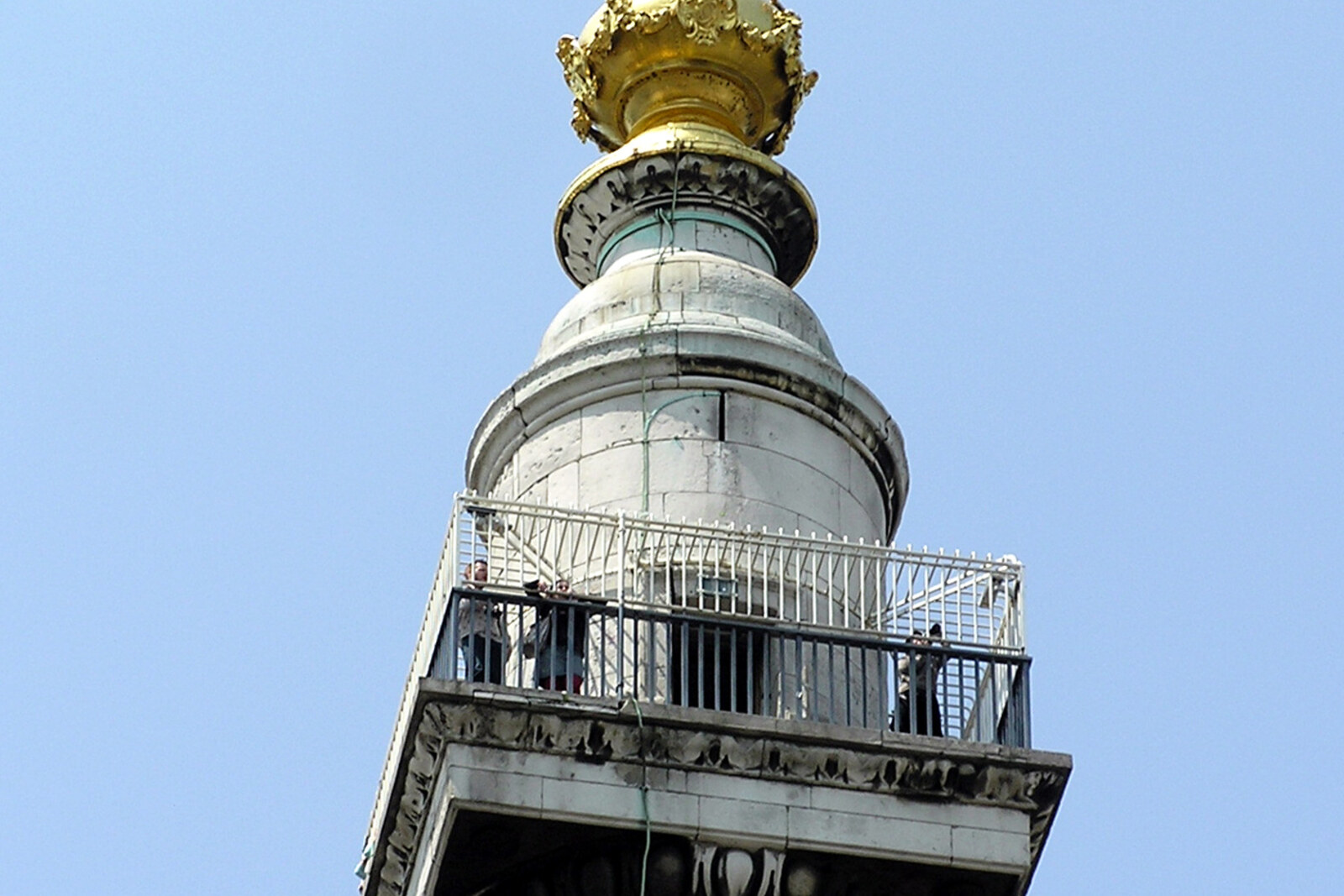
Look around first
What to notice
- Tall stone column
- Stone pedestal
- Latin inscription on the north side
- Blank damaged band
The story of the place
The column does not stand on the site of the bakery where the Great Fire of London began. St Margaret, New Fish Street stood here: it burned down and was never rebuilt. The bakery stood farther east, on Pudding Lane. It is two hundred two feet from here—and the column itself rises exactly two hundred two feet. Its architects turned its height into a measure of the distance to the first house to catch fire.
On the night of September first to second, sixteen sixty-six, Thomas Dagger was working in that house—a young hired baker who had not yet earned the right to open his own business. He worked in the trade of his employer, Thomas Farriner, the royal baker who supplied ship's biscuit to the navy. Shortly before two o'clock, Dagger woke up choking on smoke. He roused Farriner and Farriner's adult children. The three men and the master's burned daughter escaped through an upper window and crossed to the neighboring house along a rain gutter. A maid did not dare follow them and died. Dagger became the first known witness to the fire that later destroyed most of the City of London.
The exact cause of the fire could not be established. Farriner needed to prove that the disaster had not begun through his negligence. He claimed that by ten o'clock that evening the oven had been cleaned out, and that around midnight there was not even a fire in the bakery to light a candle. Such testimony protected his professional reputation, but it required another culprit.
That culprit became Robert Hubert, a young Frenchman, the son of a clockmaker from Rouen. Why he confessed to arson remains unknown; contemporaries considered him mentally ill. Hubert said that he had pushed a pole carrying a burning mixture of gunpowder and sulfur through an open window of the bakery. Farriner objected: there was no window there. The captain of the ship on which Hubert arrived from Sweden confirmed an even more important detail—the Frenchman came ashore in England two days after the fire began.
The surviving workers and Farriner's family appeared as witnesses for the prosecution. Robert Hubert was found guilty and hanged at Tyburn on October twenty-seventh. A later parliamentary inquiry found no evidence of a conspiracy and ruled that the fire had been an accident. Dagger gained the right to run his own business and opened a bakery, while Farriner continued working until his death four years later.
When The Monument was completed in sixteen seventy-seven, its inscriptions told of the fire and the rebuilding of the city, but named no culprits. Then England was gripped by panic over the fabricated Popish Plot to kill King Charles II. The Court of Common Council, which governed the City of London, decided to set the accusation in stone. In sixteen eighty-one, a sentence was added to the text on the north side of the pedestal: “But Popish madness, which wrought such horrors, has not yet died out.” Papists was then a contemptuous name for Catholics. Hubert's confession, though his family was Protestant, became an accusation against an entire religious denomination.
The sentence was removed, then restored. In eighteen thirty, the city council finally ordered it destroyed. The letters were not filled in: stonemasons roughly chiselled away the entire bottom line. The damaged band was preserved. It still runs beneath the Latin text on the north side of The Monument—a blank space where culprits were named for a century and a half.
Useful on site
Officially daily 09:30–13:00 and 14:00–18:00; last entry 12:30 and 17:30.
Checked: June 26, 2026. Check the official source before visiting.The column and its base can be examined from outside. Climbing the 311 steps is a separate choice; assess your strength in advance and check access.