 Guide On Map
Itchan Kala: From the Western Gate to the Khan's Market
From Ata Darwaza through the old city to Palvan Darvaza
Guide On Map on your phone
Open the walk like a regular app
It takes about 10 seconds to install. No app store needed.
The whole path
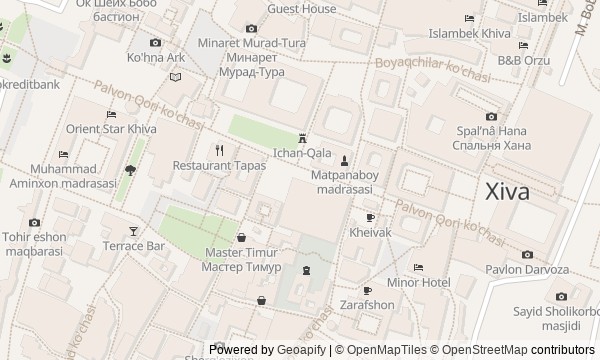
Route map
About the walk
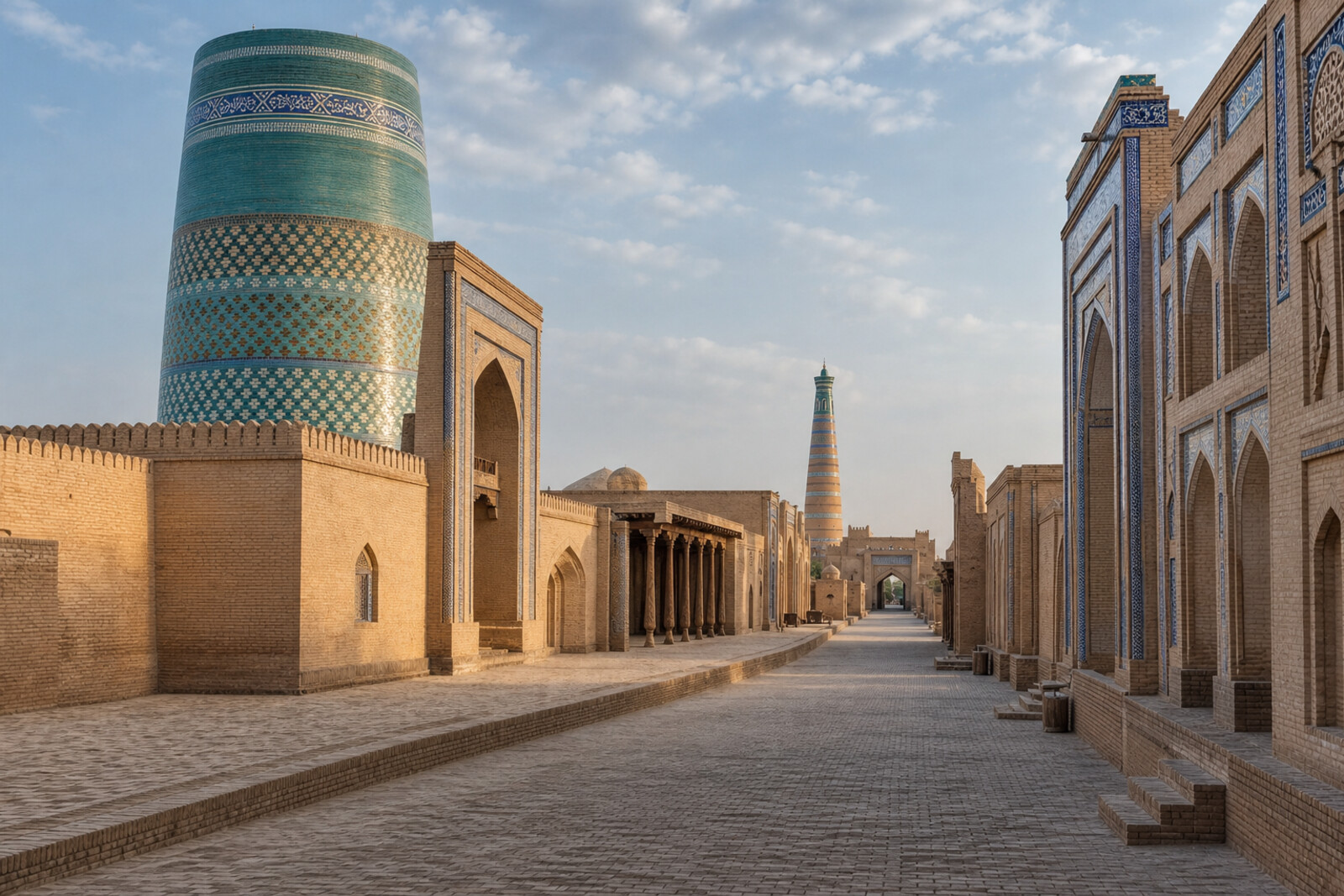
You will enter Itchan Kala through the western wall and cross the inner city to the eastern gate. At first, the route gathers a madrasa, an unfinished minaret, and the khan's citadel around a single square. Then it leads into quarters of mosques, schools, mausoleums, and palace courtyards. The final stretch brings you to the place where the city wall gave way to trading buildings.
This will not be a parade of famous facades. You will trace how study, prayer, justice, dynastic memory, and caravan trade existed side by side in compact Khiva. Why did restored gates need doors from elsewhere? What did six extra years leave in the masonry of a palace? And why did the release of hundreds of captives not end the trade in people?
The story will be calm and precise. Legends will remain legends, while conclusions rest on doors, inscriptions, columns, and courtyards. After the walk, you will be able to go from Ata Darwaza to Palvan Darvaza and explain why a throne court, a Friday mosque, a palace, and a caravanserai ended up on the same line.
Why this order
Ata Darwaza sets the western boundary of the inner city and immediately brings you to two neighboring centers of khan's Khiva. The route first turns toward the Muhammad Amin Khan Madrasa and Kalta Minor to the right of the gate, then crosses the same square to Kunya Ark: the school commissioned by the khan stands opposite the place from which the Khanate of Khiva was ruled. From the citadel, the road heads east along the main street to Juma Mosque, shifting from the khan's reception hall to the shared Friday gathering. From the old mosque, the route turns south to the Islam Khoja Complex, where two different ways of teaching children stand side by side. The next short stretch leads to the Pahlavan Mahmud Mausoleum and shows which revered place the khans tied their power to. From the tomb, the route returns to the eastern axis and Tash Hauli: after the dynasty's shrine come its residential, reception, and judicial courtyards. Beyond the palace begins Allakuli Khan's trading hub, and Palvan Darvaza ends the route where court, market, caravanserai, and city boundary meet in one section.
Those who want to understand how khan's Khiva worked, rather than simply see its facades Those interested in the fates of buildings, objects, and human decisions Those who value a calm account without pretty legends in place of facts
Those who only want a short overview of the main monuments Those who prefer light city stories without themes of power, violence, and captivity Those who do not enjoy long stops inside architectural complexes
Before you go
Wear comfortable shoes: street and courtyard surfaces are uneven, and thresholds and steps appear inside the complexes. For active religious sites, choose clothing that covers your shoulders and knees; do not photograph worshippers or pilgrims without permission. Access to interior spaces can change because of restoration, services, or events, so do not build your route around a single must-see interior. Check the conditions for visiting the complexes and climbing the minaret before your walk: those admissions may be arranged separately. Bring water and sun protection, but do not expect to drink or snack inside shrines and museum halls.
When to go
Set aside half a day for the route and start at a cooler time. You will need extra time for palace courtyards, museum displays, and the minaret climb; without them, the walk goes noticeably faster. During the hot season, avoid the middle of the day and check access to interiors just before setting out.
Backup plan
If the palaces, madrasas, or mausoleum are closed, do not reduce the route to a single square. Walk the full axis from Ata Darwaza to Palvan Darvaza: from the street, you can still see the line of the western wall, the bulk of Kalta Minor, the portal of Kunya Ark, the minaret of Juma Mosque, the vertical of Islam Khoja, the turquoise dome of the mausoleum, the outer walls of Tash Hauli, and the domed trading passage by the eastern gate. Compare the width of entrances, blank facades, the height of towers, and the way the street narrows near the markets. Even without the interiors, this sequence shows how the city's activity shifted from the old citadel toward Allakuli Khan's palace and caravan trade.
Route conditions
Surface. Paved — 1 km (data covers 71% of the route)
Facilities. Toilets — 6
Elevation. Ascent — 8 m; descent — 8 m
OpenStreetMap extract of July 3, 2026: database data, not a check on the ground. Data © OpenStreetMap contributors, ODbL licence
Walk plan
Open in maps ↗- 1
Ata Darwaza and the Western Wall
Here, the reconstructed entrance brings old Khiva together with the work of twentieth-century restorers for the first time. - 2
Muhammad Amin Khan Madrasa and Kalta Minor
This stop connects a grand building project with a campaign after which the work was never continued. - 3
Kunya Ark
In the courtyard of official receptions, it will become clear how the victor took the khan's place while preserving his title. - 4
Juma Mosque
The many-columned hall shows how private lands supported a large urban congregation. - 5
Islam Khoja Complex
Two schools standing side by side make it possible to compare customary teaching with a reform that ended with its author. - 6
Pahlavan Mahmud Mausoleum
Here, a revered grave stands beside the burial places of khans of the new dynasty. - 7
Tash Hauli
The palace courtyards retain traces of a construction project that long outlasted the deadline set by the khan. - 8
Allakuli Khan’s Trade Hub and Palvan Darvaza
The finale will link caravan trade, the diplomatic release of captives, and the market by the eastern wall.
Route features
Everything you need stays in the browser
Progress, saves and your trip plan are stored on this device.
Add Guide On Map to your home screen so the walk opens outside the browser.
How we handle sources, maps and corrections: our editorial standards