 Guide On Map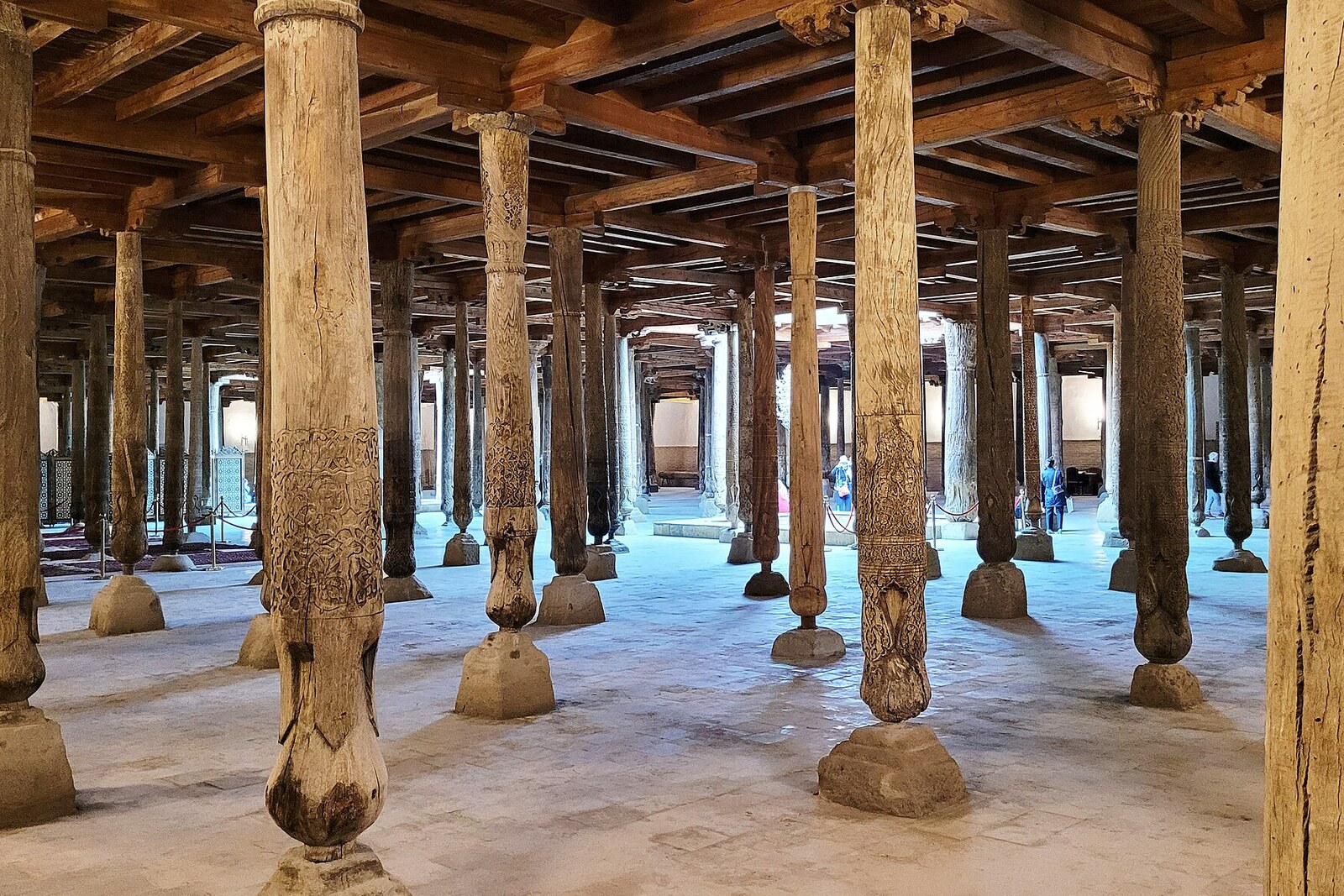
Look around first
What to notice
- Wooden columns
- Stone bases of the columns
- Mihrab in the southern wall
- Marble waqf plaque
The story of the place
The hall of Juma Mosque is assembled from wooden pillars of different ages: some of the carved columns were moved here from ruined medieval buildings. Their heights differ, but stone bases and wooden extensions at the capitals keep the roof level. The prayer niche remains in the southern wall, and to its right a marble plaque recalls the waqf: harvests and lease payments from the donated lands went toward the upkeep of the mosque, its attendants, and alms. Visitors now pass beneath this ceiling more often, while on the eastern side stands the small mausoleum of the man whose revenues helped this place outlive him.
“Juma” means Friday in Arabic. Once a week, residents of different quarters gathered here for the communal noon prayer. This required one large hall: its flat roof is supported by more than two hundred wooden columns, and there is no courtyard or domed space here.
A congregational mosque had stood on this site as early as the tenth century. By the end of the eighteenth century, the previous building had fallen into disrepair. Abdurahman Mekhtar then took it in hand. “Mekhtar” was the name of an office: he served at the Khivan court, managed civil affairs, and above all finances. The Khivan historian Munis attributed the mosque's rebuilding to him, while a surviving inscription names his son Abdurahim alongside him.
In seventeen eighty-eight to seventeen eighty-nine, father and son granted the mosque lands near the villages of Kuyuktam and Bekabad. They registered them as a waqf—property whose income was permanently assigned to a religious institution. The land could no longer be sold, returned to the family estate, or divided among heirs. The harvest and lease payments were to pay for repairs, the upkeep of the attendants, and alms. An official who lived by court service and administered other people's income gave away part of his own revenues so that they would be managed after his death as well.
With these funds, craftsmen built the present hall on the earlier many-columned plan and enlarged it. They placed new supports beside old ones brought from ruined medieval structures. That is why there is no uniform colonnade here: some shafts were carved for this rebuilding, while others were already several centuries old by then. Their differing heights did not interfere with the roof—the craftsmen leveled it with stone bases and wooden elements above the capitals. The large congregation once again fit beneath one roof, while the rural lands continued to provide funds for its upkeep.
After Abdurahman Mekhtar's death, he was buried in a small mausoleum by the eastern side of the mosque. The building now belongs to the Itchan Kala Museum-Reserve, and the hall is used mainly by visitors. To the right of the mihrab, the prayer niche in the southern wall, there remains a marble waqf plaque about the gift to the mosque. On it, the names of father and son stand beside the names of the two villages whose revenues they used to support this Friday mosque.
Useful on site
A museum site and a monument of religious architecture. In 2025, international assistance for conservation work was approved; some areas may be temporarily restricted.
Checked: date not specified. Check the official source before visiting.Let your eyes adjust to the dim light, speak quietly, and do not photograph people during prayer without their consent.