 Guide On Map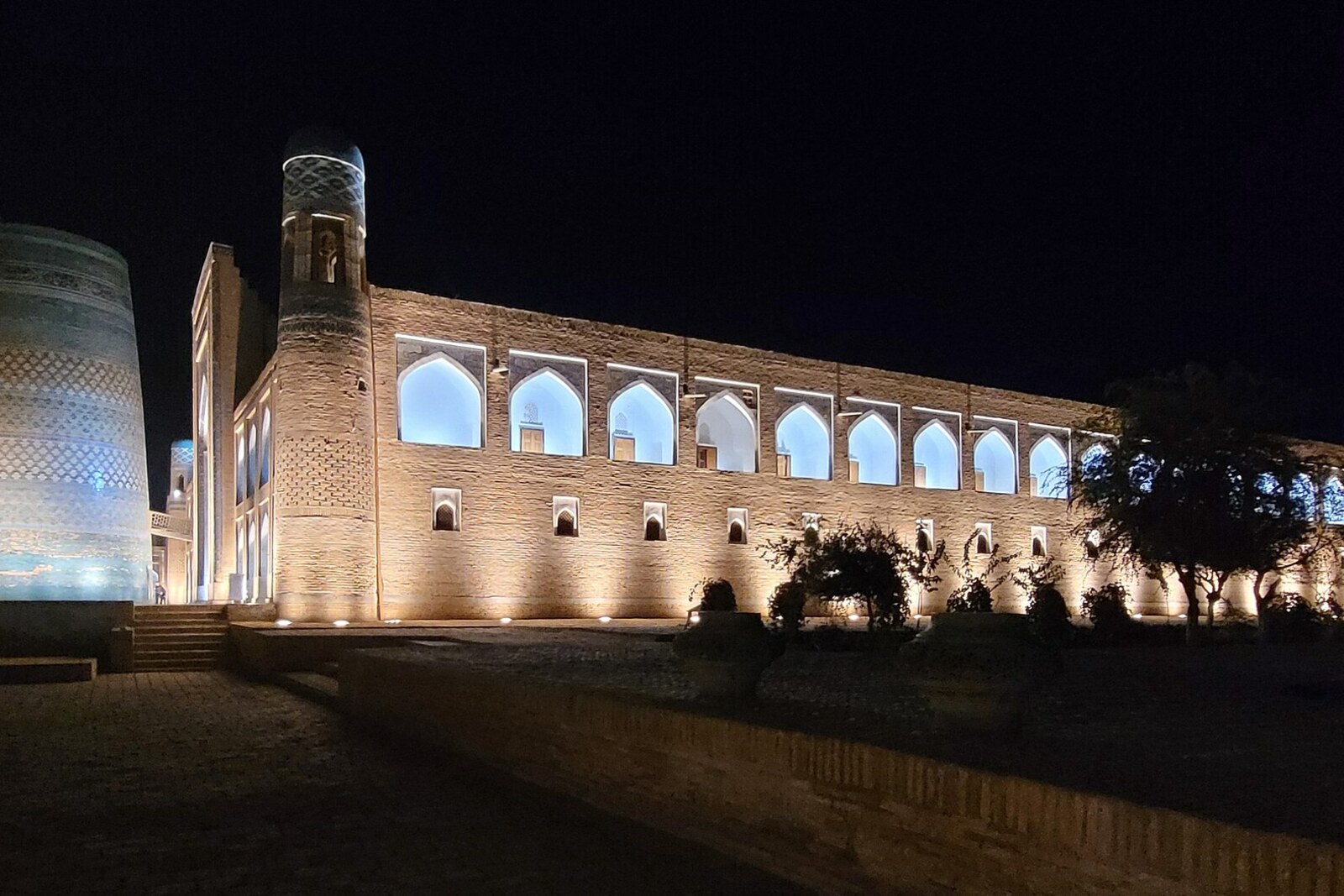
Look around first
What to notice
- The turquoise cylinder of Kalta Minor
- The minaret's broad foundation
- The madrasa facade
- Hujras around the courtyard
The story of the place
The turquoise cylinder by the facade is the lower part of a minaret that was intended to rise to about seventy meters. It was built together with the madrasa by order of Muhammad Amin Khan, ruler of the Khanate of Khiva. The madrasa received its patron's name; Kalta Minor is the name failure gave to the minaret.
In eighteen fifty-one, the khan ordered a large Muslim school to be built by the western gate. At the madrasa, students not only studied but also lived: one hundred twenty-five rooms were intended for about two hundred sixty people. It also housed the office of the ulama—scholar-theologians who took part in the religious court and in interpreting laws. To pay the teachers and support the students, Muhammad Amin Khan granted the madrasa income from fertile lands. Thus, behind the decorated facade stood a school provided for by him, with dormitories, a library, a mosque, and its own economic foundation.
The khan chose the site by the gate for a complex that welcomed everyone entering Ichan Kala and stood opposite the khan's citadel. In eighteen fifty-two, work on the minaret began beside it. A muezzin was to climb it and call the faithful to prayer, but the patron wanted a tower taller than every minaret in Central Asia. For such a height, they laid a foundation more than fourteen meters in diameter. This explains its heavy proportions: the builders managed to raise only the lowest, widest part.
While the masonry was rising, Muhammad Amin Khan was preparing another campaign to the south. Khiva's treasury did not allow a strong army to be maintained permanently. Southern campaigns brought tribute and booty, one third of which, by established practice, went to the khan himself. Merv was especially important: whoever held this oasis could influence the trade routes between Bukhara, Iran, Khwarazm, and Afghanistan. For this revenue, the khan again marched against the Turkmen tribes and reached Serakhs.
In eighteen fifty-five, near Serakhs, the Khivan army was met by Tekke Turkmens, who were also assisted by a Qajar detachment from Iran. The khan's army was defeated, and Muhammad Amin Khan was killed. The defeat did not end with his death: an uprising began in Khwarazm, the next two khans were killed one after the other, and military operations continued until eighteen fifty-nine.
By then, the madrasa had been completed. The minaret stopped at about twenty-nine meters, and work on it was never resumed. The story of the architect who supposedly fled after learning that the khan intended to execute him belongs to local legend; the Khivan chronicler Agahi linked the cessation of construction specifically to the death of the patron.
Now the completed madrasa is occupied by a hotel, and the former students' rooms serve as guest rooms. By its facade, the broad tower ends without the intended upper tiers. “Kalta Minor” means “short minaret”—the height the builders reached during Muhammad Amin Khan's lifetime became its permanent name.
Useful on site
Exterior viewing is unrestricted. The route does not require entering the madrasa; interior access depends on the building's current operating arrangements.
Checked: date not specified. Check the official source before visiting.It is best to step back to the edge of the square: up close, the facing is visible, but only from a distance are the proportions of the unfinished tower clear.