 Guide On Map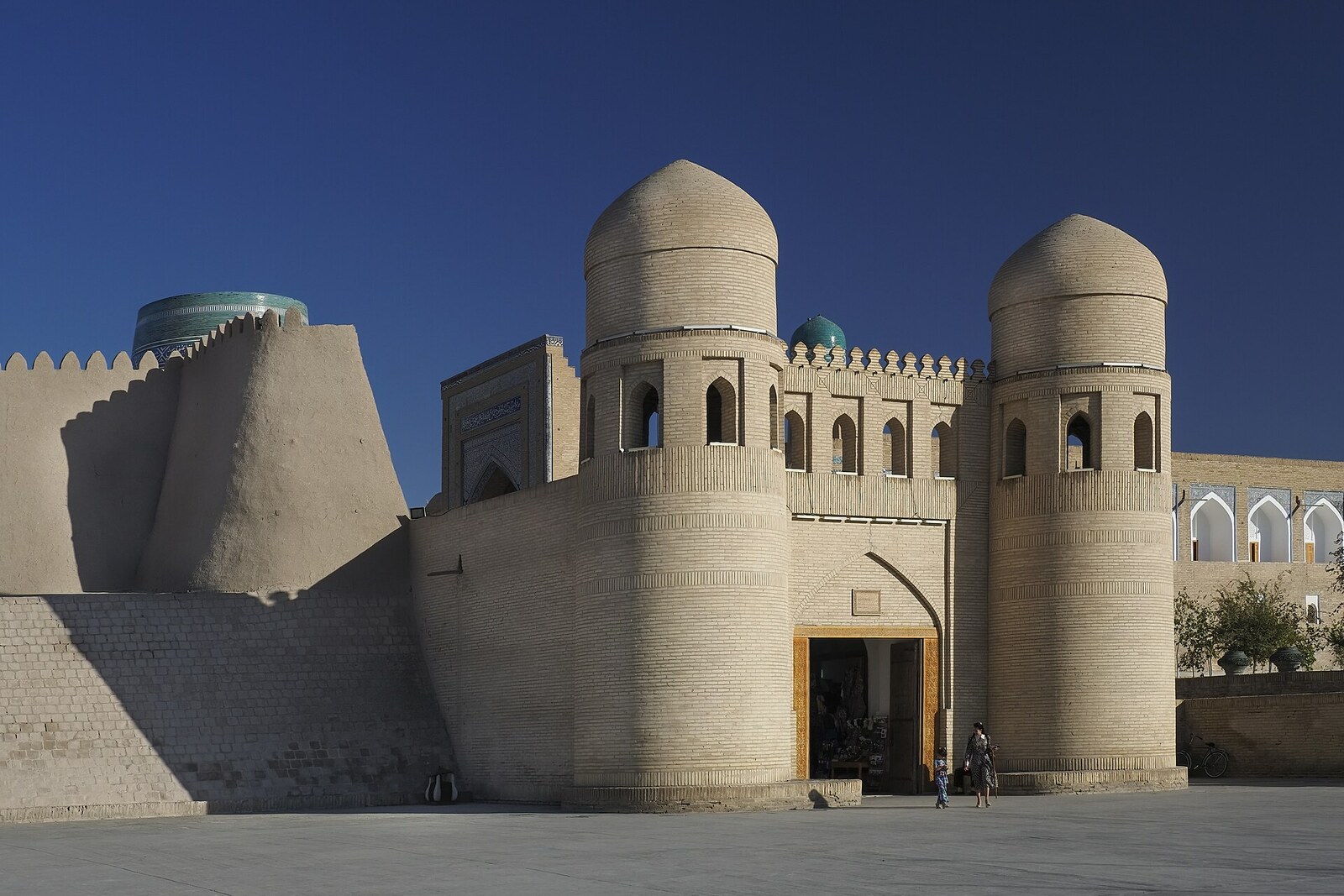
Look around first
What to notice
- Western fortress wall
- Brick domes of the passage
- Carved wooden door leaves
- Eight-pointed stars on the door leaves
The story of the place
The western wall of Itchan Kala rises to almost ten meters. In Khiva under the khans, the inner city could be entered from this side only through a controlled passage. Guards stood watch in the four rooms of Ata Darwaza, customs officers inspected goods there, and money changers exchanged money brought in from elsewhere. The wall did not allow people to bypass them: that is why inspection, duty collection, and coin exchange took place inside the gate.
The name came from outside. Sher Muhammad Ata Mosque stood before the entrance, and beside it was a pond. “Ata” is a respectful form of address for an elder. Accounts of the gateway preserve no reliable biography of Sher Muhammad himself, but they do trace the history of his name: first it was used for the mosque and the pond, then the long name was shortened to Ata Hauz and Ata Darwaza. The mosque is gone now, but its shortened name remains on the main western entrance.
In the nineteen twenties, it was decided to widen the road here. The gate was dismantled, leaving an open roadway in the western wall for several decades. The carved door leaves disappeared. When Khiva was declared a museum city and tourists began coming here, restorers were tasked with restoring the lost boundary of the inner city.
In nineteen seventy-five, the work was led by the Khivan master Samandar Kalandarov. Polvon Otajonov and Matyoqub Jumaniyozov built the domes over the passage and the side rooms. The brickwork could be restored from archival materials, but there was nothing with which to close it. The old door leaves were not found, and by then Khivan woodcarving had almost disappeared as a living craft. The elderly master Safo Bogbekov was only beginning to gather children and people who wished to learn, so that this skill could once again be passed from master to apprentice.
For Ata Darwaza, another pair of door leaves of the same size was selected. They were carved in eighteen forty-nine to eighteen fifty by the master Muhammad Niyaz, son of Abdullah. They belonged to the country estate of Khan Muhammad Amin in the village of Angarik. The estate collapsed, but the doors survived. Their former location is known from two photographs by the Khivan photographer Khudaybergen Divanov: one shows the entire façade of the estate, and the other shows the pattern of the door leaves in close-up.
So the brick passage before the western wall dates from the restoration of nineteen seventy-five, while the carved wood within it is a century older and once closed off an entirely different courtyard. The door leaves still bear the master’s name, the date, eight-pointed stars, and lines from the Quran; not a single door from the original Ata Darwaza remains.
Useful on site
Outdoor stop; passage through the western gate is usually free. Ticket offices and museum interiors operate on separate schedules.
Checked: date not specified. Check the official source before visiting.View the wall from a distance and do not climb onto unequipped sections: the mud-brick masonry is easily damaged.