 Guide On Map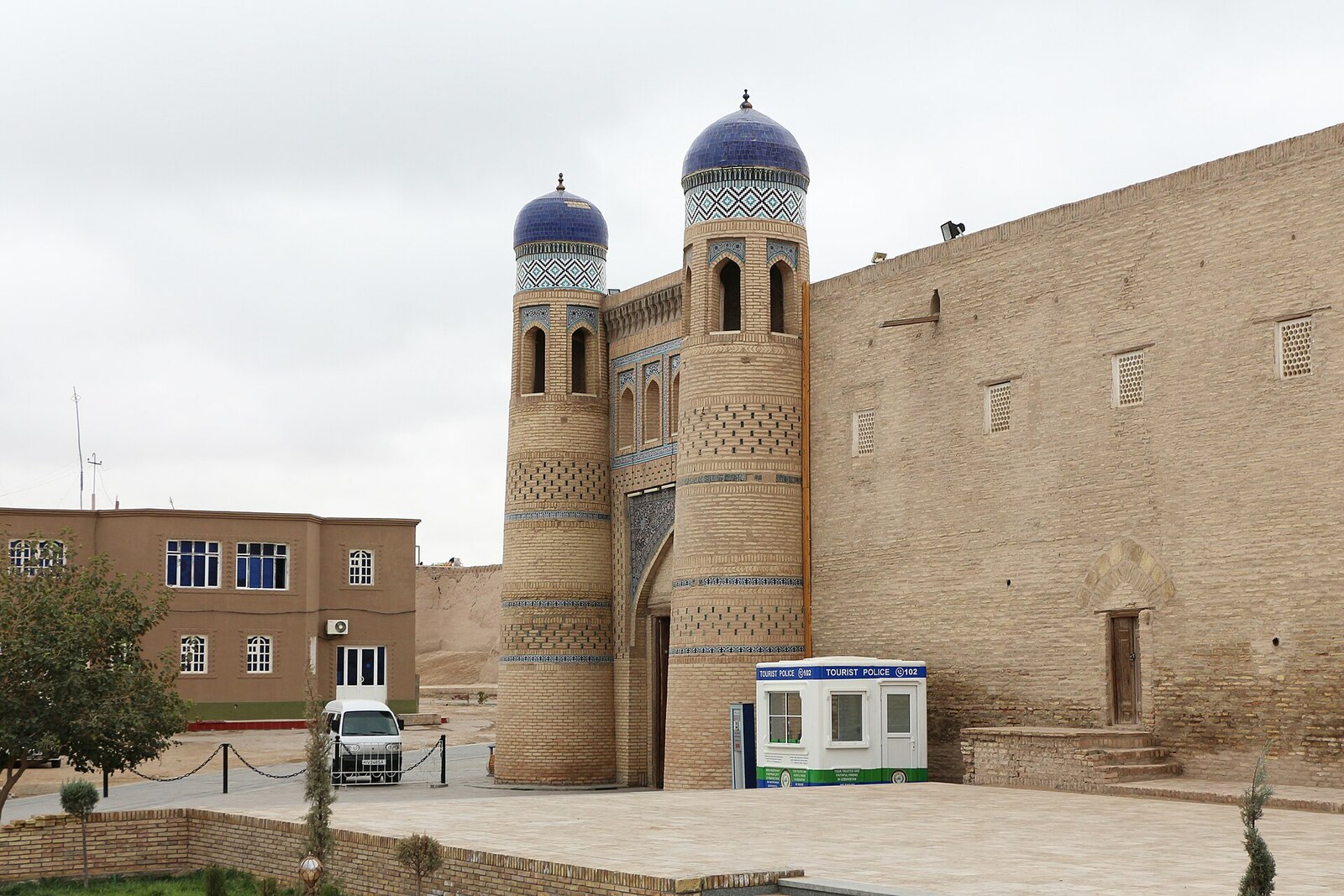
Look around first
What to notice
- The caravanserai building
- The domes of the covered tim
- The facade facing the former trading square
- The six-domed passage of Palvan Darvaza
The story of the place
The old fortress line runs directly through the khan’s caravanserai building: some of its rooms remain inside Ichan-Kala, while its facade faces the former outside trading square. Goods were kept below, and visiting merchants lived above. Next to the building stands a covered tim for wholesale trade, while Palvan Darvaza’s six-domed passage leads to the road to Hazorasp and the Amu Darya.
In eighteen thirty-six, Russian border authorities began detaining Khivan merchants and their goods. These people made their living from caravan trade: for months, they carried cotton, yarn, fabrics, and dried fruit north, returning with metal and Russian goods. Losing merchandise meant losing working capital, while detention left families without income.
In Khiva, their trade was served by a new caravanserai near Palvan Darvaza. The eastern gate, named after the already familiar Pahlavan Mahmud, opened onto the road to Hazorasp and the Amu Darya. Caravans arrived here from Bukhara, Persia, and Russia. Allakuli Khan, who ruled Khiva and wanted to expand this trade, ordered a large inn with warehouses to be built here in eighteen thirty-two to eighteen thirty-three. There was not enough space inside Ichan-Kala, so the builders dismantled part of the wall: the lower rooms were set aside for goods, and the upper ones for visiting merchants to live in. Then a tim—a covered wholesale market—was attached to the caravanserai. Allakuli Khan’s name remained on both buildings.
The reason Khivan merchants were detained lay beside their caravanserai. To the right of Palvan Darvaza, people were traded. Turkmen and Kazakh groups captured Persians, Kurds, and Russian subjects, then brought them to Khiva. If relatives could not pay a ransom, the captive was sold to work in a house or on land. The Russian government demanded the release of its subjects and cited their captivity as one of the grounds for a campaign against Khiva.
The winter expedition of General Vasily Perovsky in eighteen thirty-nine to eighteen forty was dying in the frost and turned back. The British expected another attempt and feared Russia’s advance into Central Asia. So Richmond Shakespear, a young officer of the British East India Company, was sent to Khiva. His task was to deprive Russia of a pretext for its next campaign: to persuade Allakuli Khan to release the Russian captives.
In the summer of eighteen forty, the khan agreed. He issued a firman—a khan’s decree—prohibiting, on pain of death, the future capture of Russian subjects, and ordered his close associates to free the enslaved people already purchased. The same order was sent to the other owners. Four hundred sixteen men, women, and children were assembled. Before the journey, Allakuli Khan gave each person a gold coin and a sack of flour, and one camel for every two people. A caravan of freed people left Khiva together with Shakespear and the khan’s envoy.
By autumn, the caravan had reached Orenburg. After this, Perovsky recommended releasing the detained Khivans. Six hundred forty merchants received their freedom; their surviving goods were returned to them, and those left without means received an allowance. In November, they returned to Khiva.
Allakuli Khan freed the Russian captives, but he did not close the slave market: Persians continued to be sold at this gate until eighteen seventy-three. The body of the khan’s caravanserai still crosses the former line of fortifications: part of the building stands inside Ichan-Kala, while its facade faces the former outside trading square. To the right of Palvan Darvaza’s six-domed passage was the place where people were sold.
Useful on site
Passage to the eastern gate and the outside market is usually open; the caravanserai, madrasa, and museum spaces have separate schedules.
Checked: date not specified. Check the official source before visiting.The passage remains busy: stay clear of the flow of trade, and discuss the subject of the slave market without staging photographs.