 Guide On Map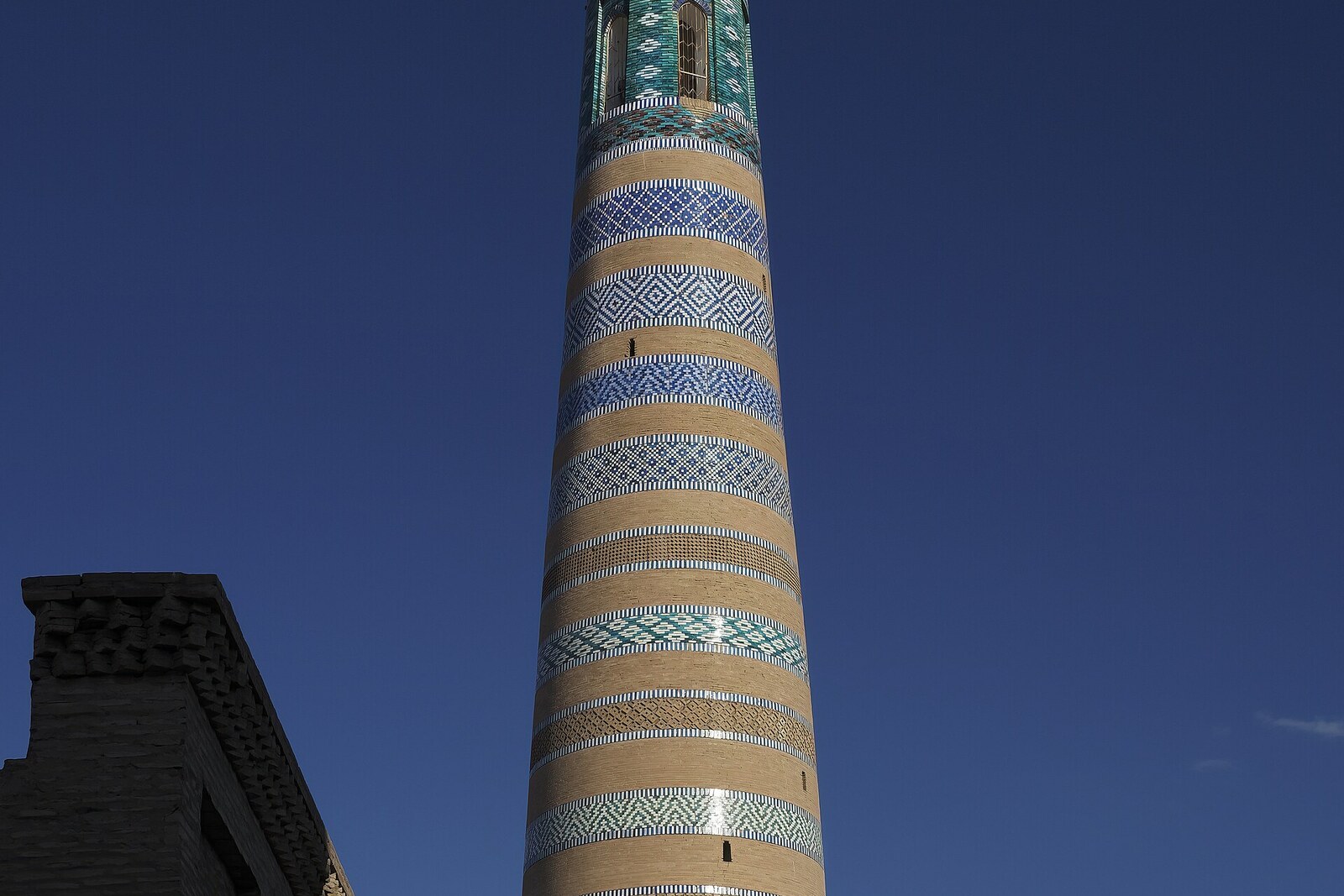
Look around first
What to notice
- Islam Khoja Minaret
- The madrasa courtyard with hujras
- The madrasa mosque
- The two-story building of the new-method school
The story of the place
Islam Khoja set up two schools here side by side, where children were taught differently. He was the chief minister of the Khanate of Khiva, led reforms, and sought faster literacy instruction. At the same time, his own lands brought him income, and he permanently assigned part of those lands to the madrasa here.
Construction began in nineteen oh eight. Two years later, a religious school with a mosque and Khiva's tallest minaret stood side by side. About fifty students lived in forty-two hujras—small rooms around the courtyard. Income from Islam Khoja's lands was meant to support them and their teachers. The minaret served the mosque: from its upper platform, the muezzin called people to prayer. The complex's name recalls the patron who paid for the buildings and secured a permanent income for the school.
But one madrasa was not enough for Islam Khoja. In nineteen twelve, directly in front of it, he was building a two-story European-style building for a new-method school. A young Tatar teacher named Abdurashitov, invited from Orenburg, taught here. At first, he taught children to read and write in their native language, then moved on to Arabic texts. A contemporary recorded that the students acquired literacy unusually quickly, and that this was precisely why their parents did not trust the result: such a short course of study seemed unserious to them.
Islam Khoja ordered textbooks, invited teachers, and intended to train teachers of his own for schools like these. These changes gave him more opponents at court. In August nineteen thirteen, the minister was stabbed to death on his way home. Later Khivan authors accused Khan Isfandiyar, Islam Khoja's son-in-law, but the investigation never identified who had ordered the murder. After the minister's death, the school reform he had begun came to a halt.
The two-story building of the new-method school survives in front of the madrasa. The former hujras now house the Khwarazm Museum of Applied Arts, and the Islam Khoja Minaret still rises above both schools.
Useful on site
Access to the madrasa and minaret varies; the climb usually requires a separate ticket and may be closed for technical or weather-related reasons.
Checked: date not specified. Check the official source before visiting.Check the conditions for climbing the minaret separately; the staircase is narrow, so viewing it from outside remains a complete alternative.