 Guide On Map
Sviyazhsk: Fortress, Town, and Monasteries
From the island entrance to the western wall of Assumption Monastery
Guide On Map on your phone
Open the walk like a regular app
It takes about 10 seconds to install. No app store needed.
The whole path
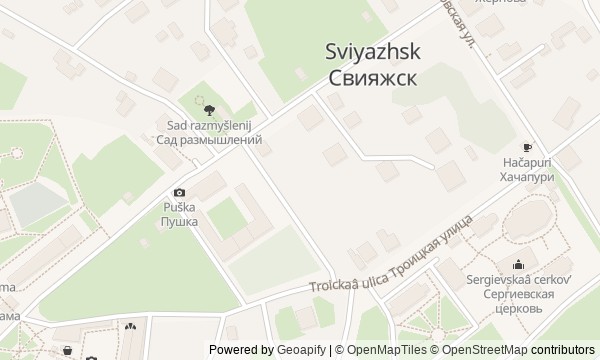
Route map
About the walk
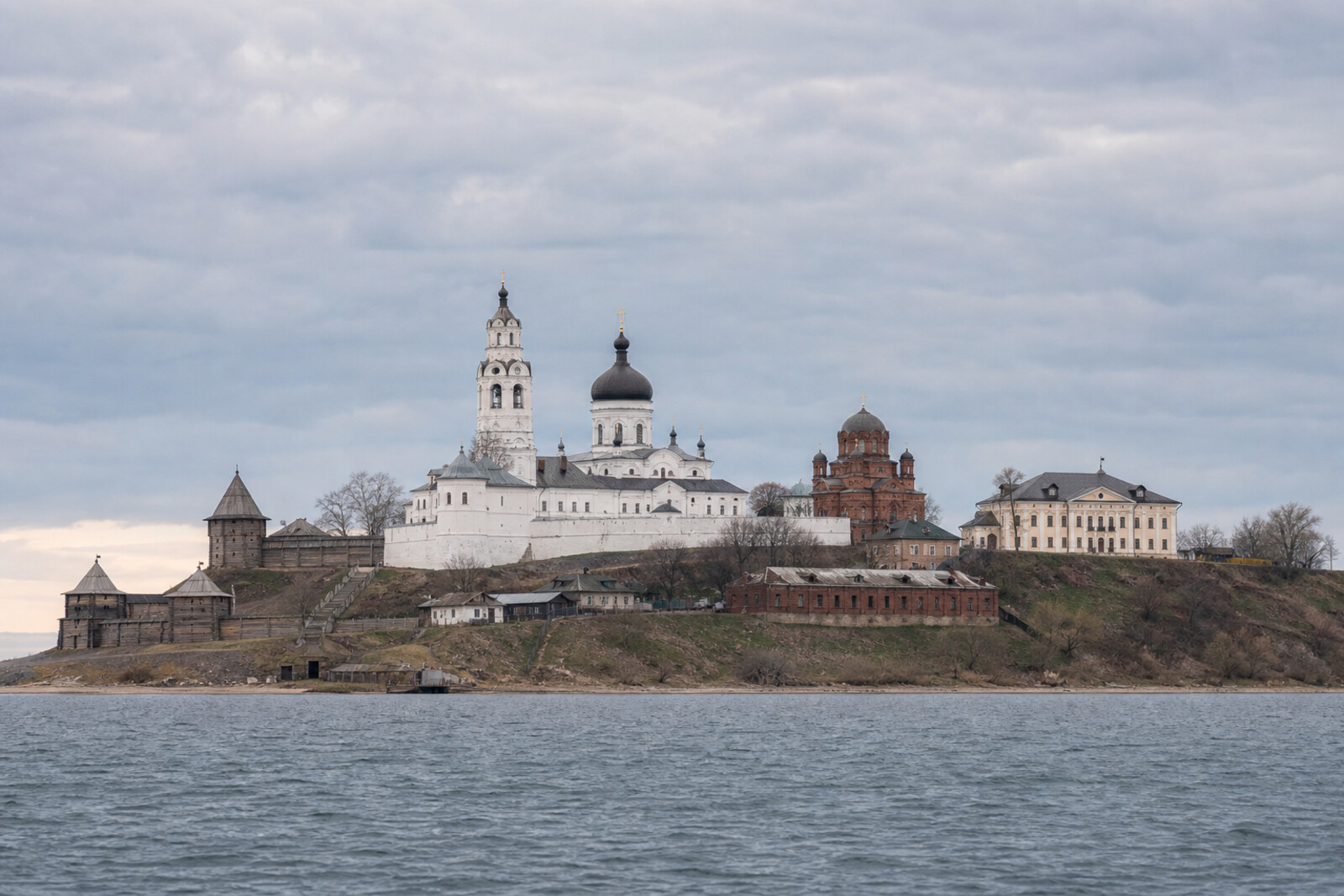
You will enter Sviyazhsk along the causeway and climb a hill with water on every side. First, the road will bring you to the former fortress gates and the town's main square. Then you will pass through two monastic ensembles, descend to a waterfront excavation, and head back uphill to the uyezd institutions and the old prison.
The route will keep changing scale. Beyond domes and walls, you will find a schoolroom, wet logs beneath the ground, a counterfeit coin, and a letter whose meaning only family members could understand. You will work out why an old log structure bears carpenters' marks, and why ancient frescoes nearly gave way to newer painting.
The story will separate documents from monastery legends and show history through the decisions of individual people. By the end, you will see Sviyazhsk not as a frozen fortress, but as a town that changed its purpose, its residents, and even its own shoreline several times.
Why this order
The approach will show Sviyazhsk as a whole and explain why the town appeared on this particular hill; the climb naturally ends at Rozhdestvenskaya Square, by the line of the old entrance. From the square, the route enters the former St John the Baptist Convent: first Trinity Church, then the vast Cathedral of the Nativity of the Blessed Virgin, to set two eras of one complex beside each other. From the upper terrace, the road descends into the waterfront settlement, where damp soil preserved a wooden quarter. From the excavation, the route returns to the town administration and prison in the Museum of Sviyazhsk History. Near the uyezd center, the special role of Assumption Monastery becomes clear; inside, the story first introduces the monastery through its founder, then turns to the main cathedral. The final exit beyond the western wall connects the monastic ensemble with the memory of a time when its buildings served as a place of confinement.
Those ready to give Sviyazhsk most of a day Those interested in documents, archaeology, and the fate of old buildings Those who want to distinguish confirmed facts from local legends
Those looking for a short overview of the main views Those uninterested in church history and museum exhibitions Those who prefer a walk without difficult subjects
Before you go
The route combines museum sites and active monasteries, so check the current visiting rules for each interior separately before you go. Access to the Archaeological Wood Museum «Tatarskaya Slobodka» and Assumption Cathedral matters especially: without entry, you will see the architecture from outside, but not the excavation, the leather toy horse, or the ancient frescoes. In church spaces, choose modest clothing, speak quietly, and do not disturb services; staff instructions and the monastery schedule take priority over your planned pace. Sviyazhsk unfolds across different levels of terrain, so wear comfortable shoes and save some energy for the climbs. Save the stop names offline: part of the story rests on lost buildings and unobtrusive traces that are easy to pass by.
When to go
Split the walk into three parts: the panorama and eastern churches, then the two museums, followed by the Assumption ensemble and the memorial. Do not give all your time to the first views: the richest stops are inside the museums and the cathedral. Check access before entering each site, so a long wait does not disrupt the sequence.
Backup plan
If the Archaeological Wood Museum «Tatarskaya Slobodka» is closed, look at the building built into the slope and continue the route knowing that the excavation itself and the everyday objects of the town cannot be seen from outside. A closed Museum of Sviyazhsk History can partly be replaced by a close reading of its symmetrical facade and the former government complex, but the reconstructed cell will remain inaccessible. If you cannot enter Assumption Cathedral, do not treat an exterior view as an equivalent substitute for the frescoes: stay in the monastery courtyard, study how the ensemble is arranged, and move on to the memorial. Keep the final stop in any case—it completes the whole conversation about walls and isolation.
Route conditions
Surface. Paved — 2.5 km (data covers 96% of the route)
Stairs. Flights: 1, 54 m in total
Access. Wheelchair — no; stroller — limited (stairs)
Facilities. Toilets — 4
Elevation. Ascent — 33 m; descent — 16 m
OpenStreetMap extract of July 3, 2026: database data, not a check on the ground. Data © OpenStreetMap contributors, ODbL licence
Walk plan
Open in maps ↗- 1
Approaching Sviyazhsk
It will show how the terrain, rivers, and lack of a reliable base determined the town’s creation. - 2
Rozhdestvenskaya Square
It will explain how the town’s central place became a point of access to education. - 3
Trinity Church
It examines what research confirms about the appearance of the oldest wooden church and what remains a matter of tradition. - 4
Cathedral of the Mother of God Joy of All Who Sorrow
It tells of an abbess who put all her resources into a shared church and did not live to see its first service. - 5
Archaeological Wood Museum «Tatarskaya Slobodka»
It will show you an entire city block where it was built and repeatedly raised above the damp ground. - 6
Museum of Sviyazhsk History
Connects a single court document with the layout of the uyezd administrative and prison courtyard. - 7
Assumption Monastery
It will explain why the return of the founder became more important than the loss of most of his remains. - 8
Assumption Cathedral
It will show how ancient wall painting survived an attempt to replace it completely with new paintings. - 9
The Western Wall and the Monastery Well
This will finish the route where the monastery enclosure separated the monastery courtyard from the town road to the water.
Route features
Everything you need stays in the browser
Progress, saves and your trip plan are stored on this device.
Add Guide On Map to your home screen so the walk opens outside the browser.
How we handle sources, maps and corrections: our editorial standards