 Guide On Map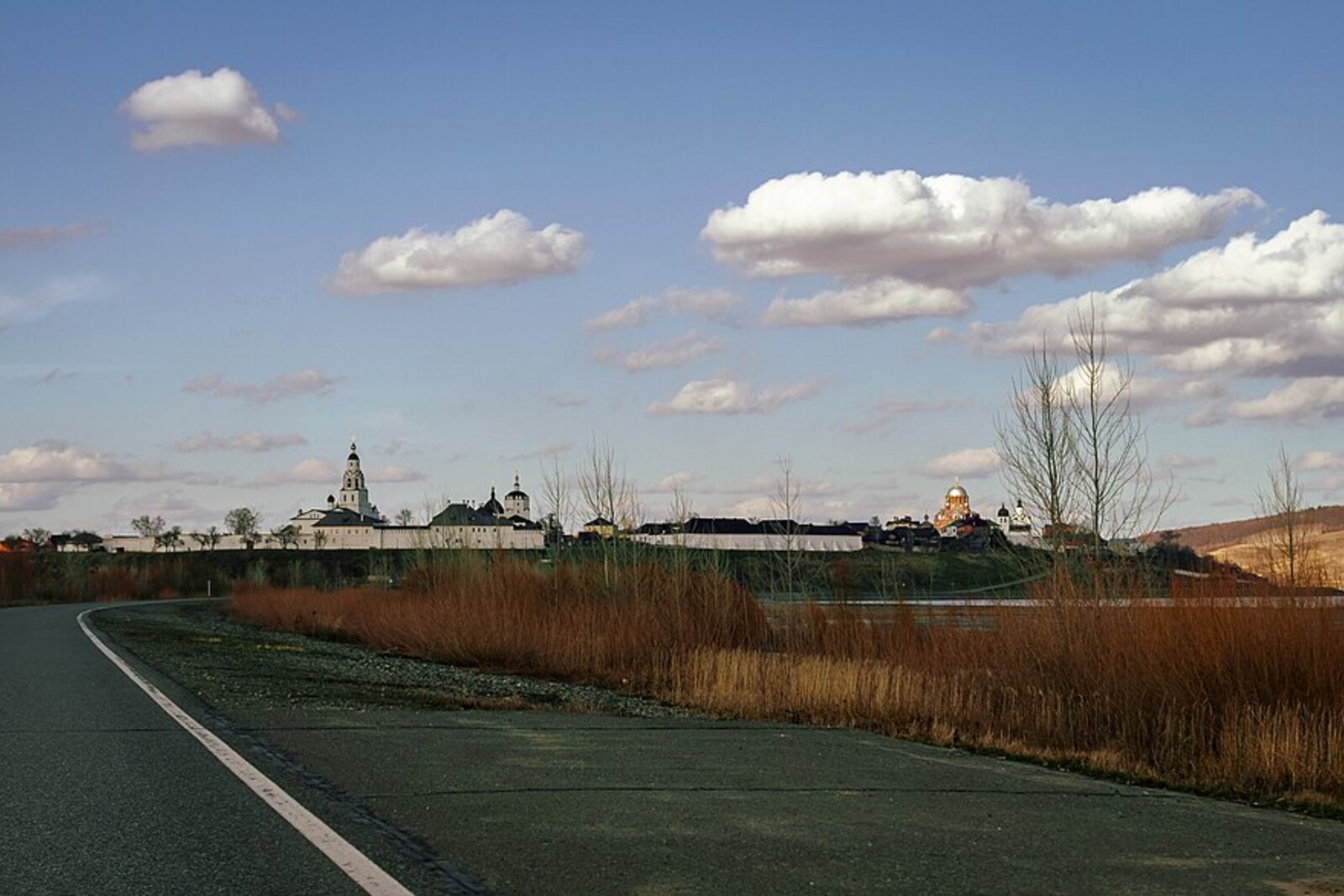
Look around first
What to notice
- Road embankment
- Canal beneath the bridge
- High oval hill
- Water around the island
The story of the place
The development of Sviyazhsk stands on the summit of Kruglaya Gora, although nothing remains of the former wooden walls and towers. The town became an island only after the reservoir was filled in nineteen fifty-seven: the water swallowed the lower settlements and fields, while the old cemetery ended up beyond the crossing. Later, the shore was connected to the town by a road embankment; then a canal was cut through it and a bridge built, so beneath the wheels here lies the former floor of the reservoir.
Today’s road follows an embankment across the water to a high oval hill. In the middle of the sixteenth century, there was no broad expanse of water here. Kruglaya Gora rose amid the Sviyaga River, the Shchuka River, and a marshy floodplain. Its steep slopes protected the summit, while the river route made it possible to bring in people, provisions, and cannons. Kazan was one day’s march away.
Tsar Ivan IV of Moscow sought to take Kazan, but the campaign of fifteen fifty ended in retreat. The army could not remain long beneath the city walls: supply trains came from far away, provisions were running out, and there was no nearby reliable base. The tsar decided to establish one on Kruglaya Gora. Ordinary construction would have taken months, and throughout that time the carpenters would have had to work in the territory of the Kazan Khanate under threat of attack.
The task was entrusted to Ivan Vyrodkov, a state clerk—an official trusted with military organization and engineering work. He had to deliver an entire fortress to Kazan before the enemy could interfere with its construction. A miscalculation would have left the army without walls, storehouses, and shelter.
In the winter of fifteen fifty to fifteen fifty-one, work crews under Vyrodkov’s direction cut down walls, towers, gates, huts, and churches in the forests near Uglich, far upstream along the Volga. The logs were marked, the structures dismantled, and loaded onto vessels and rafts. In spring, the convoy set off downstream with artillery and people.
On May twenty-fourth, fifteen fifty-one, the vessels reached the mouth of the Sviyaga River. Some members of the expedition cleared and leveled the summit, while others assembled the transported log structures. Within four weeks, the entire top of Kruglaya Gora was enclosed by wooden walls. The fortress held a garrison, cannons, food storehouses, and residential compounds. At first it was called Ivangorod—the town of Tsar Ivan; soon the name Sviyazhsk, given after the Sviyaga River, took hold.
A year later, an army gathered here for a new campaign. Vyrodkov was again responsible for engineering work and artillery, now during the siege of Kazan. In October fifteen fifty-two, the city was taken, the Kazan Khanate ceased to exist, and the forward fortress became the administrative and religious center of the annexed territory.
The wooden walls and towers are gone, but development still occupies that same Kruglaya Gora. The water around it appeared much later. In nineteen fifty-seven, hydraulic engineers raised the level of the Volga while filling an enormous reservoir. The lower settlements and fields were flooded, the hill became an island, and the cemetery remained on the opposite bank—even funerals depended on the crossing.
In two thousand eight, builders laid an embankment with a road to Sviyazhsk. Three years later, they cut a canal through the embankment and built a bridge across it, so that water once again surrounded the island. Vyrodkov’s wooden town was brought here by river; today’s approach runs over a bottom that came into being four centuries after the fortress.
Useful on site
The approach and panorama are accessible around the clock; parking arrangements may change during major events.
Checked: date not specified. Check the official source before visiting.View the panorama from a safe place, and do not hurry closer: this silhouette can be read in full precisely from a distance.