 Guide On Map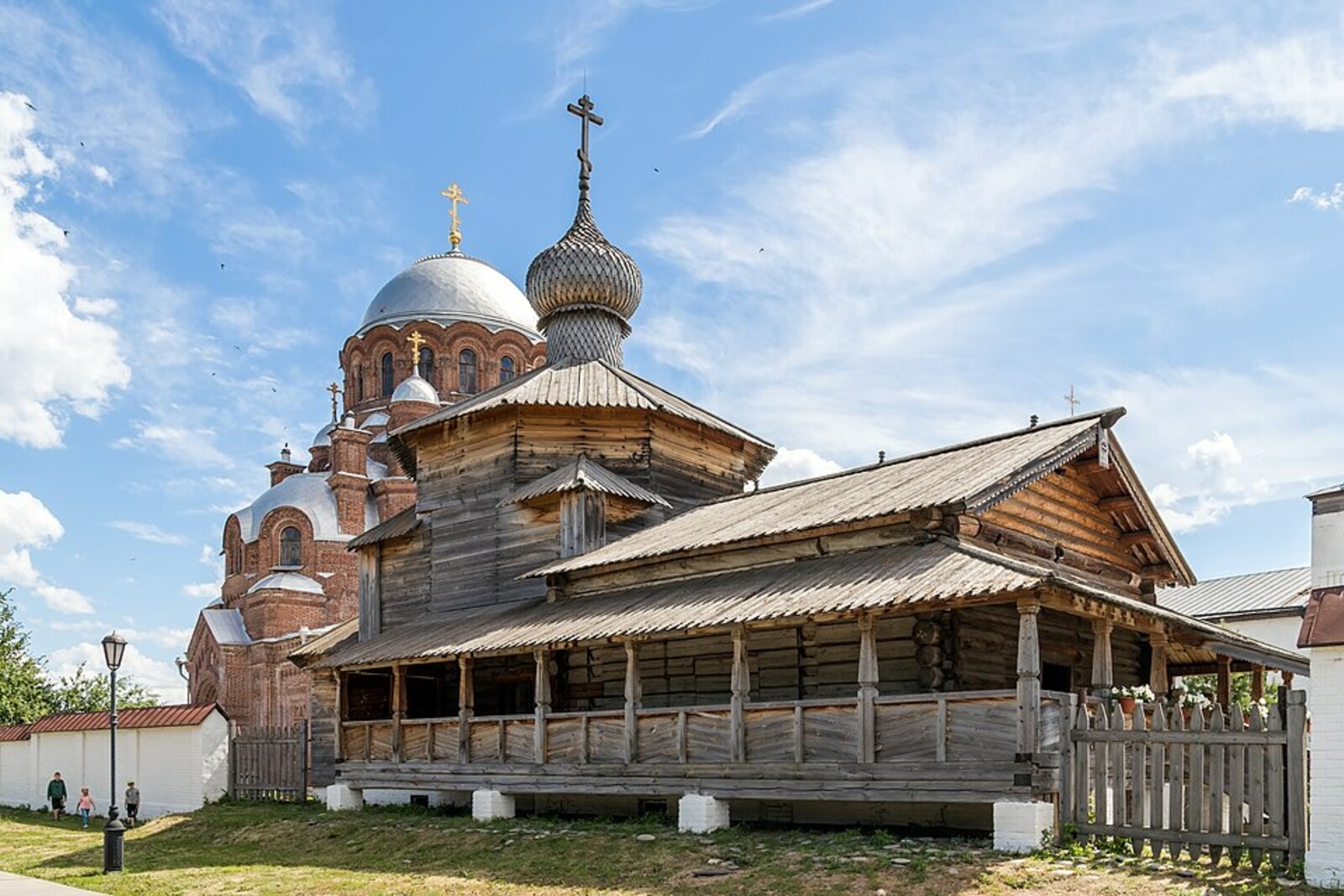
Look around first
What to notice
- Exposed logs of the log structure
- Triangular carpenters’ marks
- Grooves from a corner bench
The story of the place
The wooden walls of Trinity Church are built of pine logs; triangular carpenters’ notches and the trace of a corner bench can be seen in the exposed sections. The church occupied the main site by the monastery gates, where monks held services, received visitors, and began the day with communal prayer. The earlier church was later replaced by another one, with the same dedication and probably on the same site; the log structure had already served as a church before it was dismantled and reassembled. After the male monastery was abolished, the church passed to the local Orthodox community and is now active again.
On May seventeenth, fifteen fifty-one, Prince Pyotr Serebryany-Obolensky led an advance detachment to Round Hill. The voivode was ordered to occupy it before the main forces and builders arrived. The chronicle reports that in the evening, Serebryany and his warriors held a Trinity Vespers service here. There were still no church walls around them.
Later, monastery tradition linked this service with the appearance of the first church: supposedly, the church was begun on May sixteenth and consecrated the following day, on the feast of the Holy Trinity, or Pentecost. It received its name from the feast. The exact sequence of events remains disputed, but by the second half of the sixteenth century, written sources already mention Trinity Church here.
Monks sent by the Trinity-Sergius Monastery near Moscow settled beside it. The military camp was to become a permanent monastic community. The monks remained after the regiments left, served in the church, and lived from lands, forests, fisheries, and a mill granted to the monastery. The church occupied the main site near the gates: the brethren began their day with a service, ate in its refectory, and received visitors there.
For a long time, people spoke of the present walls as the very logs brought here with the fortress. This gave rise to the tradition that Ivan IV prayed inside before his campaign against Kazan. A comprehensive study of the wood produced a different date. The samples proved to be pine, and most of the trees were felled between the middle and third quarter of the seventeenth century—about one hundred years after Sviyazhsk was founded. Researchers also found no direct document confirming that this log structure was transported from near Uglich.
What happened to the first church is unknown. According to a cautious reconstruction, about one hundred twenty years later, the leadership of the Trinity-Sergius Monastery near Moscow paid for the purchase and delivery of materials for a new wooden church. The monks retained the earlier dedication and probably erected its successor on the same site, repeating the basic layout of the old church. For the brethren, the altar, the service, and the continuity of the monastery mattered; individual logs could be replaced.
The decision proved more durable than the brethren themselves. In seventeen sixty-four, the male monastery dependent on the Trinity-Sergius Monastery near Moscow was abolished, and the monks were sent back. Trinity Church was transferred to the local Orthodox community. It is now once again an active church, and a liturgy is held here on the feast of the Holy Trinity.
Triangular carpenters’ marks are visible on the logs exposed after the later cladding was removed. They were made before the log structure was dismantled. Researchers noticed that the marks bypass the grooves of an old corner bench: by the time the carpenters numbered the walls, the church had already been used. Ivan IV’s bench remains a tradition; the marks confirm another kind of human work—the monks and carpenters dismantled a church that had already been used, then assembled it again.
Useful on site
An active church on the grounds of a women’s monastery; no fixed visitor schedule for the interior has been published. Exterior viewing is usually possible when the courtyard is open.
Checked: date not specified. Check the official source before visiting.This is a church space: view the log structure quietly, and if the entrance is closed, focus on the exterior construction.