 Guide On Map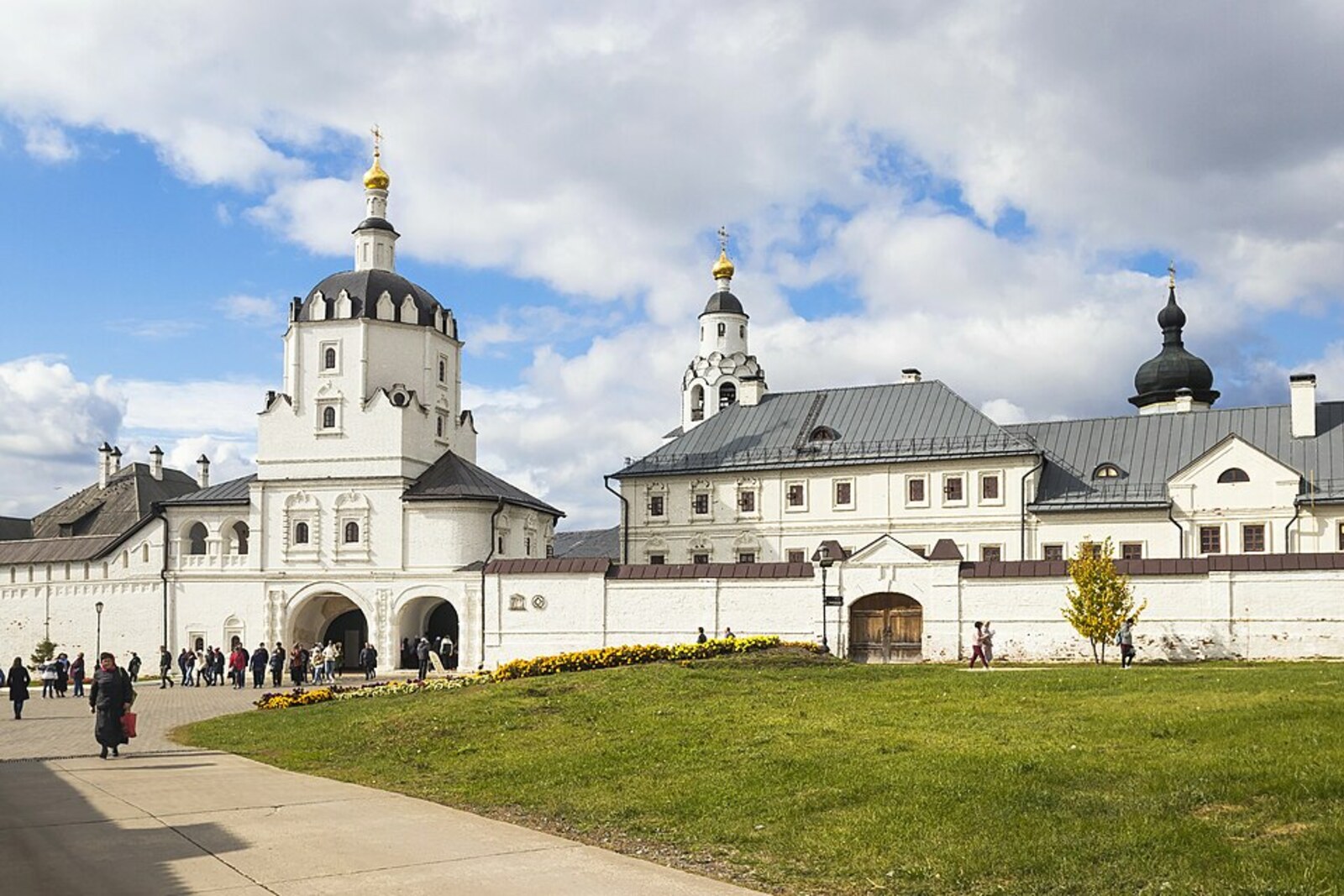
Look around first
What to notice
- Monastery walls
- Holy Gates
- St Nicholas Church
- German's stone cell
The story of the place
The Holy Gates lead into the enclosed monastery courtyard, where St Nicholas Church stands beside the Assumption Cathedral. A small stone cell has survived in the church's lower chamber: the old masonry was preserved, while its furnishings were recreated by restorers. In the sixteenth century, a library was assembled here for services, teaching, and training clergy; some books were bought, while others were copied on site.
A community of monks still lives behind the monastery walls. The monks hold services, receive pilgrims, and maintain the order for which this monastery was established soon after Sviyazhsk was founded. The fortress was meant to hold the conquered territory, while the monastery was given another task: to govern church life in the new Kazan region and convert local residents to Orthodoxy. It is called Assumption after the Assumption of the Mother of God—the church commemoration of the end of her earthly life.
In fifteen fifty-five, German Sadyrev-Polev, a monk who was to become the first abbot and gather a community on an empty plot by the fortress wall, was sent here. Before coming to Sviyazhsk, German copied books at the Joseph-Volokolamsk Monastery. Here, that skill became part of his work. Under him, the monks built the first stone churches, established the monastery's economy, and assembled a library. By the middle of the sixteenth century, it already held more than one hundred thirty books; German bought some, while others he copied himself or had copied by scribes. For the new diocese, these were books used for services, teaching, and training clergy.
Nine years later, German was appointed head of the Diocese of Kazan. He left the monastery he had founded, was then summoned to Moscow, and died there in fifteen sixty-seven. He was buried beside the Church of St Nicholas Mokry in Moscow. The Sviyazhsk brotherhood was left without the man around whom the first community had formed.
A quarter of a century later, the Moscow church was being rebuilt, and German's remains were discovered. According to church records, healings began to occur at his tomb. The Sviyazhsk monks then asked for their founder to be returned to his monastery. This required the consent of Tsar Fyodor Ioannovich and Patriarch Job. In fifteen ninety-two, Ermogen, Metropolitan of Kazan, met German's remains on the road to Sviyazhsk and, together with the brotherhood, carried them into the monastery.
The reliquary was placed in the altar of the Assumption Cathedral. The flow of pilgrims proved so great that in seventeen fourteen Metropolitan Tikhon moved it from the altar to the middle of the church, beside the northwestern pier: the shrine could now be approached. Thus, the monks' decision to return their first abbot made the monastery he founded one of the main pilgrimage sites in the Kazan region.
After the monastery was closed in May nineteen twenty-three, the reliquary was publicly opened in front of the cathedral. The later fate of the remains that had been in it is unknown. But as early as eighteen forty-nine, a small fragment was separated for a Kazan monastery. It was later hidden beneath the altar table of a cemetery church, discovered in two thousand, and part of it was returned to Sviyazhsk.
A fragment of German's relics is now kept at the monastery he founded. His small stone cell has also survived in the lower chamber of St Nicholas Church. The masonry there is original, the furnishings were recreated by restorers, and none of the first abbot's personal belongings remain in Sviyazhsk.
Useful on site
An active men's monastery; the courtyard is accessible when the gates are open, but individual rooms are subject to the rules of worship and monastery life.
Checked: date not specified. Check the official source before visiting.Follow the rules of an active monastery and do not enter closed service areas; distinguish legends about German from confirmed events.