 Guide On Map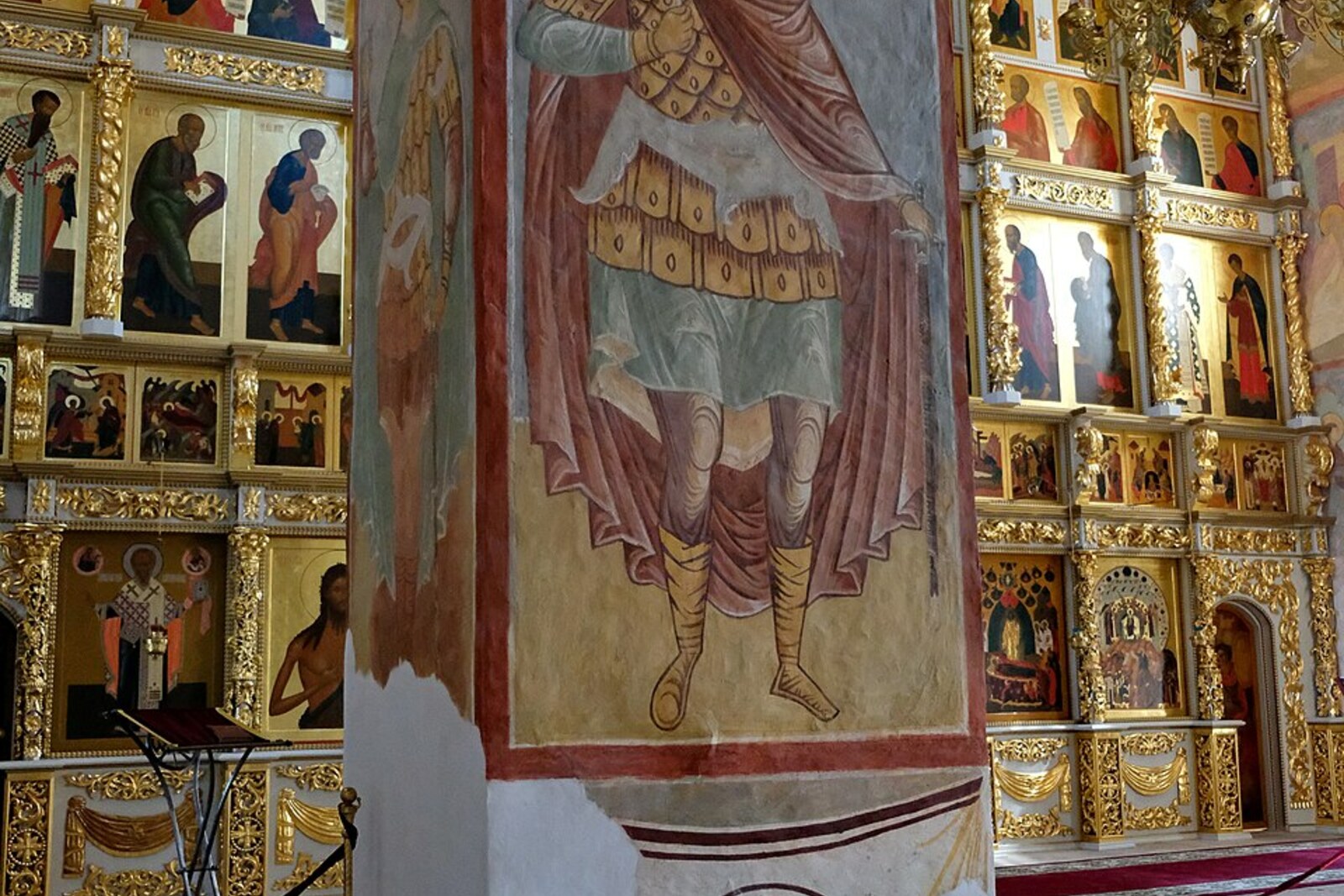
Look around first
What to notice
- Sixteenth-century frescoes
- Paintings on the walls and vaults
- Oil paintings in the refectory
- Northwest pillar
The story of the place
In eighteen fifty-nine, Archbishop Evlampy Pyatnitsky planned to repaint the walls of Assumption Cathedral completely. He had retired from the Tobolsk Diocese and was given charge of Sviyazhsk Monastery. Here, Evlampy was responsible for administration and liturgical order, and he considered the ancient paintings incompatible with that order.
Two years earlier, new images painted in oil in the customary nineteenth-century manner had already appeared in the added refectory. Evlampy now wanted to treat the cathedral's main part in the same way. By “repaint,” he meant a complete replacement of the old cycle: smooth oil paintings were to appear in place of the darkened frescoes.
These frescoes were created by masters of the second half of the sixteenth century, soon after the cathedral was built. Pskov masons erected it from fifteen fifty-six to fifteen sixty as the principal church of the new monastery. Here the monks celebrated the liturgy, while painters laid out on the walls and vaults a continuous story of the creation of the world, Adam and Eve, the earthly life of the Mother of God, and Gospel events. About one thousand eighty square meters of wall paintings have survived—one of the most complete Russian church ensembles of that era.
Evlampy submitted his petition to the Most Holy Synod, the highest body of church administration at the time. He maintained that the arrangement of the paintings lacked theological thought and departed from canon. The Synod ordered an inspection and prohibited any unauthorized alteration. Church specialists then recognized the frescoes' historical importance and instructed that they be preserved without distortions. Evlampy continued to govern the monastery until his death in eighteen sixty-two, but he never received permission to repaint the cathedral.
Later restorers nevertheless left their own additions on the ancient paintings. In the late nineteenth century, the workshop of Nikolay Safonov consolidated the frescoes and repainted them in places. Already in the twentieth century, other masters removed the Safonov layers to reveal the sixteenth-century paint. The preservation of the cathedral became a sequence of very human decisions: one administrator intended to replace the paintings, church officials stopped him, artists added their own work, and subsequent restorers separated the later work from the original.
After a major restoration, the cathedral was consecrated again in two thousand nineteen. The liturgy is now celebrated here, but visitors are admitted only in the warm season, and access may be closed during rain because of the temperature-and-humidity regime. Sixteenth-century frescoes remain in the main part; the oil paintings with which Evlampy wanted to replace them entirely occupy the added refectory.
Useful on site
03.05–30.09.2026, daily 09:00–17:30, only in dry, warm weather. Individual entry times: 10:00, 11:30, 12:30, 15:00, 17:00.
Checked: date not specified. Check the official source before visiting.Access to the ancient paintings may be regulated for their preservation; follow staff instructions, do not touch the walls, and do not block the passage.