 Guide On Map
Bolgar: Islam on the Volga
From the White Mosque through the fortified settlement to the Volga
Guide On Map on your phone
Open the walk like a regular app
It takes about 10 seconds to install. No app store needed.
The whole path
Route map
About the walk
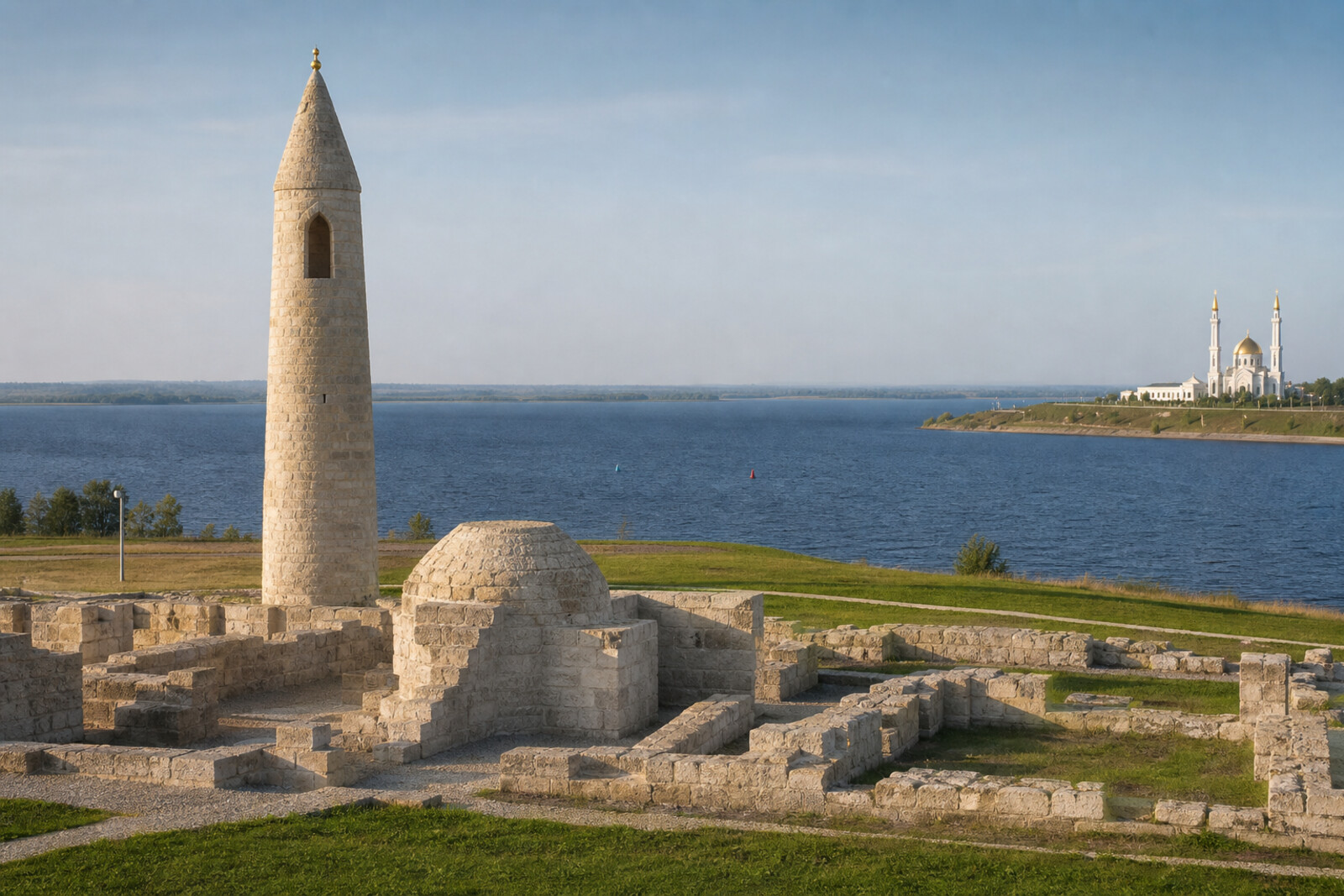
You will begin at the White Mosque beyond the Southern Gate, enter the fortified settlement, and walk through a cemetery complex, a separate stone chamber, and mausoleums to the main mosque of medieval Bolgar. Then the road will lead to the high bank of the Volga, the Memorial Sign, and a museum in the river terminal building.
Along the way, questions will arise whose answers you cannot guess from the facades. Why will an ancient tomb be called the Khan's Tomb when no one knows the names of those buried there? What will a smokehouse leave behind in a medieval chamber? How will one tunnel undo a tower repair? And why will a gold ring turn up beneath the floors of the river terminal?
The story will separate legend from document, medieval masonry from restoration, and a working place of worship from a monument to faith. By the end, you will be able to explain where ancient stone ends in Bolgar and where later ways of preserving it, altering it, and giving it new meaning begin.
Why this order
The White Mosque beyond the Southern Gate will set a modern point of reference, after which the entrance to the fortified settlement immediately separates a working place of worship from protected ruins. At the Small Minaret, that boundary will give way to a conversation about a medieval cemetery and forgotten names. From there, the road leads to the freestanding Black Chamber: after the burial complex, it becomes especially clear how a building of unknown purpose fills up with legend. The route then heads for the central part of the fortified settlement. First, the Eastern Mausoleum will show how a tomb was altered into a monastery building; then the neighboring Cathedral Mosque, Great Minaret, and Assumption Church will bring preservation, loss, and new construction together. The Northern Mausoleum opposite the entrance to the mosque will continue the theme of lost names through a museum display. After the ancient monuments, the Memorial Sign shifts the conversation to the event of 922 and its modern commemoration. The final descent to the Museum of Bulgar Civilization ends the route where construction of the river terminal uncovered a medieval workshop.
Those who want to understand the history of Islam on the Volga without a ceremonial retelling Those who like to read monuments through alterations and traces of restoration Those interested in archaeological finds and the fates of individual objects
Those looking for a walk through central Kazan Those who want a route only through working places of worship Those who prefer walks without museums and detailed historical storytelling
Before you go
Check in advance whether the museum interiors are accessible and whether you can enter the Memorial Sign: the outdoor part of the route still makes sense without them, but some details are inside. The White Mosque is active, so choose modest clothing, speak quietly, do not walk in front of worshippers, and follow the requests of the staff; tourist visits may be limited during communal prayer. Much of the route is outdoors, so bring comfortable shoes, water, and weather protection. If you plan to arrive by the Volga, separately confirm seasonal navigation and your return trip. Do not expect to enter every tower or ruin: barriers and current rules matter more than a hoped-for complete visit.
When to go
Start at the White Mosque, but do not linger there for the view alone: the route's main work begins among the ruins. Take the first three stops at an unhurried pace, leave more time for the central ensemble, and do not put off the museum until only a few minutes remain. Head to the bank after the displays. If you arrive by boat, it works well to reverse the order: begin with the museum and the Volga, then the central zone, and finish at the White Mosque.
Backup plan
If rain, fatigue, or the condition of the paths makes the full route difficult, split it into two parts: visit the White Mosque separately, then focus on the central ensemble, the Memorial Sign, the museum, and the bank. If interiors are closed, look at the buildings from outside and rely only on visible portals, masonry, openings, and silhouettes—do not try to reconstruct the interior from guesswork. If you have to skip the museum, end the walk at the Volga: from there, you can still understand the city's layout and the role of the river route. If mobility is limited, ask in advance about accessible ways of moving around the site and choose fewer stops rather than rushing through the full circuit.
Route conditions
Surface. Paved — 3.9 km (data covers 82% of the route)
Stairs. Flights: 1, 11 m in total
Access. Wheelchair — no; stroller — limited (stairs)
Facilities. Toilets — 4
Elevation. Ascent — 11 m; descent — 27 m
OpenStreetMap extract of July 3, 2026: database data, not a check on the ground. Data © OpenStreetMap contributors, ODbL licence
Walk plan
Open in maps ↗- 1
White Mosque
Here you will learn why the new mosque was built separately from the medieval ruins and why space for study was included from the start. - 2
The Small Minaret and Khan's Tomb
Here, the conventional “khan's” name will encounter the anonymous burials of noble townspeople. - 3
Black Chamber
The legend of the price of salvation will stand here beside an honest admission that the building’s original purpose is unknown. - 4
Eastern Mausoleum
This stop shows how conversion into a church both altered a medieval tomb and helped preserve it. - 5
Cathedral Mosque, Great Minaret, and Assumption Church
Here, an imperial repair, a treasure hunters’ tunnel, and stones from the ancient city in the foundation of a later church all come together. - 6
Northern Mausoleum
Here you will learn why a nameless family burial vault displays the names of people buried elsewhere. - 7
Memorial Sign and Quran Museum
This stop separates the known details of the Baghdad mission from the meeting place that researchers have still not identified. - 8
Museum of Bulgar Civilization
The final point will return the archaeological finds to the exact place where a burned workshop was discovered beneath the future river terminal.
Route features
Everything you need stays in the browser
Progress, saves and your trip plan are stored on this device.
Add Guide On Map to your home screen so the walk opens outside the browser.
How we handle sources, maps and corrections: our editorial standards