 Guide On Map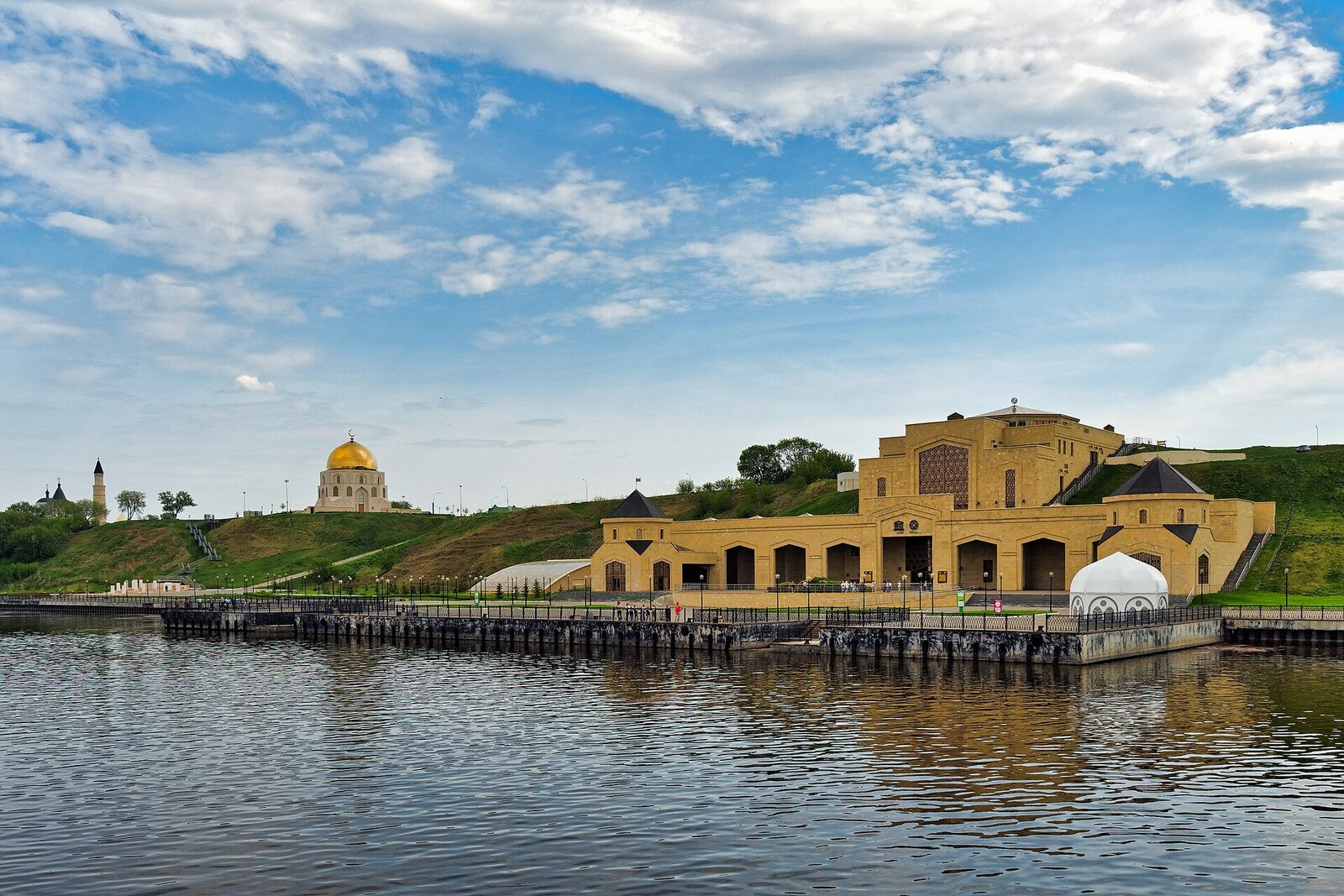
Look around first
What to notice
- Gold earrings
- Turquoise ring
- Bronze matrices
- Frame of a casting mold
The story of the place
The building descends the Volga slope in six tiers and links the museum with the river terminal. Visitors arriving by cruise ship enter the lowest level, while the upper exit leads to the fortified settlement; the main exhibition lies between them. The display cases hold gold earrings, a turquoise ring, copper blanks, and bronze parts of casting molds—the working supplies of prosperous craftspeople in medieval Bolgar.
In the summer of two thousand ten, Vyacheslav Baranov, the scientific director of a rescue excavation, was surveying the site of the future river terminal. Before the builders could remove the soil, archaeologists had to dismantle the medieval layers. At a depth of about two and a half meters, they reached the basement of a house that had burned down in the first half of the fourteenth century.
Three gold earrings, a turquoise ring, a pendant, and a tiny openwork acorn-shaped pendant lay on the floor. Copper cauldrons and a large ladle were found beside them. But other objects explained the purpose of the cache: bronze matrices, the frame of a casting mold, copper ingots, and a blank for a ring.
According to the archaeologists' conclusion, the owner of this estate worked non-ferrous metals. The gold objects were his savings for a rainy day and, at the same time, a reserve of material for his work. He hid them deliberately. Then the house was destroyed by fire, and the owner did not return for his gold. Whether he was killed, fled, or died away from home, the excavation did not reveal. Only the outcome is known: the craftsman lost his money and raw materials, while the six pieces of jewelry lay among charcoal and collapsed earth for about seven centuries.
For archaeologists, the find was especially valuable because of its precise address. Previously, similar objects often entered collections without information about the house or its owner. Here, both the cache and the workshop around it were preserved. It became clear who lived by the Volga slope: prosperous craftspeople kept semi-dugouts in their yards, melted metal, prepared molds, and stored expensive working supplies. The finds were transferred to the Bolgar Museum-Reserve, and Baranov received the right to continue studying them.
The river terminal was built nonetheless. On May twenty-fifth, two thousand thirteen, the Museum of Bulgar Civilization opened in the same building. Its six levels descend along the riverbank slope: the lowest receives those arriving by the Volga, the third and fourth are occupied by the main exhibition, and the upper entrance is at the level of the fortified settlement. Among the museum's finds are the gold ornaments recovered during construction. Beneath the level where passengers disembark from cruise ships lay the floor of the burned workshop; the turquoise ring rose from there to the museum above it.
Useful on site
The museum follows the museum street schedule, daily 08:00–17:00; an adult ticket is 300 rubles, a discounted ticket is 200 rubles as of the verification date 2026-06-24. The riverbank and outdoor grounds are accessible according to the reserve's general schedule.
Checked: date not specified. Check the official source before visiting.Allow separate time for the museum, and after the exhibition be sure to go out to the water; in wind and precipitation, the riverbank may be uncomfortable.