 Guide On Map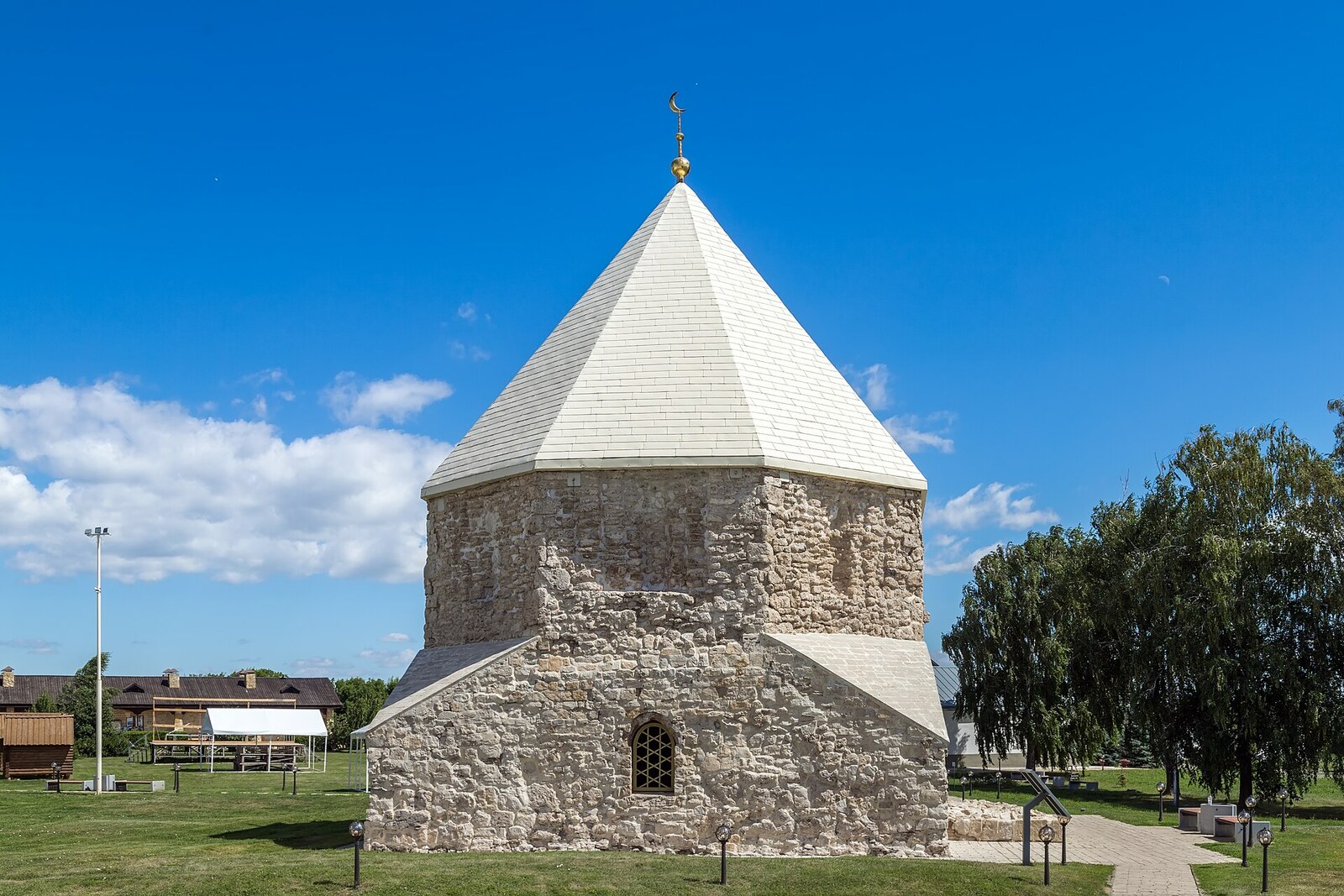
Look around first
What to notice
- Gray tented roof
- Crescent
- Walled-up southern entrance
- Open burials and sections of floors
The story of the place
At the eastern facade of the Cathedral Mosque stands a small stone tomb of a noble family of Bolgar, built in the thirteen thirties. The names of almost all the people buried here have not survived, but the walls bear traces of several alterations: the southern entrance is walled up, the windows were enlarged, and a floor was once laid over the graves. The high gray tented roof with a crescent repeats the presumed medieval form, and below, an excavation is open with burials and traces of different floors.
In seventeen twelve, Tikhon, Metropolitan of Kazan, sought to establish a men's monastery among the ruins of Bolgar. He wrote to Governor Pyotr Apraksin that the ancient Muslim city stood empty and that stone buildings remained from it. Apraksin agreed to allot land to the monastery. The brethren were to support themselves from the arable land, hayfields, and forest lands they received; there were no ready-made cells or functioning household here.
Andrei Mikhailov, an official of the provincial chancery, came to measure the monastery's holdings and describe everything that fell within their boundaries. He counted more than seventy medieval structures. At the eastern facade of the Cathedral Mosque stood a tomb built in the thirteen thirties for a noble family of Bolgar. Its position is the source of the name “Eastern Mausoleum.” The names of most of those buried there have not survived.
The monks chose this tomb for a small St. Nicholas Church. To adapt the Muslim funerary building for Orthodox worship, they altered its plan. They walled up the southern entrance and turned it into a window, while making a new entrance on the western side. They enlarged the windows, placed an altar and the base of an iconostasis by the eastern wall, built a stove in the northwestern corner, and laid a floor over the graves. They replaced the ancient tented roof with an eight-pitched wooden roof with a small cupola and cross, and supported the eastern wall with two buttresses.
The conversion damaged the original appearance, but gave the building an everyday purpose. The roof was repaired, the room was heated, and the walls were reinforced. While other ancient structures were dismantled for stone, the former tomb remained a church. By the end of the eighteenth century, forty-four of the more than seventy buildings seen by Mikhailov had survived. The Eastern Mausoleum reached modern times more intact than many neighboring structures largely because the monks continued to use it.
By the middle of the twentieth century, however, the church roof had disappeared, the southern portal lay in ruins, and the facing was crumbling away. The architect-restorer Sayyar Aidarov wanted to determine which parts belonged to the Bolgar tomb and which had appeared under the monks. In nineteen sixty-four, he had to submit a project to the Ministry of Culture and justify the excavations: the settlement site did not yet have protected-reserve status, and an error could permanently fix the later, church appearance.
Archaeologists found the base of the southern portal and the walled-up original passage. In nineteen sixty-seven and sixty-eight, following Aidarov's project, they conserved these remains, restored part of the stone facing, and erected a high wooden tented top based on a reconstruction of the medieval form. The gray tented roof above the building today is the work of restorers, not a surviving roof from the fourteenth century.
In nineteen ninety-four, a crescent was installed on the tented roof. Inside, the archaeological excavation was left open: beneath the walkway, burials and sections of floors from two different spaces—the mausoleum and St. Nicholas Church—are visible. The iconostasis, stove, and cross are no longer there; the monastic conversion survives here in the walled-up southern entrance and in the layers of flooring above the graves.
Useful on site
Interior—according to the museum street schedule, daily 08:00–17:00; exterior viewing—during site opening hours. Checked 2026-06-24.
Checked: date not specified. Check the official source before visiting.First, examine the facades all the way around: the differences between the sides of the building are easier to understand from outside than from a single point.