 Guide On Map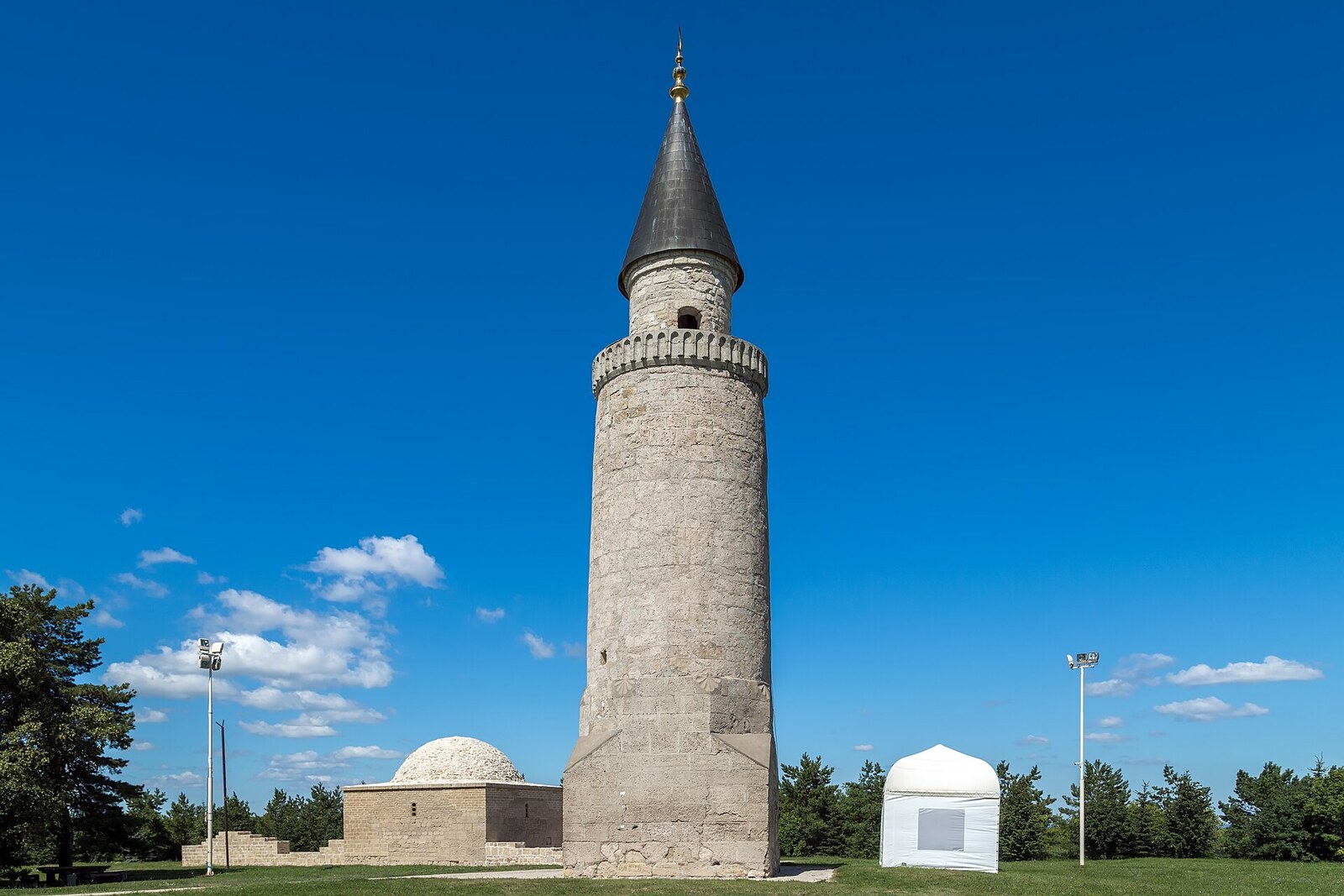
Look around first
What to notice
- The tower of the Small Minaret
- The spiral staircase
- The hemispherical dome of the tomb
- Stone gravestones
The story of the place
The name “Khan's Tomb” promises the grave of a ruler. Archaeologists, however, have found no evidence that a khan was buried here. This conventional name describes those who established the cemetery more accurately than those who lie in the graves.
In the first half of the fourteenth century, Bolgar was a wealthy city of the Golden Horde. In the southeastern part of the city, the military, commercial, and religious elite buried their relatives separately from ordinary townspeople. Muslim rites did not allow weapons, jewelry, or vessels to be placed in the grave. A family's standing was displayed above ground: they commissioned a heavy carved slab, listed ancestors and titles in the inscription, and built a stone mausoleum. A poor family could mark a grave with a wooden stake or a simple stone. These markers disappeared, while the buildings commissioned by wealthy patrons remained.
First, one square tomb was built here. Then relatives of the deceased added two more mausoleums to it. Nearby stood a heated building where memorial prayers were performed or pilgrims were received. When a new place was needed for burials, it too was turned into a mausoleum. The result was a connected complex of domed tombs. Inside the surviving building, archaeologists discovered eight burials in special boxes.
The Small Minaret served this funerary complex. A muezzin—a person who summoned Muslims to prayer—climbed its internal spiral staircase. His voice was intended for people who had come to the cemetery to commemorate the dead. The name “Small” appeared only at the end of the eighteenth century, when the tower began to be distinguished from the larger minaret of the Cathedral Mosque.
After Bolgar declined, the neighboring mausoleums collapsed, gravestone inscriptions disappeared, and the names of those buried were forgotten. Residents used the word “khan's” for the ancient cemetery with especially massive monuments; it meant wealthy and noble, not a confirmed grave of a khan.
By nineteen sixty-eight, mainly bare walls of the tomb remained standing. The restoration architect Sayyar Aidarov restored the missing parts and the hemispherical dome. The present dome belongs to his reconstruction; beneath it remain medieval burials with no established names. Nearby rises the minaret of that memorial mosque, for which the families of those buried came here.
Useful on site
Exterior viewing — during site hours; access to the spiral staircase may be limited by weather, safety, or capacity. Checked 2026-06-24.
Checked: date not specified. Check the official source before visiting.Do not count on climbing the stairs: the possibility of access is determined by the rules on site, and the narrow steps require caution.