 Guide On Map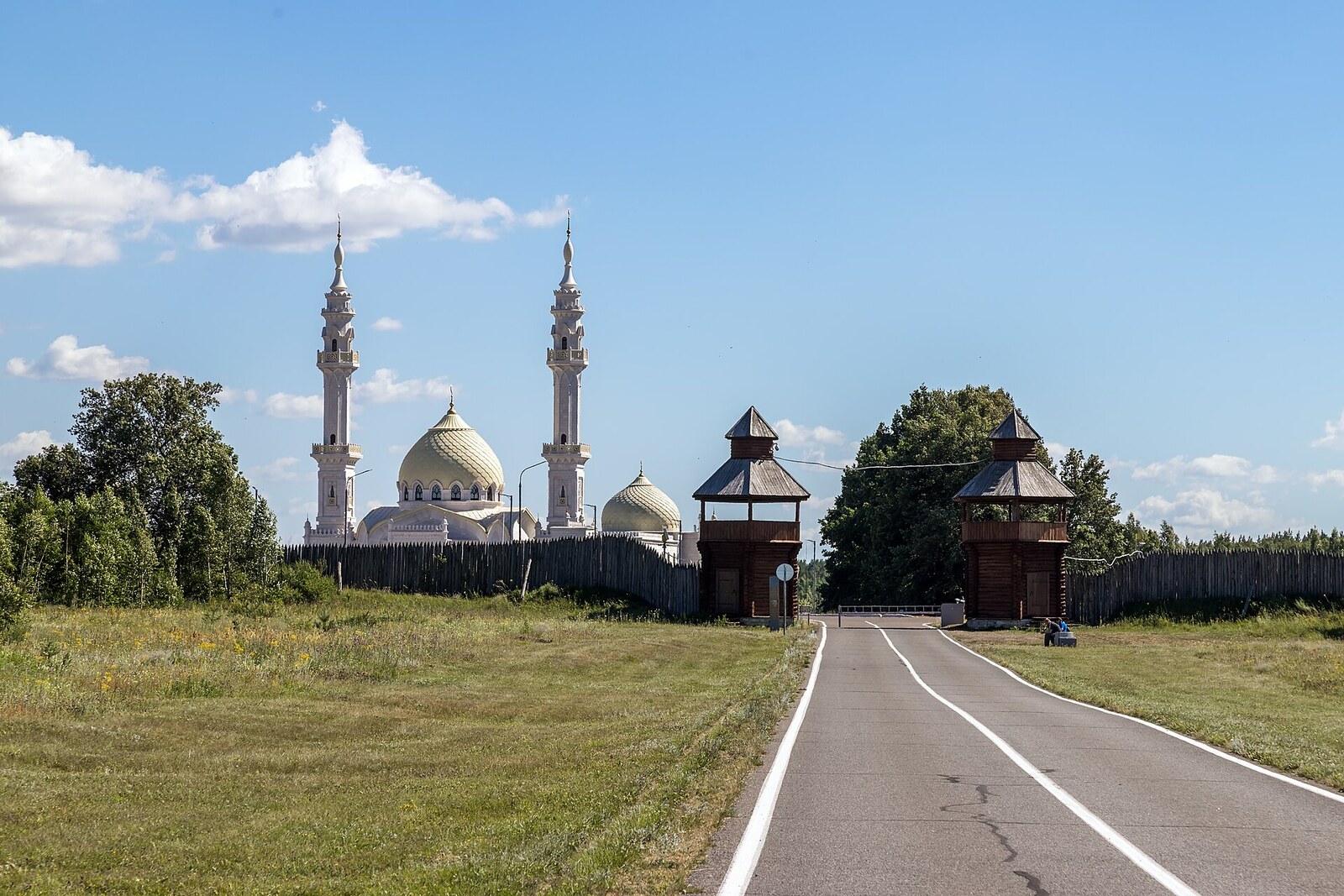
Look around first
What to notice
- White marble facades
- Minarets
- Prayer square
- Madrasa wings
The story of the place
White Italian marble covers the mosque's facades and two minarets; the prayer square lies before them. On either side stand wings housing a madrasa, a religious school, and the mufti's residence. During the day, the Quran is recited here by hafizes, who have learned it by heart, while students take practical classes.
Mintimer Shaimiev, who led the revival of Bolgar, did not initially intend to build a new mosque here. The medieval Cathedral Mosque had survived in ruins, and pilgrims were already praying beside it. But an open space was unsuitable for daily prayer in winter and bad weather. Shaimiev decided that worshippers needed an active mosque that could receive them year-round.
It was impossible to build it among the ancient structures: UNESCO monument-protection rules required the historic part of the fortified settlement to remain free of such an intrusion. So the site was chosen by the Southern Gate, outside the medieval city. The distance between the White Mosque and the Cathedral Mosque was not created for the sake of a beautiful panorama: this is how people separated the archaeological monument from a mosque that would be used every day.
The project was entrusted to Sergey Shakurov, one of the architects of the Kul Sharif Mosque in Kazan. The client wanted a small, convenient, yet ceremonial building and suggested using the minarets of the Prophet's Mosque in Medina as a model. Shakurov brought the first sketches just two months later.
Color became a separate question for him. While working on Kul Sharif Mosque, the architect had gone through long debates about what color the dome should be: blue, green, gold, and white options were considered. For Bolgar, he decided not to start another debate and printed the entire sketch in a single light tone. The clients unexpectedly made their decision at once. Later, Shakurov linked the emergence of the name “White Mosque” specifically to that sheet.
Mintimer Shaimiev told the story of the name somewhat differently: it became firmly established after white Italian marble was chosen. The architects were looking for matte stone in a warm shade; they could not find suitable local limestone in the necessary quantity. In the end, they ordered marble from the same quarry that supplied stone for La Scala in Milan. The white sketch first spared Shakurov a debate, and the marble turned a temporary graphic decision into facades and a name.
From the start, Shaimiev worked to ensure that this place would not be limited to prayer. That is why the structures on either side of the square are not decorative wings: the complex included a madrasa, a religious school, and the mufti's residence. When the mosque opened in June two thousand twelve, its creators held the first prayer here, and rooms for study were already part of the plan.
Three years later, the first thirty students of the future Bolgar Islamic Academy moved into them—serving imams from regions of central Russia. The academy did not yet have a building of its own. For six months, they studied and memorized the Quran intensively in the White Mosque complex; this course became the first stage in the work of the new educational center. In two thousand seventeen, the mosque became part of the academy, which had by then opened.
Now five daily prayers are held here, and students take practical classes. During the day, the Quran is recited by hafizes—people who have learned it entirely by heart—taking turns. Beyond the Southern Gate lie the ancient ruins, while in the white-marble complex, what Shaimiev had provided a madrasa for in the very first sketch continues.
Useful on site
Active mosque; visitor access depends on prayers and religious events. Checked 2026-06-24.
Checked: date not specified. Check the official source before visiting.This is an active mosque: enter only where permitted, keep quiet, and do not disturb prayer.