 Guide On Map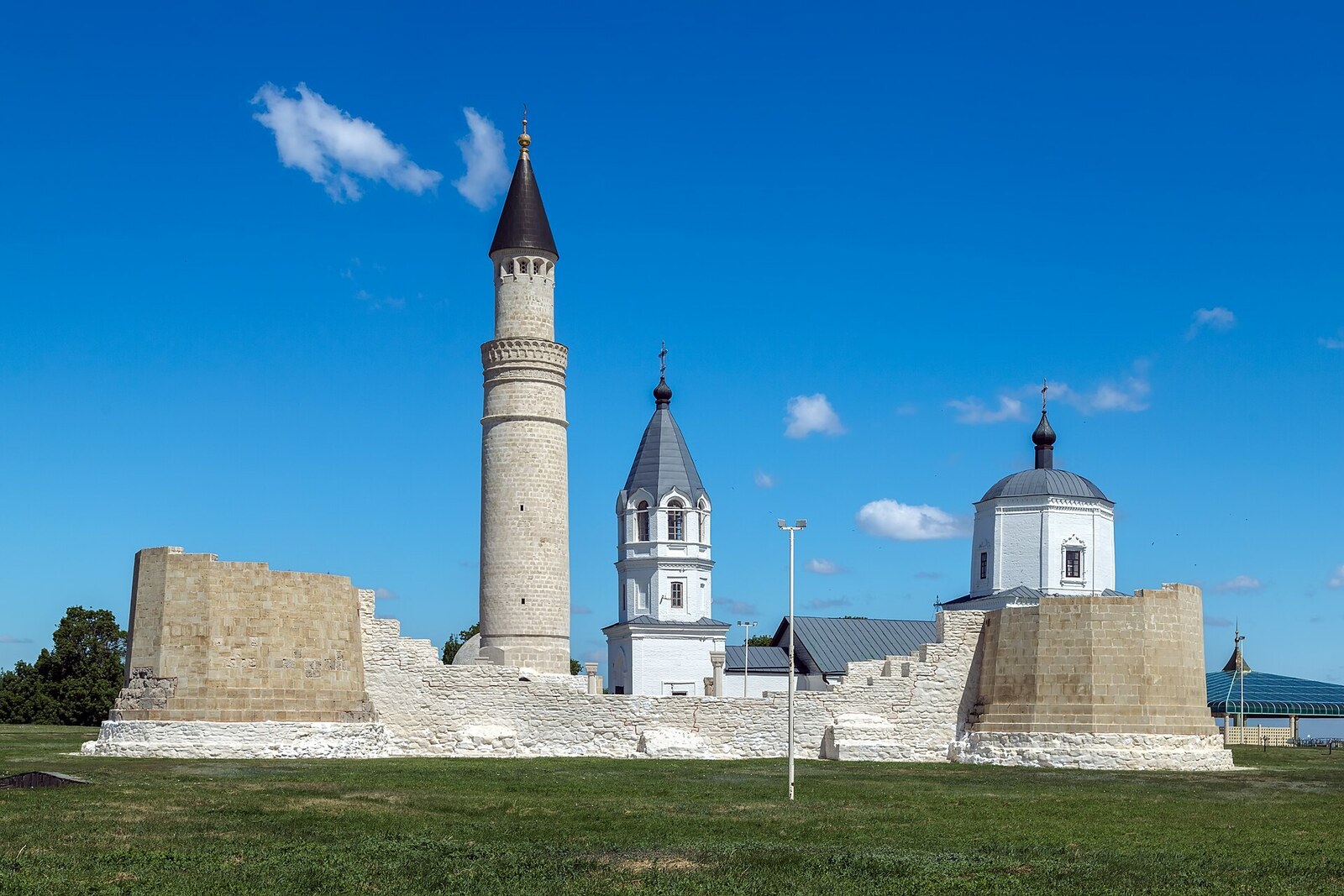
Look around first
What to notice
- Great Minaret
- Low walls of the Cathedral Mosque
- Assumption Church
- Gravestones in the plinth
The story of the place
The Great Minaret, standing beside the low walls of the Cathedral Mosque, was rebuilt. The one climbed by the people of medieval Bolgar disappeared in the nineteenth century. The Cathedral Mosque was the capital’s main mosque: this was where people gathered for Friday prayer. The Great Minaret took its name in comparison with the Small Minaret—the original tower reached twenty-four meters and was roughly twice as tall.
In June seventeen twenty-two, Peter I’s vessel approached the Bolgar fortified settlement. The emperor was heading down the Volga to the army preparing for the Persian Campaign. He stopped on shore to see the ruins and climbed the Great Minaret’s narrow spiral staircase. The tower was already leaning, and its foundation was crumbling.
A few weeks later, Peter reached Astrakhan and sent an order to Artemy Saltykov, the governor of Kazan: send twelve or fifteen stonemasons to Bolgar, give them lime, and repair the foundation. The upper part of the minaret was then tightened with two iron bands. The emperor also ordered the inscriptions on Bolgar and Armenian gravestones to be copied and translated. To him, these were antiquities that had to be preserved, but the methods of preservation remained those of construction: in his letter, he specifically reminded them that there was plenty of old stone at the fortified settlement.
Ten years later, construction began beside the mosque on the Assumption Church for an Orthodox monastery. It was funded by Ivan Mikhlyaev, a Kazan merchant and one of the city’s wealthiest entrepreneurs. He made his money from a cloth manufactory, tanneries and distilleries, and trading shops. The church was meant to commemorate Peter’s visit to Bolgar; the merchant had known him through Kazan. Mikhlyaev himself died four years before the work began; his family continued to spend his money.
The church was dedicated to the Assumption of the Mother of God—the feast of her death and being taken up into heaven. The builders used stones from the medieval ruins in the foundation and laid gravestones with Arabic and Armenian inscriptions into the plinth. The people whose names Peter had ordered copied were also recorded in the masonry of the new church itself. After the monastery was closed, the church became a parish church, and a museum of its history now operates inside.
Peter’s repair extended the life of the Great Minaret by more than a century. Then treasure hunters dug a tunnel beneath the tower’s base, hoping to find treasure. In eighteen forty-one, the excavation subsided, the minaret collapsed, and local residents quickly took its stone apart for their own buildings. Sources preserve neither the treasure hunters’ names nor the treasure they found; what is known is the result of their work—the tower was reduced to its base.
In the late twentieth century, restorers assembled a new Great Minaret from old drawings, surveys, and descriptions. Peter did not climb this tower. Nothing remains of that staircase, gallery, or shaft. The authentic stones of medieval Bolgar lie lower down—in the mosque’s walls and in the foundation of the Assumption Church, among slabs bearing the inscriptions of those once buried here.
Useful on site
The ruins are accessible during site opening hours; the Great Minaret and part of the mosque may be used for religious purposes. Access to interiors and the climb depend on conditions on site. Checked 2026-06-24.
Checked: date not specified. Check the official source before visiting.Do not call the whole ensemble medieval: consider each structure separately and read the dates on site.