 Guide On Map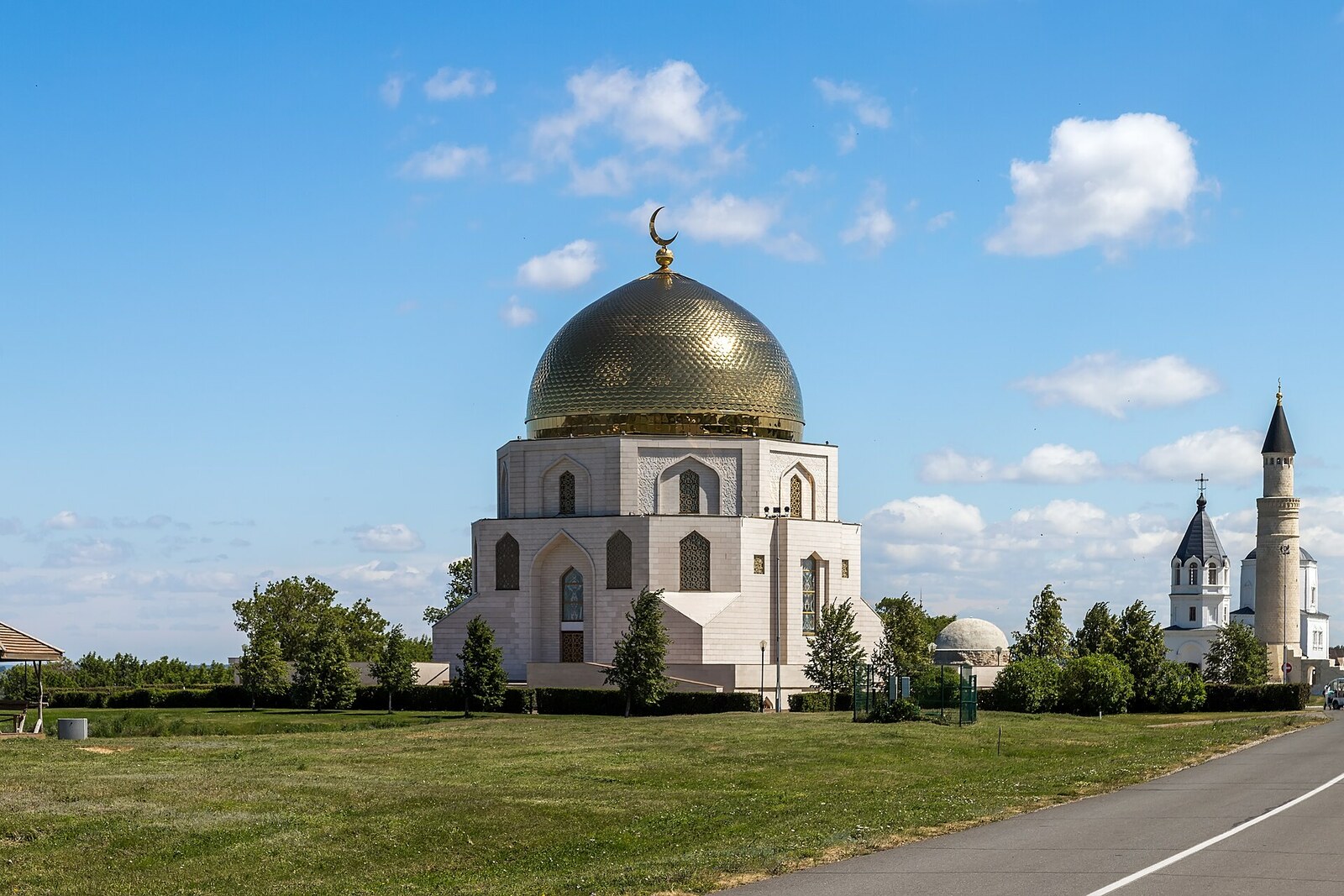
Look around first
What to notice
- Octagonal building
- Round dome
- Large printed Quran
- Mosaic of the embassy's meeting
The story of the place
The Memorial Sign and the Quran Museum occupy an eight-sided structure crowned with a round dome. The central hall holds a printed Quran nearly two meters high, while manuscript and printed editions are assembled below. This place preserves the memory of the early Muslim history of Volga Bulgaria.
The octagonal building with a dome appeared here in two thousand twelve. The Revival Foundation, which collected donations for work in Bolgar, commissioned a printed Quran from Italy for it, about two meters high. The book was first brought to the Kul Sharif Mosque in Kazan, then transported to Bolgar. On May twenty-first, during the opening of the Memorial Sign, Ildus Faizov, the mufti of Tatarstan, recited the final surah before it. After that, the Quran remained in the central hall, and beneath it a museum was set up with manuscript and printed editions, a map of the Baghdad embassy's route, and a mosaic of its meeting with the Bulgars.
The embassy depicted in the mosaic was summoned by Almush himself, a Muslim and ruler of Volga Bulgaria, which was dependent on the Khazars. His treasury was replenished through transit trade: a tenth of passing goods was collected. But trade income did not free Almush from subordination. The Khazar ruler held his son hostage and took his daughter as his wife by force. Almush needed outside support that would allow him to protect his family, strengthen his position among Bulgar chieftains, and build a fortress.
In nine twenty-one, he sent men to the Baghdad caliph al-Muqtadir, head of the largest Muslim state of that time. Almush asked him to send experts in the faith, teach the Bulgars Islamic law, help build a mosque, and provide money for a fortress. The caliph agreed to send an embassy.
Ahmad ibn Fadlan, a Baghdad official and secretary of this mission, was responsible for the letters, gifts, and observance of ceremony. The journey took nearly a year. Several invited religious teachers refused to continue through nomads' lands, but ibn Fadlan reached Almush's camp in the spring of nine twenty-two. He understood that he was taking part in a Khazar vassal's attempt to find another patron: an encounter with a Khazar detachment could have ended in captivity or death for him.
A few days later, the envoys unfurled the banners they had brought, dressed Almush in the caliph's black robes, and read out the letter with a translation into the Bulgar language. It was a public ceremony recognizing the ruler as part of the Muslim world. Islam was already practiced by Almush himself, his entourage, and some Bulgar communities; at one of them, ibn Fadlan saw a wooden mosque. The year nine twenty-two became the date of the religion's official affirmation, not the inhabitants of the Volga region's first encounter with it.
The envoys did not bring the main promised gift. They did not have four thousand dinars for the fortress. Almush demanded explanations and received neither a fortification nor a military alliance with Baghdad. After this mission, the Khazar ruler threatened him with war. Yet the ceremony helped Almush assert his seniority among local chieftains and gave him recognition from a distant caliph. Ibn Fadlan returned to Baghdad and compiled a report; it is his account that preserved the participants' names, their demands, and the failure over the money.
He did not name the exact place of that meeting. His account describes a temporary camp of tents by a river, and researchers still dispute where it stood. No foundation of Almush's tent has been found beneath the present building. The Memorial Sign marks Bolgar as the historical location of the adoption of Islam, not as the established point of the ceremony. Inside lies that very enormous Quran before which Ildus Faizov concluded the museum's opening in two thousand twelve; only ibn Fadlan's account survives from the camp of nine twenty-two.
Useful on site
The museum site follows the Museum Street schedule, daily 08:00–17:00; an adult ticket is 250 rubles and a reduced ticket is 150 rubles, as checked on 2026-06-24. Check prices again before your visit.
Checked: date not specified. Check the official source before visiting.The visit depends on access inside; treat the Quran as a religious text, not merely as a record-setting exhibit.