 Guide On Map
Kanazawa of the Kaga Domain: Residences, Castle, Gardens, and Tea Districts
From Nagamachi Samurai District through the castle and Kenrokuen Garden to the districts by the Asanogawa River
Guide On Map on your phone
Open the walk like a regular app
It takes about 10 seconds to install. No app store needed.
The whole path
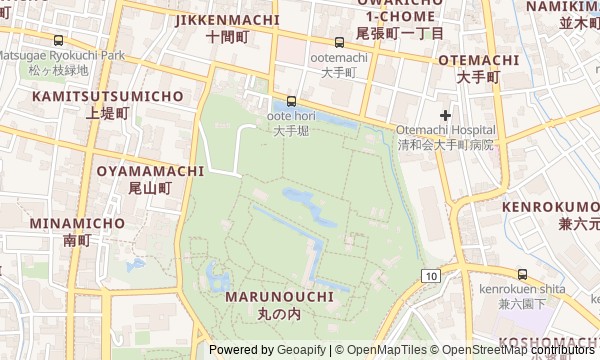
Route map
About the walk
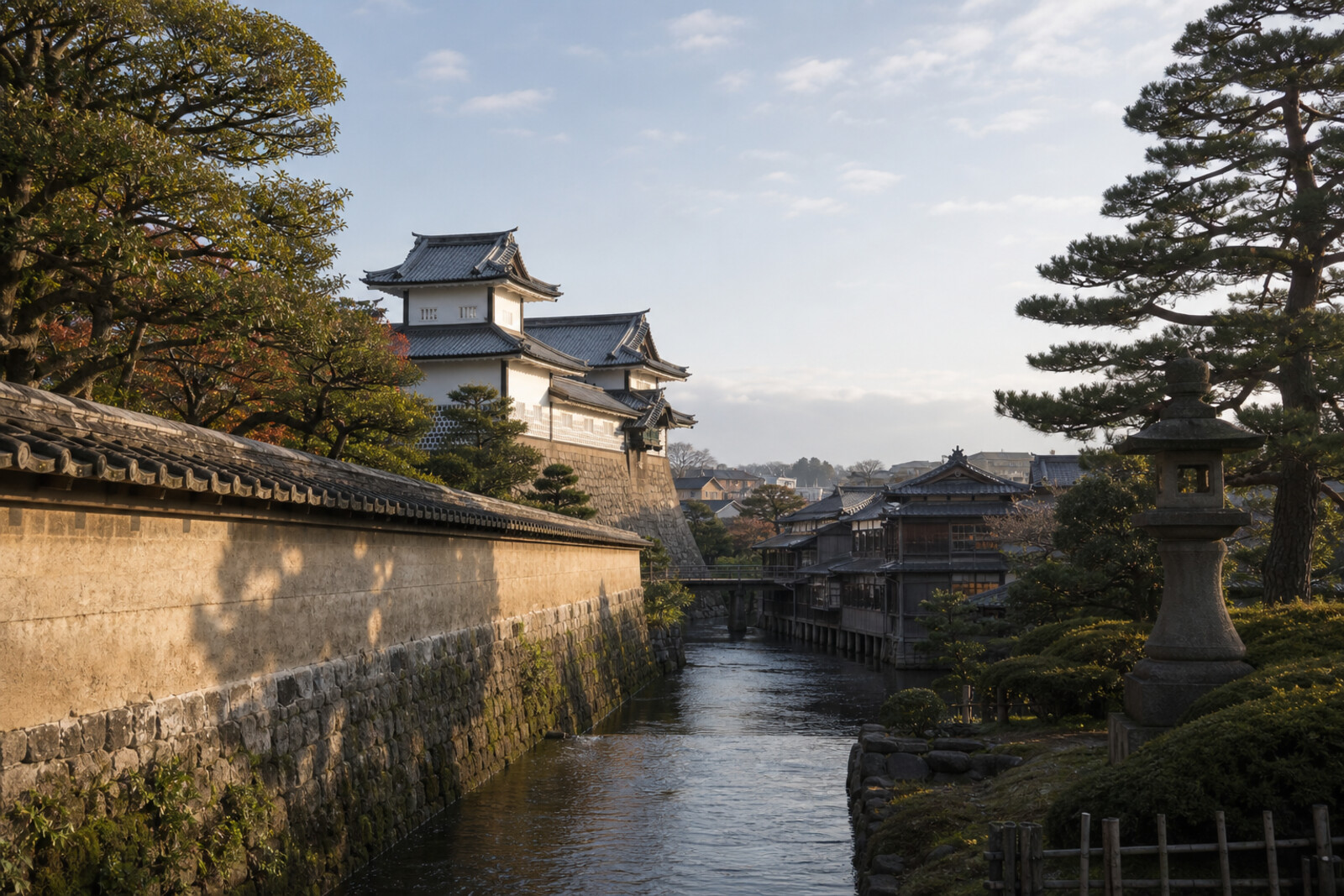
You will begin among the earthen walls of Nagamachi Samurai District, step inside a samurai residence, then climb toward the unusual gate of Oyama Jinja Shrine and enter Kanazawa Castle. From there, the road will lead through two gardens—one inside the fortress, the other along the city's high edge—before descending to the tea districts by the Asanogawa River.
This walk reveals Kanazawa as the capital of the Kaga Domain. By a gate, a stretch of water, or the scale of a garden, you will learn to read the standing of their former owners. You will find out why one residence brings together rooms and wood from different histories, what remains beneath a rebuilt cascade, and why prosperous guests needed a dark staircase.
The story stays close to documents, construction details, and human calculations. Legend will remain legend.
By the end, you will be able to read Kanazawa after the domain: through estate walls, the empty site of a palace, garden water, and the lattices of tea houses.
Why this order
Nagamachi Samurai District first shows the social order from the street: a master's rank was marked here by walls, gates, and the size of the plot. Nomura Samurai Residence then lets you step inside such an estate while also showing what became of it after the domain was abolished. From there, the road leads to Oyama Jinja Shrine, founded by former vassals after their service had disappeared. Beyond the shrine begins the castle itself—the place where the ruler, the administration, and the ceremonial palace once stood. After the defensive towers, the route descends to Gyokusen'inmaru Garden, where castle water changed from a means of defense into part of a private garden. Kenrokuen Garden continues that change on a larger scale, where the palace gave way to paths open to everyone. You will then descend from the ruler's gardens to the Asanogawa River. In Kazue-machi Chaya District, the unofficial side of the city's prosperity comes into view—the route of clients avoiding other people's eyes. Across the river, Higashi Chaya District ends the walk with the opposite experience: the authorities tried to gather the same trade within a licensed district.
Those who want to understand how the capital of Kaga was organized, not simply see its major views Those interested in samurai residences, gardens, and urban history Those who enjoy long routes with interiors and a story that unfolds in sequence
Those looking for a short overview of a few major sights Those who want only panoramas, without museums and historical interiors Those who prefer a route without extended walks through gardens
Before you go
The route combines freely accessible streets with places whose interiors require separate admission, especially Nomura Samurai Residence, the castle buildings, Kenrokuen Garden, and Shima. Do not expect to see a working tea house from the inside without a special arrangement: the Shima museum introduces the layout of such a space, but it is no substitute for a private geiko evening. Wear shoes suitable for stone paths and garden slopes, and bring protection from rain. In residential and working tea districts, do not linger by doorways, peer through lattices, or photograph visitors without permission.
When to go
Start in the first half of the day, so you do not rush through the first six stops and still have time for the accessible interiors. Nagamachi Samurai District and both gardens reward a slow look, while the castle grounds involve moving between distinct areas. Kazue-machi Chaya District is especially pleasant when the light softens, but do not leave the finish too late if you want to enter Shima. Without interior visits, the route becomes noticeably shorter; with them, it is best to allow most of the day.
Backup plan
In heavy rain, do not try to cover both gardens in detail: spend more time at Nomura Samurai Residence, the accessible castle interiors, and Shima, then take in Gyokusen'inmaru Garden and Kenrokuen Garden through a few key views. There will still be open stretches between covered stops, so the route has no completely dry version. If fatigue or weather forces you to shorten it, keep Nagamachi Samurai District, the castle, and Higashi Chaya District: together, they preserve the arc from the economic foundation of power to its ceremonial and cultural language. A closed interior does not make a stop pointless—at the castle, Kazue-machi Chaya District, and Higashi Chaya District, an important part of the story can be read from outside.
Route conditions
Surface. Paved — 2.6 km; unpaved — 293 m (data covers 67% of the route)
Stairs. Flights: 5, 158 m in total
Access. Wheelchair — no; stroller — limited (stairs)
Facilities. Toilets — 17; drinking water — 7
Elevation. Ascent — 74 m; descent — 77 m
OpenStreetMap extract of July 3, 2026: database data, not a check on the ground. Data © OpenStreetMap contributors, ODbL licence
Walk plan
Open in maps ↗- 1
Nagamachi Samurai District
The district sets the route’s starting measure: a family’s standing here could be determined by the boundaries of its compound. - 2
Nomura Samurai Residence
The garden and formal rooms will show how, after the abolition of the domain, a historic house had to be reassembled. - 3
Oyama Jinja Shrine
Here, former vassals would respond to the disappearance of the Kaga Domain for the first time not with weapons, but with a new place of remembrance. - 4
Kanazawa Castle
The restored defensive line will mark the site of the lost palace, where the whole domain was governed. - 5
Gyokusen'inmaru Garden: a waterfall in the castle wall
This stop links the fortress's fire protection with the most unusual decoration of its inner garden. - 6
Kenrokuen Garden
Here, the ruler's private residence will finally give way to a garden open to townspeople. - 7
Kazue-machi Chaya District
A dark staircase will show how the closed world of teahouses was woven into ordinary city streets. - 8
Higashi Chaya District and Shima House
The final stop will show how the authorities tried to turn a scattered trade into a regulated urban district.
Route features
Everything you need stays in the browser
Progress, saves and your trip plan are stored on this device.
Add Guide On Map to your home screen so the walk opens outside the browser.
How we handle sources, maps and corrections: our editorial standards