 Guide On Map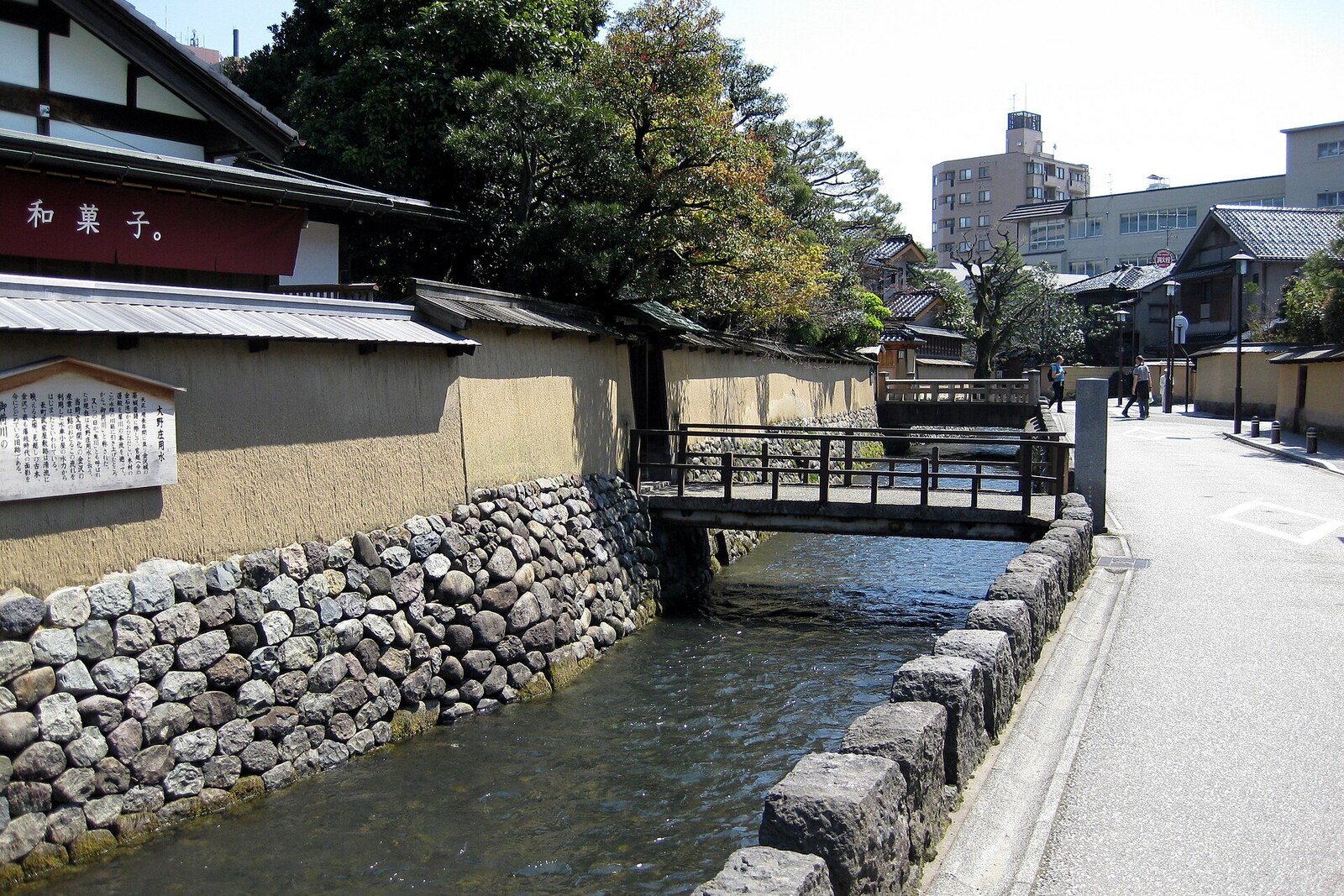
Look around first
What to notice
- Earthen walls
- Stone foundations of the walls
- Covered gates
- Onosho Canal
The story of the place
Nagamachi can be translated as “long district.” Yet the name probably conceals a surname. The character meaning “long” is read here as “naga,” but in the name of the clan that owned a huge estate nearby, it is read as “Cho.” Another version links the name to the length of the streets, so the clan origin of the name remains the most widespread, but not undisputed, explanation.
The man who made the Cho clan name significant for Kanazawa was Cho Tsuratatsu. He was born the third son and lived at a temple from childhood: he was not being prepared as an heir. Later, Tsuratatsu left the monastic life and returned to his family, which served the lords of Nanao Castle in neighboring Noto Province.
In fifteen seventy-seven, Nanao was besieged by the forces of the commander Uesugi Kenshin. The Cho clan supported his opponents. Tsuratatsu was sent to Oda Nobunaga to request military assistance. While he was on the way, one of the castle’s defenders went over to the besiegers. Nanao fell, and Tsuratatsu’s relatives were massacred. The mission did not save the family, but his absence from the castle was precisely what saved Tsuratatsu himself.
He now needed to regain the lands, people, and income without which the surname of a former warrior meant nothing. Tsuratatsu fought on Nobunaga’s side and received half of Kashima District—fifty-nine villages. He expected to become lord of all Noto Province, but Nobunaga gave it to Maeda Toshiie. Tsuratatsu had to come to terms with his new lord. He served Maeda on campaigns, and Maeda recognized his rights to Kashima District. Tsuratatsu did not become an independent ruler; his descendants became one of the eight senior vassal houses of Kaga Domain.
In sixteen twelve, the Cho clan’s urban estate was moved here. It covered about thirty-three thousand square meters. Nearby stood the holdings of another senior house, the Murai clan, and the residences of middle-ranking samurai. Tsuratatsu died seven years later, but the family retained its place among Maeda’s principal vassals for many generations. The estate itself no longer exists: its site is occupied by Tamagawa Park. According to the accepted version, the character in the name Nagamachi Samurai District also remained from the surname.
The walls here showed their owner’s standing more precisely than any sign. Ashigaru, low-ranking foot soldiers, were not allowed to enclose a house with a wall—they were assigned a hedge. Full vassals of middle rank and those above them could build earthen walls on stone foundations and make covered gates. So the long line of walls separated the holdings of families whose incomes, duties, and number of servants were predetermined by their place in the domain hierarchy.
The canal at the foot of the walls is called the Onosho Canal. The exact date of its construction is unknown; it is considered one of Kanazawa’s oldest waterways. Maeda people transported construction timber and rice along it, drew water for household use and firefighting, and directed it into estate gardens. Water still reaches some private gardens in the Nagamachi Samurai District from here. The canal served the very compounds whose boundaries were marked by the earthen walls.
After the abolition of social estates in eighteen sixty-eight, people of any background could live here. The area escaped major fires and bombing, but in the twentieth century old houses began to give way to new development. In nineteen sixty-seven, the architect Taniguchi Yoshiro assembled specialists who walked through Kanazawa and identified districts requiring protection. The city adopted their proposal and, the very next year, introduced Japan’s first rules for preserving the historic urban landscape. Nagamachi Samurai District became part of the protected zone.
Every December, students of the Kanazawa School of Crafts cover the walls with woven rice-straw mats, called komo. Wet snow soaks into the earth; when it freezes, the water expands and tears off the outer layer, so in early March the mats are removed and the masonry is inspected. Behind them remain the surviving and restored boundaries of samurai compounds; the Cho clan estate behind these walls is gone, but its name remains with the entire district.
Useful on site
The city street is open around the clock. The winter komo mats on the walls usually remain until early March.
Checked: date not specified. Check the official source before visiting.It is best to explore the district without rushing and not go beyond the fences of private homes. In winter, the straw mats are practical protection, not festive decoration.