 Guide On Map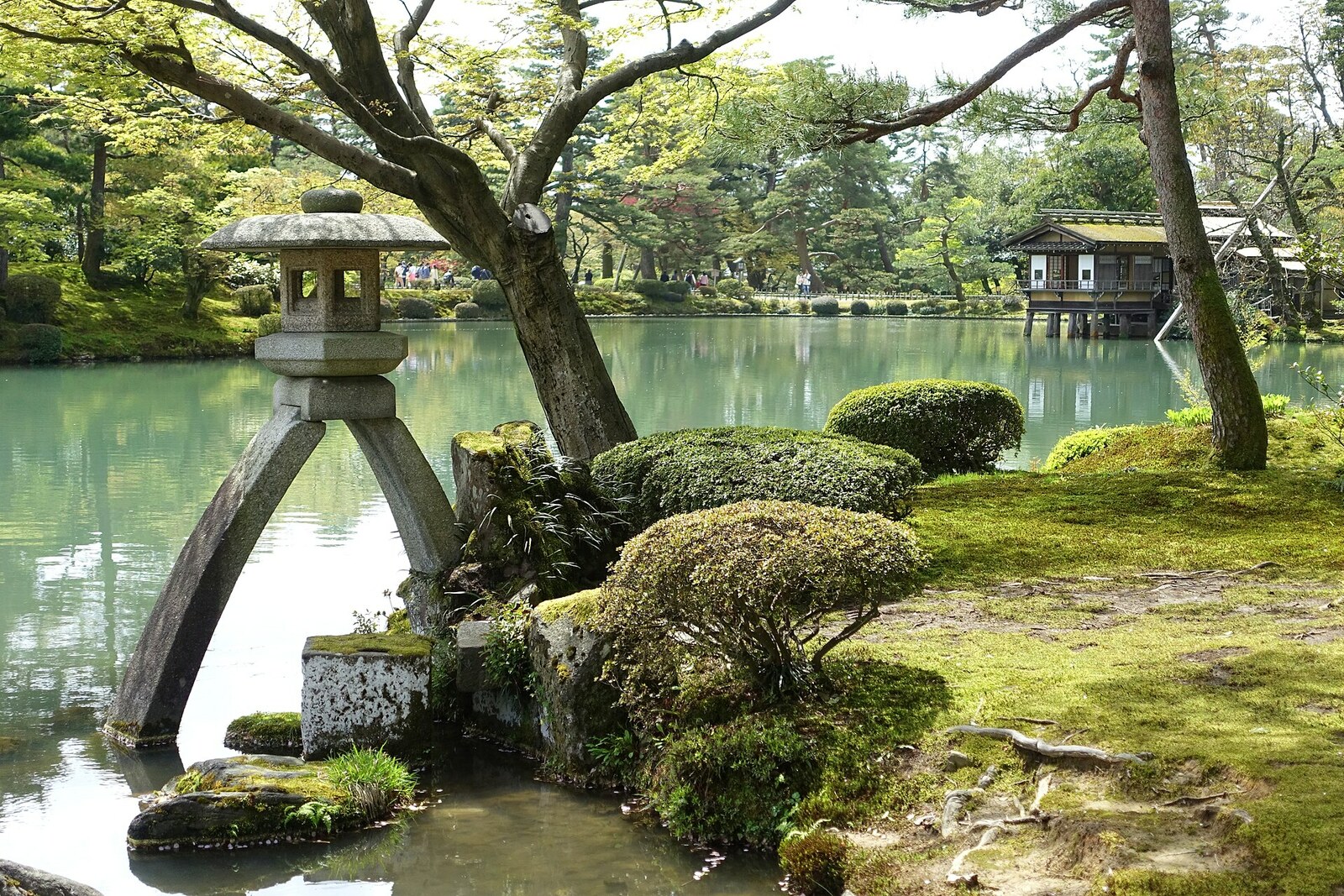
Look around first
What to notice
- Kasumigaike Pond
- Winding streams
- Stone bridges
- A plaque with three characters
The story of the place
On Chitosedai, the rise in the upper part of today's Kenrokuen Garden, Takezawa Palace once stood. It was built by Maeda Narinaga, the twelfth ruler of Kaga Domain. In eighteen twenty-two, he handed the title to his eleven-year-old son Nariyasu, but had no intention of giving up control.
Senior vassals had previously prevented Narinaga from carrying out the reforms he had planned. Now he wanted to act through personally selected advisers from his own residence. The domain school that had stood here was relocated for the palace. Kaga's treasury was already burdened by debt, yet Narinaga commissioned an extensive complex with reception rooms, rooms for officials, stables, and two Noh theater stages. The old garden on the slope behind the palace was incorporated into the estate as its outer section.
At the same time, Narinaga asked Matsudaira Sadanobu, the former chief adviser to the shogun and a renowned garden designer, to write three characters for the gate: “Kenrokuen Garden”—“a garden combining six merits.”
The Chinese scholar Li Gefei listed these six merits in Records of the Famous Gardens of Luoyang. He divided them into three pairs and explained why one usually has to choose between them. A large open space deprives a garden of secluded depth. Work by the gardeners that is too conspicuous interferes with the feeling of antiquity. Many ponds and streams usually require low, enclosed terrain, with no distant view. The name asserted that the Maeda clan's garden combined spaciousness and seclusion, human artistry and the appearance of an old landscape, water and panorama.
For a long time, these words were thought to have been invented by Sadanobu himself. But an entry in his diary for September twentieth, eighteen twenty-two says otherwise: the ruler of Kaga asked him to write the already established name “Kenrokuen Garden” for a large plaque. Sadanobu wrote the characters; documents have not yet established who exactly chose them.
Narinaga did not live long in the palace. In eighteen twenty-four, he created a personal council at the residence to carry out reforms, and a few months later he died here of measles. The council was dissolved. His son Nariyasu, who until then had remained ruler chiefly in title, took control himself.
Beginning in eighteen thirty, Nariyasu started dismantling his father's palace. At the same time, he enlarged Kasumigaike Pond, laid out winding streams, built bridges, and planted trees. Water was brought up to the plateau through an already existing canal, so ponds and streams, as well as distant views, could be preserved at one elevation. In eighteen sixty, Nariyasu ordered the gate and wall between the upper Takezawa Garden and the old garden on the slope removed. After that, the two previously separate sections joined into a single walking route.
Takezawa Palace, its service rooms, and both Noh theater stages have disappeared. Paths now run through their former site in the upper part of Kenrokuen Garden. The plaque written by Sadanobu survives, and its three characters became the name of the entire garden, which was opened to townspeople in eighteen seventy-four.
Useful on site
7:00–18:00; from 16 October through the end of February, 8:00–17:00. Open 365 days; adult ticket 320 yen, children 100 yen.
Checked: date not specified. Check the official source before visiting.Do not try to see everything in sequence: choose a few views and notice how open space gives way to a narrow path. The fountain and yukizuri depend on the water level and the season.