 Guide On Map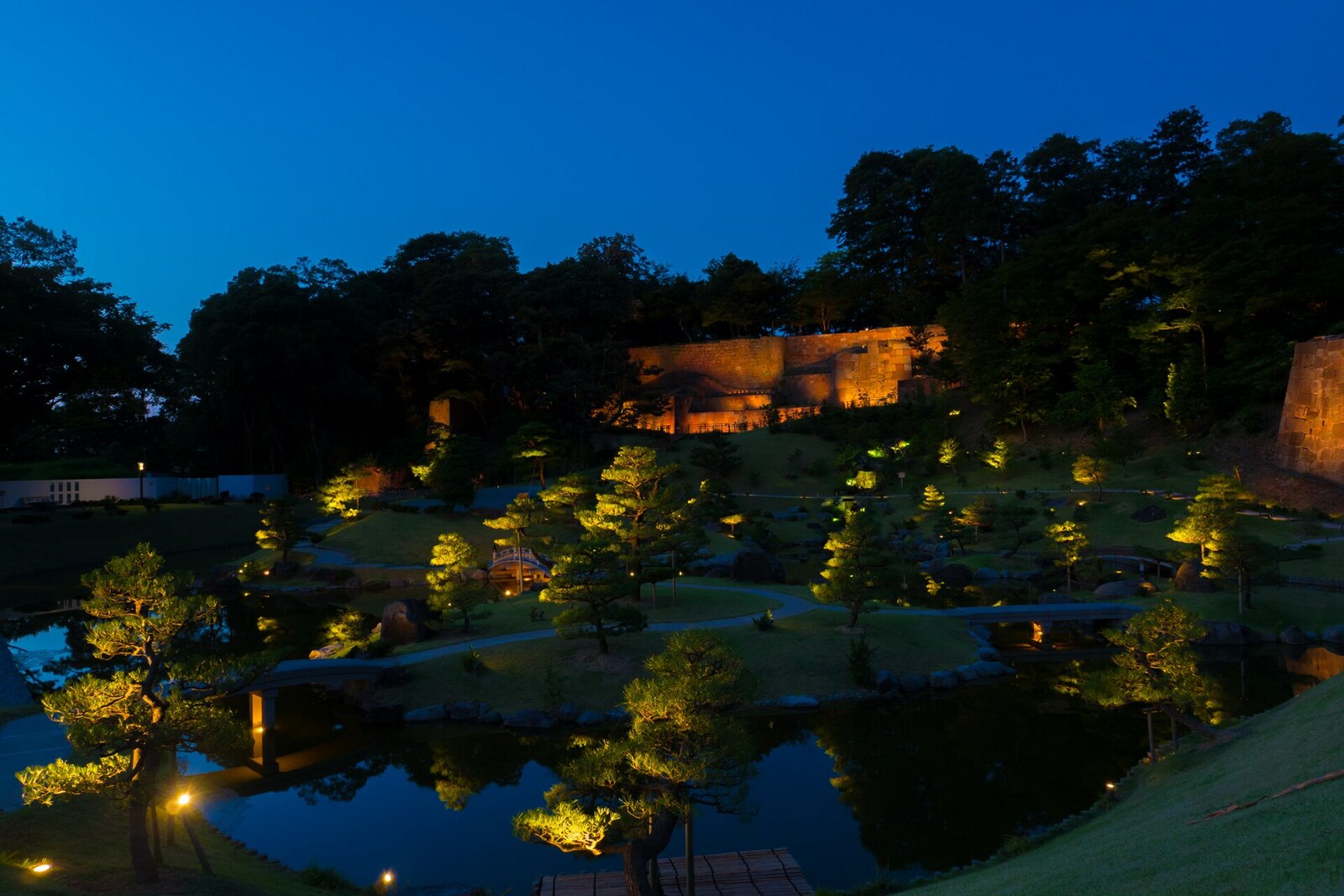
Look around first
What to notice
- Four-tiered cascade
- Shikishi-tanzaku wall
- Dark stone channel
- Garden pond
The story of the place
Inside Kanazawa Castle lies the Gyokusen'inmaru Garden courtyard, where under the rulers of Kaga there was an inner garden with a pond. The courtyard's name is connected with Gyokusen'in, the monastic name of the woman whose residence once stood on this site. After the abolition of the domain, the garden was abandoned, the pond was filled in, and both a riding ground and a gymnasium later occupied the site. When the gymnasium was demolished, excavations revealed the old bed of the pond and the remains of the cascade; the present four steps beneath the dark stone channel have been reconstructed above its original stones.
In sixteen thirty-one, a fire reached Kanazawa Castle. The third ruler of Kaga, Maeda Toshitsune, needed a permanent water supply: the previous system left the fortress defenseless against fire. He commissioned the work from Itaya Hyoshiro, a resident of Komatsu known as a master of arithmetic and surveying. For a man without samurai rank, it was a commission of the highest level and a task with no ready solution.
Itaya diverted water from the Saigawa River about eight kilometers from the castle. Part of the canal had to run through tunnels, and in front of the fortress the water encountered a low-lying area. Itaya used an inverted siphon: enclosed in a pipe, the flow first went down and then rose on the other side because of the difference in elevation. In sixteen thirty-two, the water reached Ninomaru. It filled the moats and was used in fires and everyday life. Later, the same canal made it possible to run water through the garden ponds.
Two years later, Toshitsune invited the gardener Kenzaemon from Kyoto and ordered him to lay out the inner garden of the head of the domain here. The site already bore the name Gyokusen'inmaru Garden. “Maru” means a separate castle courtyard, and Gyokusen'in was the Buddhist name of the woman whose house had once stood on the site of the pond.
Before taking vows, she was called Eihime. She was the daughter of Oda Nobunaga and the wife of Maeda Toshinaga, the second ruler of Kaga. The couple had no son, so Toshinaga adopted his younger brother Toshitsune and passed the inheritance to him. After her husband's death, Eihime returned to Kanazawa, took the name Gyokusen'in, and settled in a residence arranged for her in the western courtyard of the castle. She died in sixteen twenty-three. The house was dismantled, but the courtyard continued to be called by her monastic name. Eleven years later, Toshitsune turned the site of the former residence of the woman in whose family he had become the heir into his garden.
Later members of the Maeda clan altered it. Under the fifth ruler, Tsunanori, a particularly ornate wall appeared: large square and rectangular stones alternate with small polygonal ones. The squares resembled shikishi, sheets for poems and paintings, while the rectangles resembled narrow tanzaku poetry strips. This is where the masonry got its name: shikishi-tanzaku. A dark stone channel shaped like the letter V was set into the upper part of the wall.
In eighteen fifty-six, the thirteenth ruler of Kaga, Maeda Nariyasu, ordered a four-tiered waterfall to be made beneath this channel. A diary kept by one of his retainers notes on August eighteenth that the work was about seven-tenths complete. The water from the Tatsumi Canal, which more than two centuries earlier Itaya Hyoshiro had managed to raise into the castle for fire protection, now emerged from the castle wall and descended to a private garden pond.
After the abolition of the domain, the garden was abandoned. The pond was filled in, a riding ground was made here, and later a gymnasium was built. When it was demolished, archaeologists found the stone bed of the pond, the waterfall basin, and the remains of four steps. It was decided to leave the original structures underground: they were covered with a protective layer of soil, and in two thousand fifteen the cascade above was restored from the excavation results. The walls retain their Maeda-era appearance; the waterfall steps before them have been recreated, and water is now pumped up to them from Imori Moat. The original stones of the cascade lie directly beneath the present ones.
Useful on site
Same as the castle park: spring–summer 7:00–18:00, autumn–winter 8:00–17:00, free admission. Gyokusen-an Tea House: 9:00–12:00 and 13:00–16:30, admission until 16:00; closed December 29–January 3; matcha 1000 yen, possible closures for private events.
Checked: date not specified. Check the official source before visiting.Compare the garden from its highest and lowest points: only then is its height visible. The present composition has been restored, while the historic remains are preserved beneath it.