 Guide On Map
Traces of Königsberg in Kaliningrad: From King's Gate to Friedrichsburg Fortress
From King's Gate via the castle site, the embankment, and Kneiphof to Friedrichsburg Gate
This entire route and all recorded chapters are free.
Guide On Map on your phone
Open the walk like a regular app
It takes about 10 seconds to install. No app store needed.
The whole path
Route map
About the walk
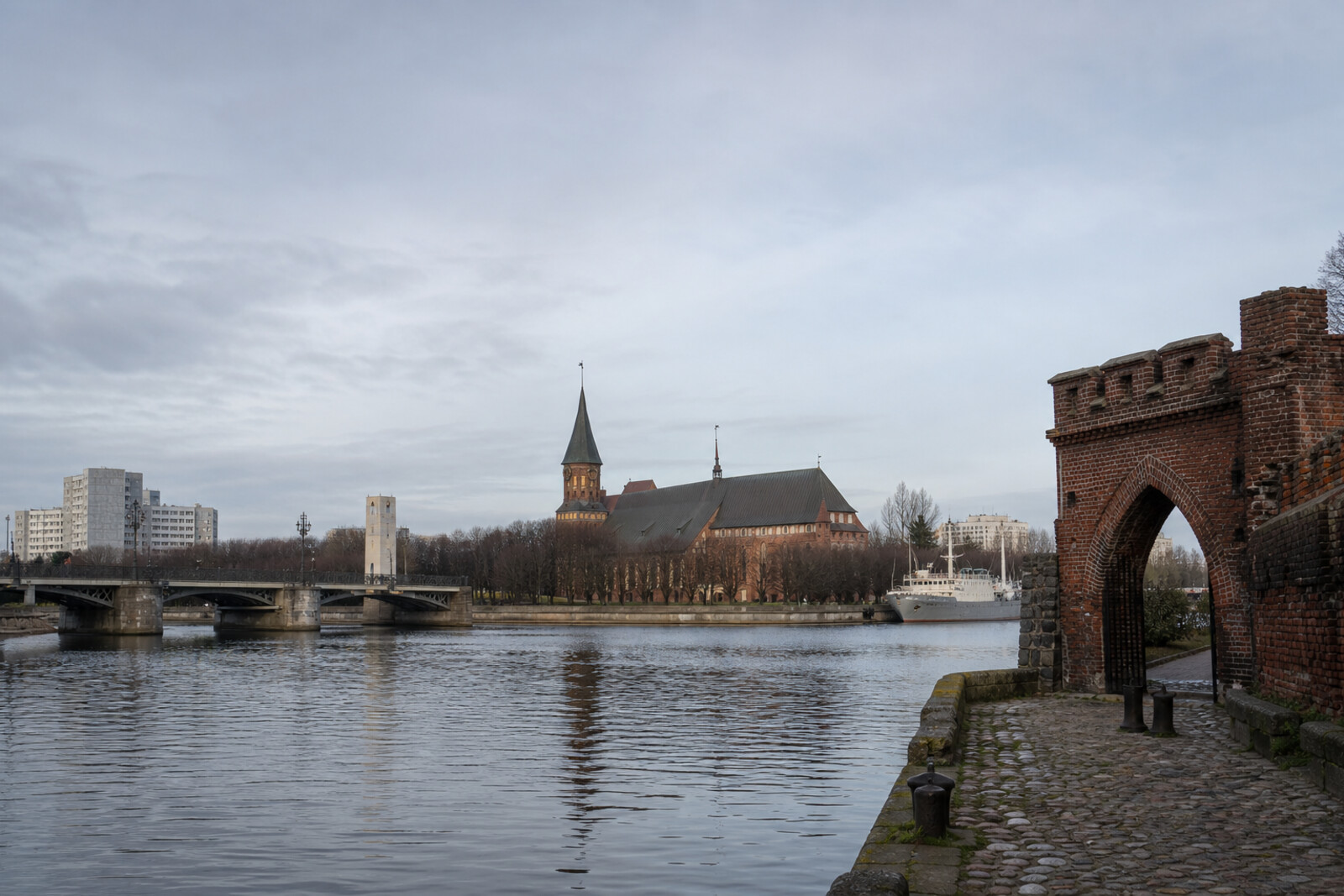
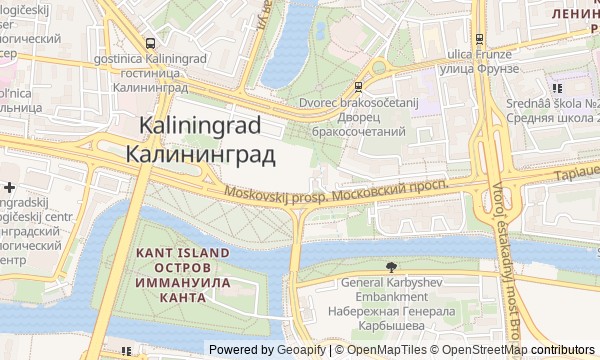
You will walk from King's Gate to the empty site of the castle, then reach Vityaz, cross Kneiphof, and finish at Friedrichsburg Gate. Along the way come brick fortifications, museum ships, lawns with sculptures, Honey Bridge, the cathedral, and a concrete estacade.
This is a walk through a city where the past does not settle into one neat layer. Some landmarks were reconstructed from old photographs; others could neither be brought back nor replaced. You will find out why nearly finished stone heads had to be remade, what set architects arguing over an empty island, and how a stage appeared beneath a bridge that was meant to run somewhere else. The story stays close to documents, visible details, and necessary caveats: a city legend remains a legend, and a stone tombstone needs its own explanation.
By the end, you will be able to read Kaliningrad through its breaks: to tell what survived from what was restored, never built, or adapted for a new use.
Why this order
King's Gate will set the line of former Königsstraße, leading to the site of Königsberg Castle: a monarchs' route ends where one of them turned a title into a hereditary crown. From the vanished center of power, the route descends to the Pregolya and Vityaz, an object from another era that the city managed to preserve. From the embankment, the crossing to western Kneiphof continues the theme of choosing between loss and a new purpose: here, instead of a ship, the city fabric was saved or replaced. Moving across the island toward Honey Bridge shows how an old rivalry remained in the crossing's name, while a modern version of the old city appeared nearby. The return to Königsberg Cathedral separates a genuinely surviving place from historical scenery. Next, the estacade shows how Soviet transport cut across the island and how the space beneath it is used today. The final crossing over the river to Friedrichsburg Fortress closes the route: at the western outlet of the Pregolya, city trade again meets power and fortifications.
Those who want to connect scattered traces of Königsberg into one city route Those interested in architectural disputes, restoration, and the fate of landmarks Those who prefer verifiable details to a general retelling of history
Those looking only for an intact district of old buildings Those who need a short walk without long crossings Those expecting a story exclusively about Immanuel Kant
Before you go
Decide in advance whether you want to visit at least one interior: the museum and concert programs at Königsberg Cathedral, the exhibitions at the Museum of the World Ocean, and the gate interiors all require extra time. Before setting out, check their current visiting conditions and event schedules—the outdoor route does not depend on them.
Bring headphones, comfortable shoes, and protection from wind or rain: much of the route runs beside the water and across an open island. If ship gangways or stairs are uncomfortable, leave Vityaz for viewing from the embankment. The walk ends in another part of the city, so allow separate time for the return journey.
When to go
About 3 hr 40 min if you listen to the stories and view the sites from outside. With the Kant Museum or one exhibition at the Museum of the World Ocean, allow around 4 hr 30 min. A concert and several interiors can extend the walk to 6 hours.
Backup plan
A closed museum does not cancel the stop: the route's main connections can be read through facades, silhouettes, and city space. If access to the former House of Soviets site is restricted by work, stay at the nearest permitted viewing point and do not approach the barriers.
In bad weather, you can shorten the walk across the western part of the island while keeping Königsberg Cathedral and the estacade. If Vityaz cannot be visited or the gangway seems uncomfortable, view the ship from the embankment and continue to Friedrichsburg Gate.
Route conditions
Surface. Paved — 4.5 km (data covers 67% of the route)
Stairs. Flights: 2, 48 m in total
Access. Wheelchair — no; stroller — limited (stairs)
Facilities. Toilets — 10
Elevation. Ascent — 33 m; descent — 50 m
OpenStreetMap extract of July 3, 2026: database data, not a check on the ground. Data © OpenStreetMap contributors, ODbL licence
Walk plan
Open in maps ↗- 1
King's Gate
This is where the route's main method appears: reading a restored facade as work with incomplete evidence. - 2
Site of Königsberg Castle and the former House of Soviets
The empty space shows how two vanished buildings from different eras left an address of power without a building in the city center. - 3
The Vityaz Research Vessel and the Historic Fleet Embankment
The vessel will change the scale of the story: what had to be preserved here was not a ruin, but an entire floating institute. - 4
Western Kneiphof and Sculpture Park
The lawns preserve the trace of a dispute over what should have filled the space of the vanished blocks. - 5
Honey Bridge and Fish Village
The crossing will connect an old urban rivalry with modern development that depicts a historic quarter. - 6
Königsberg Cathedral and Kant’s Grave
The memorial makes it possible to trace how the city established the identity of its most famous professor. - 7
Estacade Bridge and Cultural Place
Under the spans, the cost of the transport decision and its later adaptation as an urban stage will come into view. - 8
Friedrichsburg Gate
The finale returns the route to river trade and the fortification that controlled the western approach to the city.
Route features
Everything you need stays in the browser
Progress, saves and your trip plan are stored on this device.
Add Guide On Map to your home screen so the walk opens outside the browser.
How we handle sources, maps and corrections: our editorial standards