 Guide On Map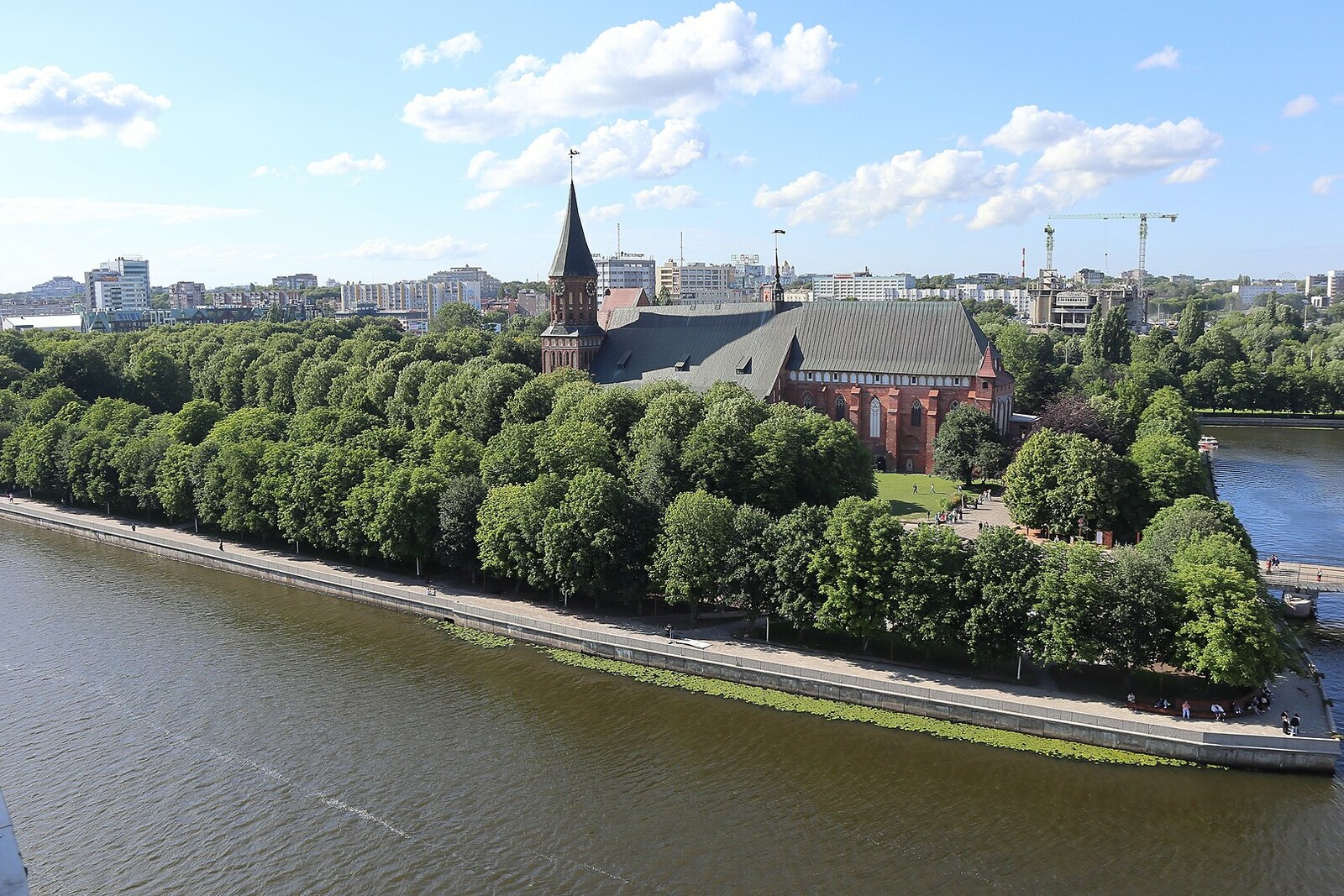
Look around first
What to notice
- Park lawns
- Sculptures on pedestals
- Plaques with the authors' names
- “Singing Children”
The story of the place
The western part of Kneiphof was once crowded with the houses of the island city. When the ruined development was cleared away, a dendrological park was laid out here, and another ten years later the Sculpture Park opened among the trees as a branch of the museum. Moscow art organizations transferred fifty-four works to it; about one hundred were to be installed across twelve hectares. Now the figures stand separately on the lawns, with plaques naming their authors, and Mikhail Pereyaslavets's “Singing Children” occupy the site of former houses.
In nineteen eighty-nine, Yuri Zabuga, a young Kaliningrad architect, brought his graduation project to the Kaliningrad City Art Gallery. For him, it was the work with which he entered the profession. For the island, it was an attempt to overturn an already funded plan by experienced colleagues from Leningrad.
The dispute began because western Kneiphof would not take shape as a complete urban space. After the war, the destroyed blocks were dismantled, and of the densely built island city only the cathedral remained amid empty land. In nineteen seventy-four, architect Yuri Vaganov laid out a dendrological park here. At that time, Kneiphof was officially called Central Island. Ten years later, a branch of the historical and art museum—the Sculpture Park—opened among the young trees.
The plan was ambitious. Moscow art organizations gave Kaliningrad fifty-four works; about one hundred were to be installed across twelve hectares. The sculptures were to be arranged by themes: labor, peace, space, history, science, and art. It turned out differently. The works came from different collections, they did not form a unified ensemble, and the pedestals and explanations lagged behind. Inna Mironchuk, the park's director, defended the new form of museum in the newspapers, but admitted that the island and its landscape had been poorly taken into account. Kaliningrad residents asked why Pyotr I, Gagarin, a panther, a female torso, and “Singing Children” had ended up together among the empty lawns.
The city administration commissioned a redesign from specialists at the Leningrad branch of the Art Fund. Architects Leonid Kopylovsky and Lev Bochkarov, together with sculptor Lev Lants, proposed the “New Sculpture Park.” The figures were to rise on columns as high as a three-story building. One part of the island became the “Hoffmann Theatre,” with characters from the works of the Königsberg writer, while another became the composition “Kant and His Time.” The whole ensemble was to be crowned by the “Column of Time,” with a mother and child at its top.
This project left almost no room for either the sculptures already given to the city or the island itself. The ruins of the cathedral would have stood beside the new scenery, while the former blocks of Kneiphof would once again have disappeared beneath an invented ensemble.
Zabuga proposed the opposite. He wanted to uncover the foundations of the lost houses, restore the medieval street grid, and partially mark the former buildings. Instead of new three-story columns, visitors would have been able to walk through the plan of the city that once occupied the island. At the exhibition “What Should the Island Be?” the public supported the graduate. That was enough to keep the Leningrad project from being built.
The victory did not bring Zabuga a construction project: the city administration did not carry out his plan either. The damaged sculptures were restored and returned to the lawns. Now just over two dozen remain, with plaques bearing their titles and their authors' names installed beside them. There is neither the “Column of Time” nor exposed foundations here. Mikhail Pereyaslavets's “Singing Children” stand among the trees on the site of vanished houses—in that very park which one architect wanted to raise above Kneiphof on tall columns, while another intended to cut through with old streets.
Useful on site
Do not look for literal remains of every street: it is more important to appreciate the distances between the cathedral, the river, and the trees. After rain, stay on the paths and expect an open, windy stretch.