 Guide On Map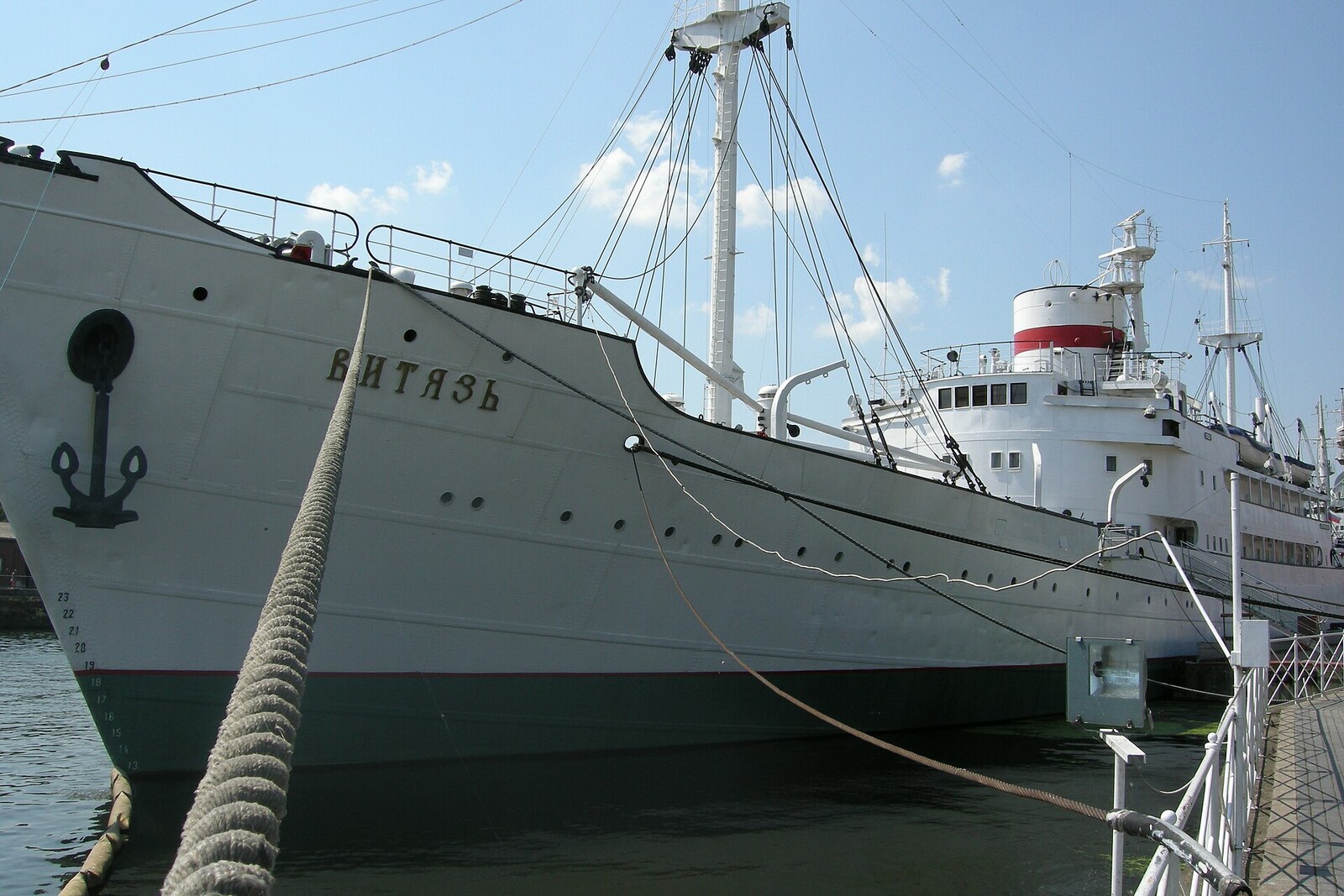
Look around first
What to notice
- The white hull of the Vityaz
- Masts and deck superstructures
- The quay wall
- Museum vessels
The story of the place
NIS in the name stands for research vessel. The white hull with masts served oceanologists: beneath the decks were laboratories, sample storage facilities, and winches for deep-water work. The cabins and engine room have retained their former layout, and the present-day Historic Fleet Embankment began to take shape around the ship on a site with a damaged quay wall.
On July twelfth, nineteen ninety-four, tugs guided a vessel along the Pregolya with its masts laid down on the deck. To get it through to this berth, workers deepened the channel, raised the power lines, and opened a double-deck bridge. Beyond the bridge, the masts were put back in place. This was how the Vityaz covered the final kilometers of a journey that had begun fifteen years earlier.
In nineteen seventy-nine, it completed its sixty-fifth scientific expedition and arrived in Kaliningrad. Scientists had long proposed opening a museum on board. At first, the vessel was to be moored in Moscow, but its ocean-going hull could not pass through the canals. Kaliningrad, too, had neither a ready berth nor an institution prepared to pay for the ship's upkeep. For eleven years, the Vityaz rusted beside Yantar Shipyard while agencies tried to persuade one another to take it onto their books. Scrapping it for metal was also discussed.
Svetlana Sivkova, an employee of the Kaliningrad Regional Museum of History and Arts and an oceanologist by training, worked to preserve the vessel. She was assigned to study the Vityaz: it was assumed that one day it would become a branch of the museum. Sivkova held no position that allowed her to give orders to the shipyard or the ministries. She brought scientists and local residents together around the ship, and a club of friends of the future museum emerged. One participant in this campaign, the scientist and bard Alexander Gorodnitsky, personally went to the Ministry of Culture to persuade officials to take the vessel.
In April nineteen ninety, the government established the Museum of the World Ocean in Kaliningrad, and Sivkova became its first director. The decree preserved the name, but not yet the hull. The city council gave the museum a litter-strewn site on the Pregolya, with a damaged quay wall and two partly ruined buildings. The Academy of Sciences transferred the vessel itself to the Ministry of Culture, along with the costs of repairs and the crew. At Yantar Shipyard, the portholes and doors were replaced, decking was laid, and the superstructures and deck equipment were put in order.
Sivkova had asked for this entire shore for a historic fleet as early as nineteen ninety-two, when not a single museum ship stood here. So today's line of vessels grew up around the Vityaz; it was not a ready-made old harbor that the museum occupied in its entirety. The first visitors were admitted aboard in October nineteen ninety-four. The staff of the cultural institution had to include a captain, a boatswain, and sailors: the large exhibit needed a real crew in order to stay afloat.
The abbreviation NIS means “research vessel.” In nineteen forty-nine, the oceanologist Veniamin Bogorov proposed naming the former cargo steamship Vityaz in memory of two Russian corvettes. The first brought the ethnographer Nikolai Miklouho-Maclay to New Guinea. On the second, naval officer Stepan Makarov measured the temperature and density of ocean water, then published Vityaz and the Pacific Ocean. Pyotr Shirshov, director of the Institute of Oceanology, personally drew the lettering for the new name.
Scientists converted the steamship into a floating institute with laboratories, sample storage facilities, and deep-sea winches. On the twenty-fifth voyage, Gleb Udintsev's geological team searched for the bottom of the Mariana Trench. The echo sounder showed about ten thousand six hundred meters, but the instrument treated the speed of sound as constant. For many more hours, the researchers lowered thermometers and bathometers, took water from different depths, determined its temperature and salinity, and applied corrections. After the calculations, a depth of eleven thousand twenty-two meters emerged. Later measurements refined that figure, but at the time it entered reference books as a record.
The laboratories, cabins, and engine room that visitors now walk through have retained the layout of the floating institute. And the Vityaz's place at the berth has remained the first in the line: museum staff later placed the other vessels of the Historic Fleet Embankment beside the ship for which the city had once been asked to provide this embankment.
Useful on site
Closed Mon; Tue–Sun exhibitions and upper decks 10:00–19:00; upper decks only 19:00–20:30.
Checked: September 24, 2026. Check the official source before visiting.From the embankment, the vessel's size and layout are easy to see. Visiting the ship requires additional time; if stairs, narrow passageways, or the gangway are difficult, limit yourself to viewing it from outside.