 Guide On Map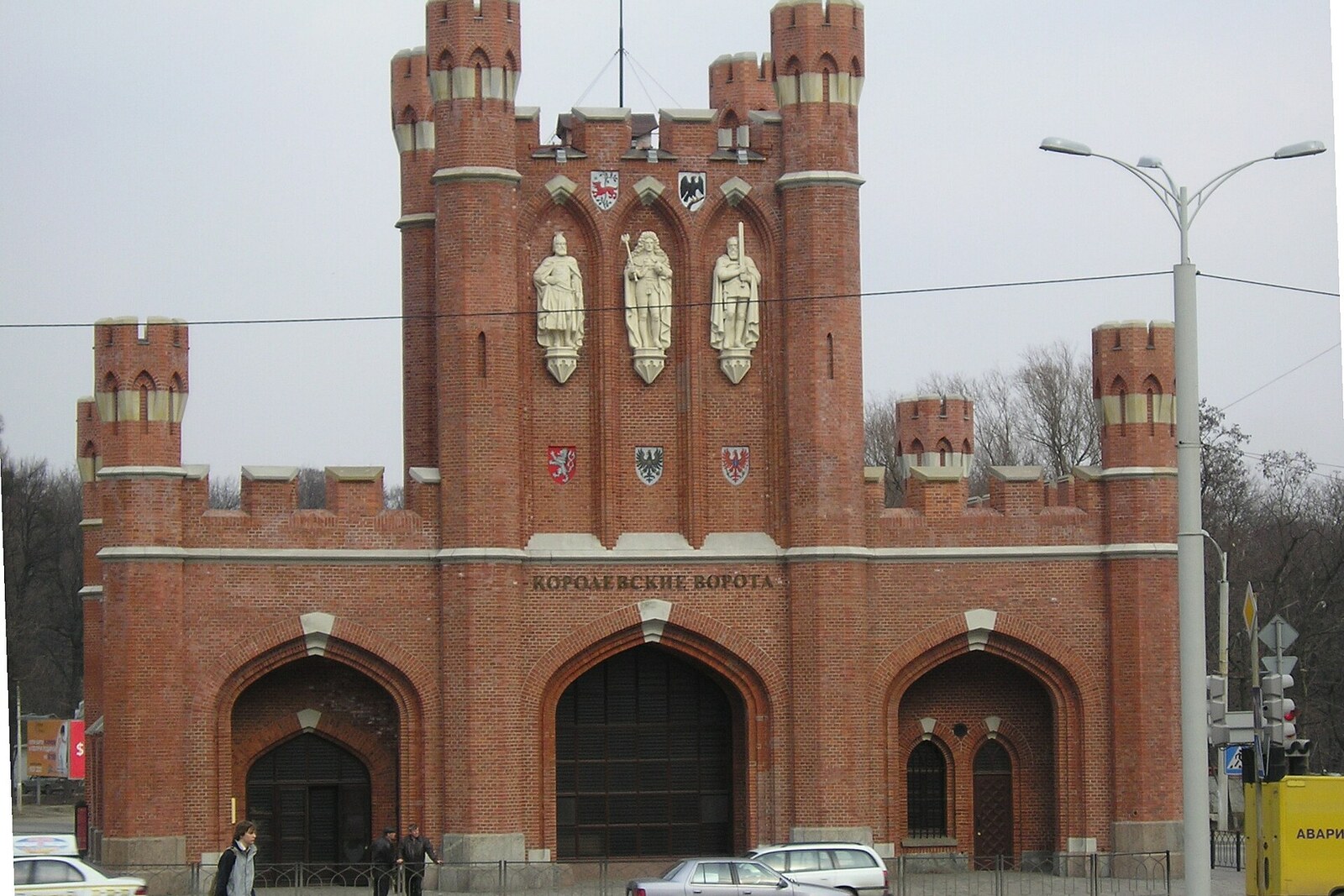
Look around first
What to notice
- Red-brick facade
- Three stone figures
- Central arch
- Side casemates
The story of the place
The current building inherited its name from an earlier gate on the same site. Along Königsstraße—now Frunze Street—Prussian monarchs rode from Königsberg Castle to military reviews in the suburb of Devau. That is how the road acquired its royal name.
On August thirtieth, eighteen forty-three, King Friedrich Wilhelm IV of Prussia personally lowered the first stone into the construction trench here. He had come to begin building a new defensive ring around Königsberg—the name Kaliningrad bore until nineteen forty-six. King's Gate became the first structure in this large project.
Carts and riders passed through the central arch, four and a half meters wide. In the side casemates, the windows and doors faced the city, while the embrasures faced outward. In front of the outer facade stood an enclosed yard: anyone who broke through from the road found themselves under the defenders' fire. Yet while the engineers were completing the ring of ramparts, long-range artillery was rapidly changing the rules of siege warfare. By the end of the nineteenth century, the fortifications were already obstructing traffic. The ramparts beside the gate were dismantled, and the solitary brick structure no longer sealed off the city.
The three figures above the passage appeared by royal commission. In eighteen forty-seven, the Berlin sculptor Wilhelm Stürmer wrote that he had been commissioned to make stone statues about two and a half meters tall, but lacked information about the heroes' clothing and weapons for the sake of “historical truth.” Each of them was meant to explain the origins of Prussia and of Königsberg itself.
On the left stands the Czech king Přemysl Otakar II, who came to Sambia together with the Teutonic Order during the crusade of twelve fifty-five. After that campaign, the knights founded a fortress and named it Königsberg—“King's Mountain”—in Otakar's honor. On the right is Albrecht, the last grand master of the Order, who tried to preserve his lands after a lost war. In fifteen twenty-five, he dissolved the Order's state, swore an oath to the Polish king, and received Prussia as a hereditary duchy. In the center is Friedrich I, Elector of Brandenburg, who sought a royal title. In 1701, he crowned himself in Königsberg and became the first King in Prussia.
Stürmer carved the rulers from sandstone, which proved too porous for an exposed facade. After the war, the figures were left without heads and hands, and moisture continued to split the stone into layers. Attempts to hold it together with cement produced no result. By the early two thousands, a significant part of the original work had been lost.
In nineteen forty-seven, Stürmer complained about the lack of historical examples; a century and a half later, Vyacheslav Mozgovoy, the lead restorer of the State Hermitage Museum, faced the same difficulty. He was assigned to preserve the surviving sandstone and restore the missing parts for the city's anniversary. The author's models and drawings had disappeared, so the team worked from small prewar photographs. While chemists selected a compound capable of strengthening the stone, sculptors modeled the faces, hands, swords, and symbols of royal dignity anew.
A month before the work was completed, clearer photographs were found in a Polish archive. They showed that one ruler's beard had been twice as long and that his sword had a different shape. The nearly finished heads had to be remade. On June sixth, two thousand five, the corrected figures were lifted into the niches, while the first three heads remained as spares.
The passage is now closed, and the former casemates are occupied by a branch of the Museum of the World Ocean. Parts of the old sandstone remain above the entrance, while the faces of the three rulers belong to the restorers' second attempt to read Stürmer's photographs.
Useful on site
Wed 11:00–19:00; Thu 12:00–20:00; Fri–Sun 11:00–19:00; Mon–Tue closed.
Checked: September 24, 2026. Check the official source before visiting.The main story can be read from outside. For an unhurried look, step away from the roadways so that the entire facade fits within your field of view; you can add the museum inside separately.