 Guide On Map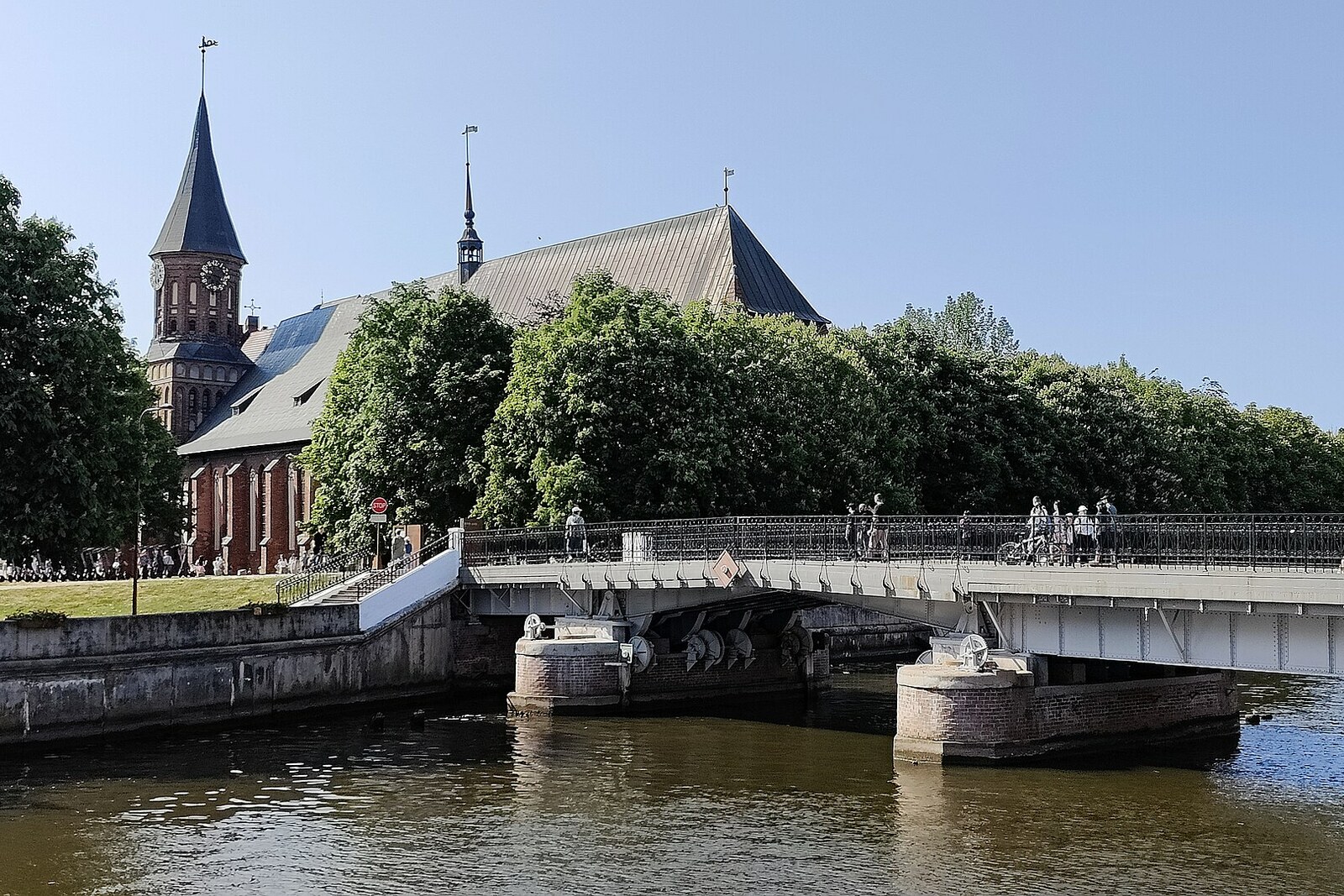
Look around first
What to notice
- Brick cathedral walls
- Open colonnade
- Granite cenotaph
- Northeastern corner of the building
The story of the place
By the north wall of Königsberg Cathedral, a university cemetery stood from the end of the sixteenth century: professors of the Albertina and their family members were buried here. The cathedral’s brick structure now stands beside an open colonnade and a granite memorial placed outdoors. Inside are a museum and a concert hall, while regular services are scarcely held in the main space.
The stone coffin beneath the open colonnade is empty. It is a cenotaph—a tomb without a body. Immanuel Kant’s remains lie deeper down, in the ground by the cathedral’s northeastern corner. They had to be identified after the grave yielded the bones of two men.
Kant was a professor of logic and metaphysics, the author of Critique of Pure Reason, and twice rector of the University of Königsberg (Albertina). The university stood next to the cathedral, and professors and their family members had been buried by the north wall since the end of the sixteenth century. That is why, on February twenty-eighth, 1804, students carried Kant’s coffin here. He became the last professor buried in this vault.
At first, there was no separate gravestone. Five years later, the philosopher’s friend Johann Georg Scheffner, who had sought a marked grave for him, paid to convert the old vault into a covered gallery. The coffin was moved to its eastern end, and a stone bearing Kant’s name was placed above it. The gallery was called Stoa Kantiana.
By the eighteen seventies, the structure had fallen into disrepair. A city committee decided to replace it with a chapel, but first the remains had to be found. In June eighteen eighty, the ground was opened. The wooden coffins had rotted away. Beside a metal plaque inscribed “The mortal remains of the immortal Kant” lay the bones of one man; lower down, a second male skeleton was found. The professor of theology Johann Ernst Schulz had once been buried nearby, and one inscription was no longer enough to determine whom they had found.
The examination was overseen by Karl Wilhelm von Kupffer, Albertina’s professor of anatomy. Fritz Bessel-Hagen, then still a candidate of medicine, worked with him: he was to document the excavation and substantiate the conclusion under whose name the bones would be reburied. A mistake would have turned the new chapel into the grave of an unknown professor.
Immediately after Kant’s death, an exact plaster cast was taken from his head. Kupffer and Bessel-Hagen compared it with both recovered skulls. The measurements and asymmetry matched. There was also one very particular sign: a single tooth remained in the lower jaw of the second skull—a protruding right canine. On the death mask, it corresponded to a raised lip. The committee recognized the second skeleton as Kant’s remains. Bessel-Hagen published a report on the excavation, and Kupffer prepared a separate anatomical study with him.
On November twenty-first, eighteen eighty, the bones were placed in a double zinc coffin and reburied here. A chapel was built over the grave. For Kant’s bicentenary, the architect Friedrich Lahrs was commissioned to replace it with a new memorial. In nineteen twenty-four, the present colonnade with its granite cenotaph appeared; Lahrs left the burial itself underground.
Today, the cathedral houses a concert hall and a museum, while regular services are generally not held in the main space. The museum exhibition contains a copy of Kant’s death mask. Outside, beneath the colonnade, lies an empty stone coffin, and deeper down are the remains that Königsberg anatomists identified by skull measurements and one protruding canine.
Useful on site
Cathedral and museum daily 10:00–19:00; concerts follow a separate schedule.
Checked: September 24, 2026. Check the official source before visiting.You can view the grave and the cathedral’s architecture from outside. Plan the museum, an organ concert, and other programs as a separate visit, and check their terms in advance.