 Guide On Map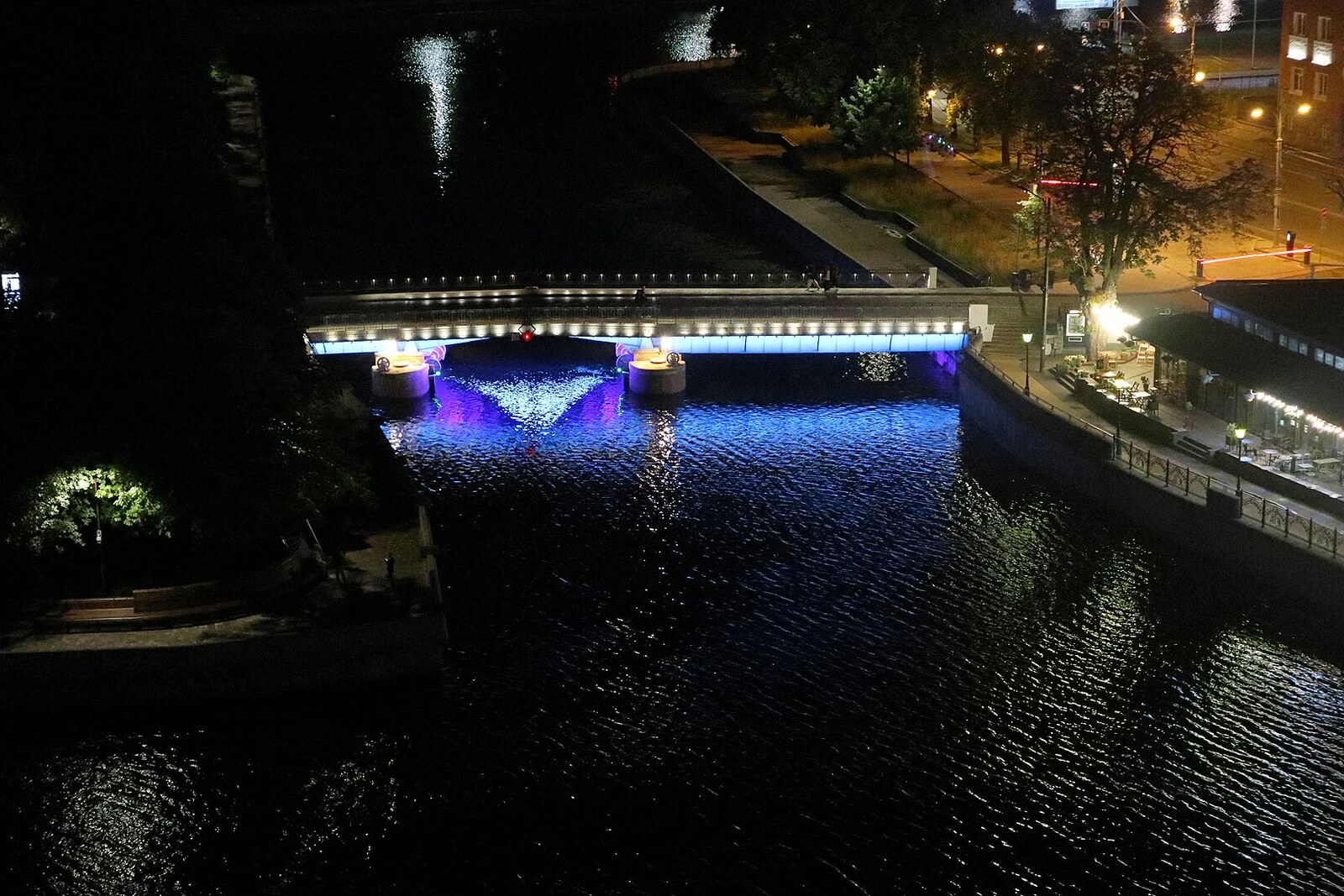
Look around first
What to notice
- The bridge's metal spans
- A branch of the Pregolya
- The facades of Fish Village
- The tower on the opposite bank
The story of the place
A permanent crossing over a branch of the Pregolya links the former island towns of Kneiphof and Lomse, today’s Oktyabrsky Island. Above the water stand the metal spans of Honey Bridge, installed in the late nineteenth century along the line of the old crossing. Nearby, on the site of former rowing clubs, hotels, restaurants, offices, and residential buildings now operate.
In the winter of fifteen forty-two, Duke Albrecht was seeking the towns' and landowners' consent for a new permanent levy on trade and consumption. Representatives of the estates resisted, and the duke needed the support of at least Kneiphof. At that time, it was an independent town with its own council.
Hans von Besenrode, a confidant of the duke and a senior palace official, was tasked with persuading the councilors to agree. According to city legend, Besenrode offered the people of Kneiphof permission to set up market stalls near the cathedral and sent several barrels of honey. The council stopped objecting to the levy, and Kneiphof residents received the right to build a bridge to the neighboring island of Lomse—today's Oktyabrsky Island. The builders hurried to complete the crossing before their rivals could stop them.
The new route made it possible to transport people and goods without going over High Bridge, which belonged to Altstadt—the neighboring town around the castle. Altstadt merchants lived off the traffic through their streets and crossing. Now some customers and cargo bypassed them, while they would still have to pay the new levy. In response, the people of Altstadt called the people of Kneiphof “honey lickers,” and the bridge they built, Honey Bridge. Over time, people stopped hearing the insult, but the name remained.
The deal involving the barrels cannot be confirmed: it is a legend, not bribery established by documents. There was another version—that the name came from the German word for “mockery.” However, a sixteenth-century chronicle already knew this crossing specifically as Honey Bridge.
The name on the opposite bank appeared much later. The authors of the architectural concept, Oleg Vasyutin, Alexander Bashin, and Alexander Popadin, designed a tourist quarter here on the site of former rowing clubs. According to the city administration, the plot allocated to the developer resembled a fish in outline—hence Fish Village. The first buildings were erected in two thousand six. The historical, ethnographic, and craft complex ultimately came to house hotels, restaurants, offices, and homes; there is no old fishing settlement among these facades.
The current metal structure of Honey Bridge was installed between eighteen seventy-nine and eighteen eighty-two. It still crosses the same branch of the Pregolya between the former Kneiphof and Lomse, over a direct crossing between which townspeople had argued as early as the sixteenth century.
Useful on site
Choose a spot from which both the bridge and the new quarter are visible, without blocking pedestrian traffic. An exterior view is sufficient for this stop.