 Guide On Map
Commercial Istanbul: Port, Markets, and Sultan's Endowments
From Galata Bridge through Eminönü and Tahtakale to Nuruosmaniye Mosque
Guide On Map on your phone
Open the walk like a regular app
It takes about 10 seconds to install. No app store needed.
The whole path
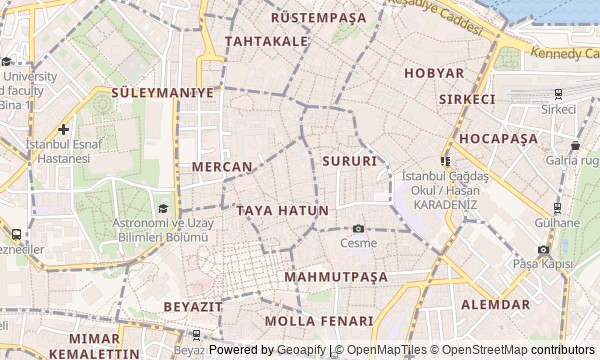
Route map
About the walk
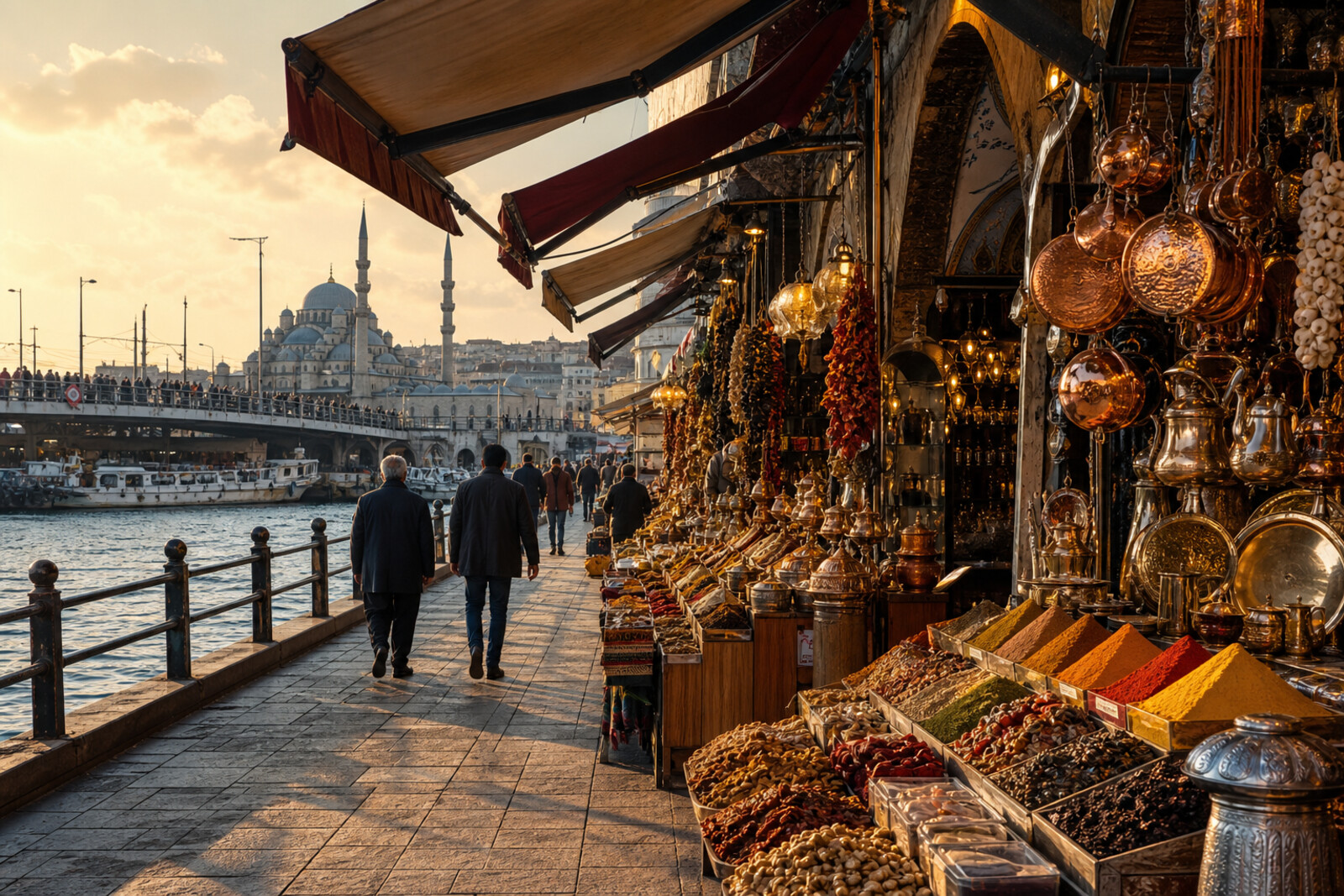
You will walk uphill from the water, along the old commercial road between the piers of the Golden Horn and the covered market on the hill. At first there will be trams, fishermen, and Eminönü Square around you; then the road will narrow between vaulted rows, warehouses, stairs, and shops; at the end, it will pass beneath the domes of Grand Bazaar and emerge at Nuruosmaniye Mosque.
This walk is not about shopping, nor is it a list of mosques. You will see how port goods became urban revenue, and how rental income supported prayer halls, kitchens, schools, and libraries. Questions will remain along the way: why did a gunman disappear in the middle of a guarded bridge, why was money spread beneath mats, and whose name did people try to erase from donated books?
The story will rest on documents, small calculations, and human decisions, without a gilded sultan's voice. After the walk, you will be able to read this slope as an old financial diagram of Istanbul: from unloading goods to the dome paid for by shops.
Why this order
Galata Bridge sets the route's starting line: it links port-side Galata with the markets of Eminönü. New Mosque continues that line along the waterfront and shows why a sultan's complex needed a site by the customs house and the piers. Spice Bazaar follows as the commercial part of the same complex, supporting it with income from its shops. Beyond the bazaar, the stairs of Rüstem Pasha Mosque separate trade and prayer across 2 levels of one building. Descending from its platform brings you back to Uzunçarşı and Tahtakale—to the road along which goods were carried up from the warehouses to the market. Higher up, Mahmutpaşa shows how an entire slope was turned into revenue-producing rows. Those rows lead to the protected core of trade: the Old Bedesten of Grand Bazaar. Through the eastern gate, the route reaches Nuruosmaniye Mosque, where shops, library, and mosque come together once more in a single endowment, completing the journey from port goods to a sultan's complex.
Those who want to understand how an Ottoman commercial city worked Those interested in markets as more than places to shop Those who enjoy documentary stories with human details Those ready for a gradual climb through crowded neighborhoods
Those looking for a walk focused only on grand monuments Those who dislike narrow, noisy commercial streets Those who need a route without visits to active mosques
Before you go
Choose sturdy footwear: the route includes bridge decking, stone commercial streets, steps, and a noticeable climb. Check current access to mosques and bazaars before setting out. Active mosques require modest clothing; shoes come off before entering the prayer hall, and visits may be restricted during services. In crowds, keep your bag in front of you and do not block the way, especially near stairs, gates, and unloading points. If you want time to look closely at details, allow separate pauses beyond shopping and bargaining.
When to go
Set aside most of the first half of the day, or a quiet stretch after noon, for the route. What usually takes the most time is not the distance but the dense flow of people, mosque entrances, finding the stairs to Rüstem Pasha Mosque, and the forks inside Grand Bazaar. Long shopping stops can easily turn the walk into a half-day program.
Backup plan
If you cannot enter a mosque, do not skip the stop: look at the courtyard, entrances, lower commercial spaces, and the building's position in relation to the market. If Grand Bazaar is closed, continue along the outer commercial streets to Nuruosmaniye Mosque—the essential connection between the port, shops, and religious complexes is still visible from outside. In rain, you can shorten the loop through the open streets, but the stairs and stone will still be slippery; it is safer to slow down than to try to keep your usual pace.
Route conditions
Surface. Paved — 1.7 km (data covers 56% of the route)
Stairs. Flights: 3, 35 m in total
Access. Wheelchair — no; stroller — limited (stairs)
Facilities. Toilets — 11; drinking water — 6
Elevation. Ascent — 75 m; descent — 19 m
OpenStreetMap extract of June 18, 2026: database data, not a check on the ground. Data © OpenStreetMap contributors, ODbL licence
Walk plan
Open in maps ↗- 1
Galata Bridge
Here you will see why the short crossing over the Golden Horn was at once a transport corridor and a political stage. - 2
New Mosque
This stop links an unfinished sultanic construction project with the commercial rows intended to support it. - 3
Spice Bazaar
Here, the range of goods sold is a trace of an old division between pharmacists and sellers of medicinal raw materials. - 4
Rüstem Pasha Mosque
This stop will show how a will became a building where income from below was meant to pay for the prayer hall above. - 5
Uzunçarşı and Tahtakale
Here it will become clear why a new beverage turned from the commodity of two shops into a distinct urban trade. - 6
Mahmutpaşa
This stop explains how rent from hundreds of shops covered the ongoing expenses of a large charitable complex. - 7
Grand Bazaar
In the market's protected core, an investigation will unfold that temporarily halted trade and deprived merchants of access to their own valuables. - 8
Nuruosmaniye Mosque
The final stop will show how, after the founder’s death, the complex received a new name while traces of the original gift remained inside the library.
Route features
Everything you need stays in the browser
Progress, saves and your trip plan are stored on this device.
Add Guide On Map to your home screen so the walk opens outside the browser.
How we handle sources, maps and corrections: our editorial standards