 Guide On Map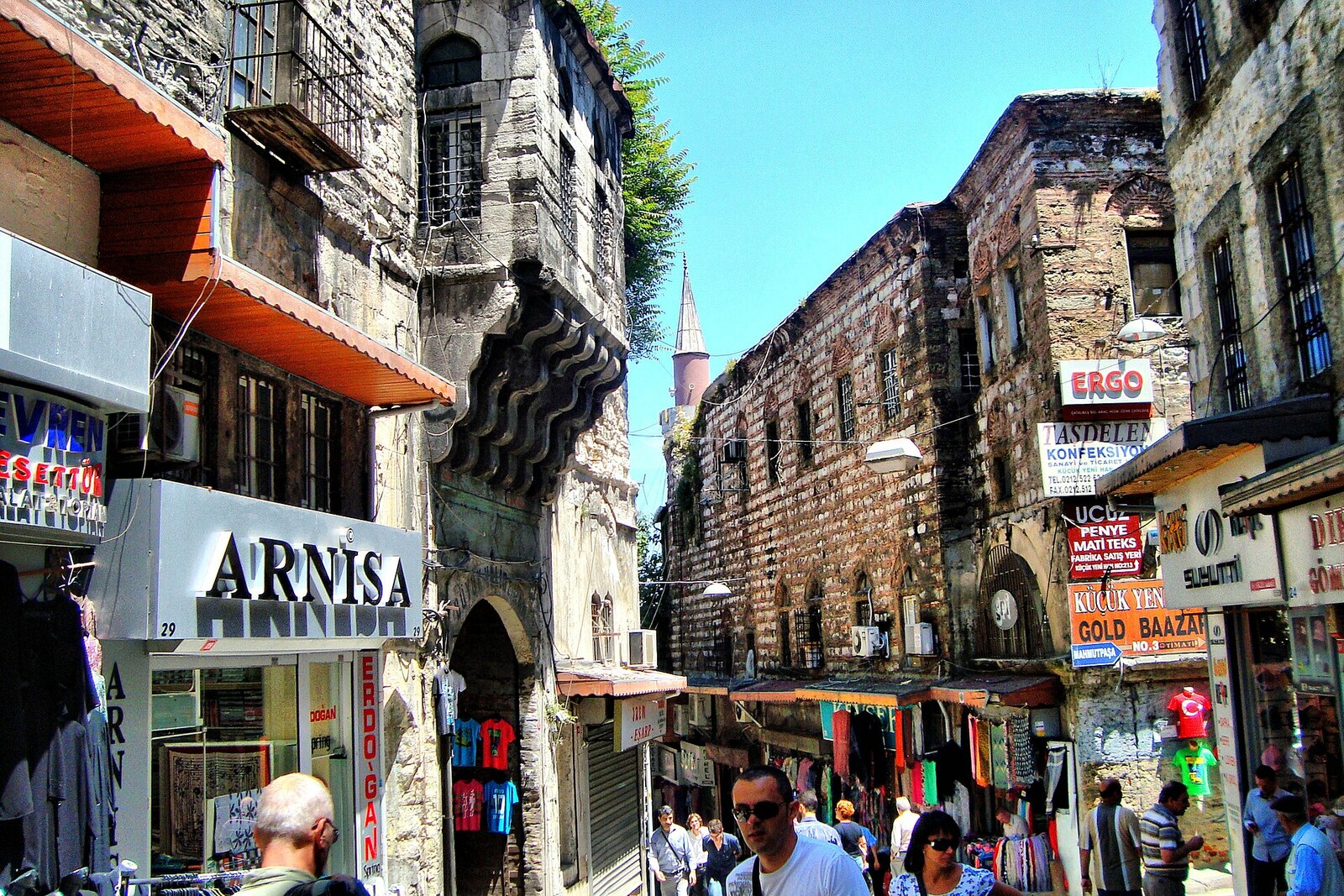
Look around first
What to notice
- Uzunçarşı
- Wholesale shops
- Entrances to commercial hans
- Tahmis Street sign
The story of the place
Uzunçarşı, the Long Market, runs from the quays of the Golden Horn to the covered market on the hill. Even before the Ottoman conquest, this ascent linked port warehouses with trade above: cargo was unloaded, kept in hans, and carried farther through the city. That is why box-size wholesale transactions and small retail still stand side by side here. The name Tahtakale itself is linked either to a wall by the port or to the sultan's Old Palace on the hill.
In the mid-sixteenth century, two newcomers staked their livelihoods here on a new commodity. Hakem, a merchant from Aleppo, and Shams, a merchant from Damascus, arrived in Istanbul to sell coffee. Around fifteen fifty-four, each opened a large shop in Tahtakale. The Ottoman chronicler İbrahim Peçevi calls their establishments Istanbul's first coffeehouses.
By then, coffee was already drunk at court and in dervish lodges. Hakem and Shams offered something different: a place one could enter without an invitation from the owner of a house, pay one or two akçe—small silver coins—and remain to talk. Visitors read books, brought new poems, played chess and backgammon. Peçevi noted a thoroughly everyday reason for their success: previously, to meet, people had to provide refreshments at home, whereas now a group could gather for the price of several cups.
They chose the location shrewdly. From the piers of the Golden Horn to the covered market for expensive goods—the bedesten—rose Uzunçarşı, the “Long Market.” This route had existed even before the Ottoman conquest and linked the port warehouses with trade on the hill. Goods were transferred here, stored in hans, and carried farther toward the future Grand Bazaar. Hence the present-day proximity of wholesale and retail shops: a box of goods can be sold to one merchant, while its contents can be sold to many passersby.
Tahtakale is usually translated as “under the fortress.” Historians dispute exactly what gave the district its name: a wall near the port or its position below the sultan's Old Palace on the hill. What mattered more to Hakem and Shams was something else: goods brought from afar and people ready to try them met here—merchants, sailors, porters, craftsmen, officials, and scholars.
The venture brought both men great wealth; after that, their personal fates are lost in the sources. Yet the result of their calculation is well documented. Coffeehouses quickly began opening in other districts, and Istanbul residents needed so many beans that in the fifteen nineties administrators established tahmishanes precisely in Tahtakale—workshops where raw coffee was roasted and ground for sale throughout the city. Later, two such workshops were already operating here; in the eighteenth and nineteenth centuries, about five hundred fifty to six hundred fifty tons of coffee passed through them each year.
Peçevi did not record the addresses of Hakem's and Shams's shops, so no present-day façade can confidently be called the first coffeehouse. Another clue remains: Tahmis Street is still nearby, named for the roasting and grinding of coffee. The exact shops of the two merchants can no longer be found here, but the street name preserves the production that grew from their venture.
Useful on site
The street district is accessible at all times; individual shops and hans are usually more active during working hours from Monday through Saturday, but each courtyard and shop has its own exact schedule.
Checked: July 1, 2026. Check the official source before visiting.This is a working district: do not stand in passageways, watch for carts, and enter courtyards only when access is open.