 Guide On Map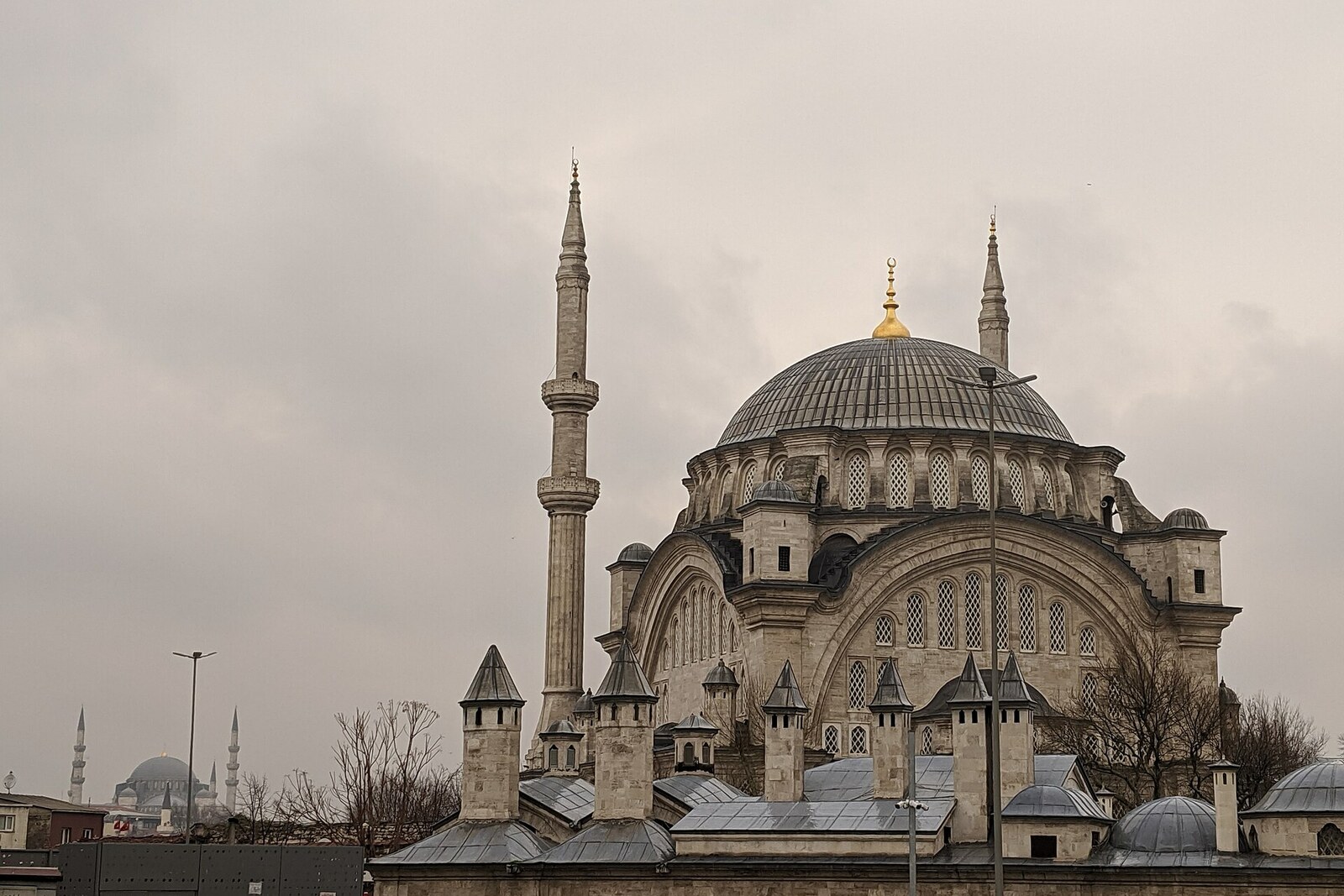
Look around first
What to notice
- Main dome
- Tall portico
- Archway of the passage to the bazaar
- Library building
The story of the place
The tall portico leads to a mosque with one of the city’s most important manuscript libraries still preserved beside it. Its collection was considered the largest in Istanbul at the time, and the rules for its librarians were taken from two sultanic libraries that had already been established. On some books, an old impression still shows through beneath pasted paper. Such traces recall that the manuscripts belonged to a charitable foundation and could not become anyone’s private inheritance.
The name on this mosque belongs not to the sultan who began it. By the eastern gate of the Grand Bazaar stands an entire charitable complex: a mosque, a manuscript library, a madrasa, a mausoleum, a fountain, and rooms from the former public kitchen. One of the courtyard passages leads directly to the bazaar. A small Fatma Hanım Mosque once stood on this site; shops and an inn were arranged around the new complex. Part of the rent went toward its upkeep. People were meant to pray, study, receive food and water in the same place where trade took place and where income for these services came from.
In January seventeen forty-nine, Sultan Mahmud I laid the foundation here for a large Friday mosque. He intended to open a library beside it and selected books for it in advance from the palace collections. His seal and a donation record were placed on the manuscripts. Such a record turned a book into the property of a vakf—a charitable foundation: it could no longer be divided among heirs or taken back.
Mahmud died in December seventeen fifty-four. The builders had little left to do, but prayers had not yet been held in the mosque and the foundation had not been formally completed. The dead sultan’s brother, the new Sultan Osman III, decided to finish the complex in his own name. A single order was not enough for this. Through the grand vizier, Osman obtained a fatwa—an opinion from the foremost authority on religious law. Its reasoning was this: since the mosque had not yet opened for prayer, it remained the sultan’s property and passed to the successor by inheritance. After that, the entire complex was registered as Osman’s vakf.
The new founder named it Nuruosmaniye Mosque—“Osman’s Light.” The word “light” is linked to a line from the Quran inscribed beneath the dome; Osman’s name referred both to the dynasty and to Osman III himself. He too was named as the founder in the construction inscription.
On December fifth, seventeen fifty-five, Osman opened the mosque and library. Dignitaries and scholars attended the ceremony, and refreshments were laid on for the guests. The library held five thousand thirty-one volumes—the largest collection in Istanbul at the time. Osman added books of his own, but did not compose rules for the librarians: in the charter, he ordered them to follow the arrangement Mahmud had already established in his libraries at Hagia Sophia and Fatih Mosque.
The name of the late brother was treated differently. On the manuscripts prepared by Mahmud, his seals were scraped away or covered with paper, and Osman’s seal was placed over them. These marks determined who was regarded as the donor of a book, so the replacement was part of the same re-registration as the fatwa, the inscription, and the mosque’s name.
The Nuruosmaniye Library still holds the collections of both brothers. Some of Mahmud’s books can be identified by an erased seal or by an old impression showing through beneath pasted paper. Outside, Osman III is named as the founder; Mahmud’s name remained inside, beneath his seal.
Useful on site
Operating mosque; non-worshippers may visit outside prayer times, but exact visitor hours and temporary restrictions should be checked on site.
Checked: July 1, 2026. Check the official source before visiting.Visit the mosque with worship services in mind; the library and other rooms of the complex may have separate access arrangements.