 Guide On Map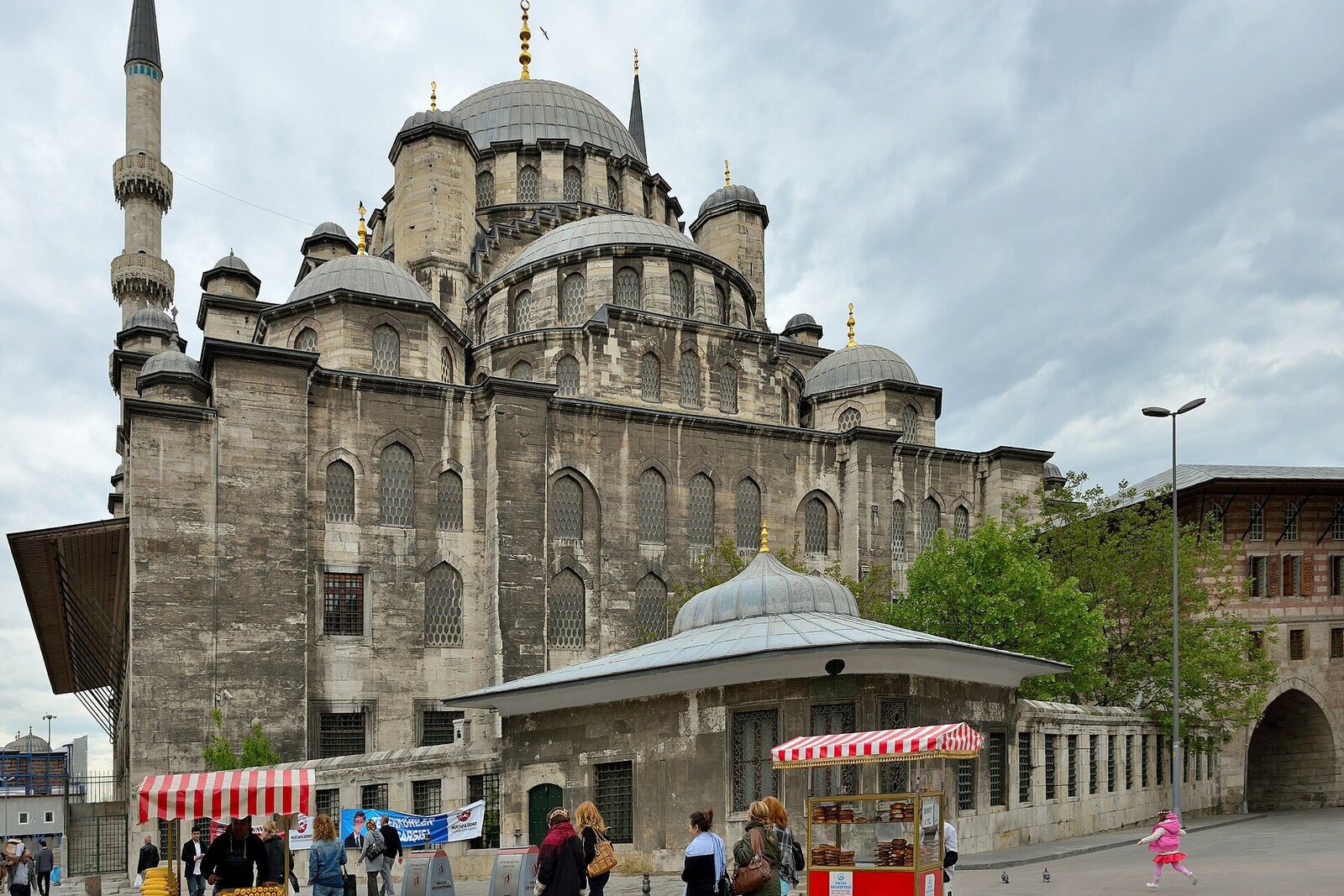
Look around first
What to notice
- Main dome
- Two minarets
- Lower courses of stone masonry
- Mausoleum on the southern side
The story of the place
The main dome and two minarets rise above the shore by the customs house and the main port. This site was a residential and commercial part of the city: a church and a synagogue stood among the houses of the Jewish and Christian communities. Around the sanctuary stands an entire complex with a school, a fountain, imperial chambers, a mausoleum, and commercial rows whose income supported the mosque and its charitable institutions. An earlier foundation survives in the lower courses of stone masonry, and the Spice Bazaar continues nearby.
In fifteen ninety-eight, Safiye Sultan ordered this site cleared for a large mosque. She was the mother of the reigning Sultan Mehmed the Third and wanted to establish a religious complex that would bear her title. The mother of a reigning sultan was called a valide sultan; her position at court depended on her son.
For the construction, Safiye chose the shore by the customs house and the main port. Jews and Christians predominated among the people who lived and traded here, and their houses, a church, and a synagogue stood on the site. By Safiye's order, the houses were expropriated with compensation at twice their value, while, in place of the two houses of worship, two other buildings, already abandoned, were to be restored for the communities. The mosque thus took the place of a commercial quarter where people and goods arrived every day.
On the damp coastal ground, the builders drove wooden piles and bound them with lead bands. The walls had risen above the first row of windows. Then, in sixteen oh three, Mehmed the Third died. Safiye was soon sent from the Sultan's Palace to the Old Palace, and funds for construction ceased to be released. She was not left without money: she continued to receive three thousand akçe—small silver coins—every day. But as the mother of the deceased sultan, she could no longer direct a major palace project. The builders left, Safiye died without ever seeing the mosque, and the lower walls stood unfinished for more than half a century.
After the great fire of sixteen sixty, Turhan Sultan—the mother of the reigning Mehmed the Fourth—inspected the burned-out quarters. She, too, intended to found her own religious complex and decided to use Safiye's abandoned walls. Stonemasons dismantled one damaged course of masonry and continued construction on the original foundation.
On October thirtieth, sixteen sixty-five, Turhan opened the mosque with Friday prayer; her son, the Sultan, was beside her. She added a school, a fountain, imperial chambers, a mausoleum, and commercial rows to the building. These rows became the Spice Bazaar: rent from the stalls was intended to support the mosque and its charitable institutions. Commerce around the building was built into its design by the patron herself.
At first, the complex was called the Valide Sultan Mosque—the Mosque of the Sultan's Mother. After another valide had completed it, the name "New Mosque of the Valide Sultan" appeared, later shortened to "New Mosque." Turhan died in sixteen eighty-three and was buried in her own mausoleum on the mosque's southern side. Safiye is buried elsewhere; what remains of her here are the foundation and lower masonry on which Turhan completed the building.
Useful on site
Active mosque; non-worshippers can usually enter outside prayer times, but fixed tourist hours should not be included without checking again on site.
Checked: July 1, 2026. Check the official source before visiting.If prayer is in progress, remain in the courtyard and continue looking around from outside; inside, observe the rules of an active mosque.