 Guide On Map
Imperial Hue: citadel, river, and market
From Phu Van Lau through the Nguyen palaces to Dong Ba Market
Guide On Map on your phone
Open the walk like a regular app
It takes about 10 seconds to install. No app store needed.
The whole path
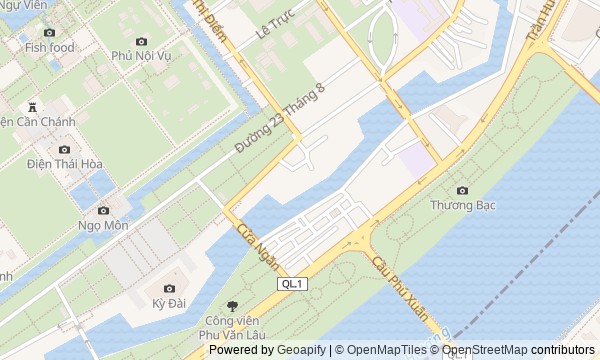
Route map
About the walk
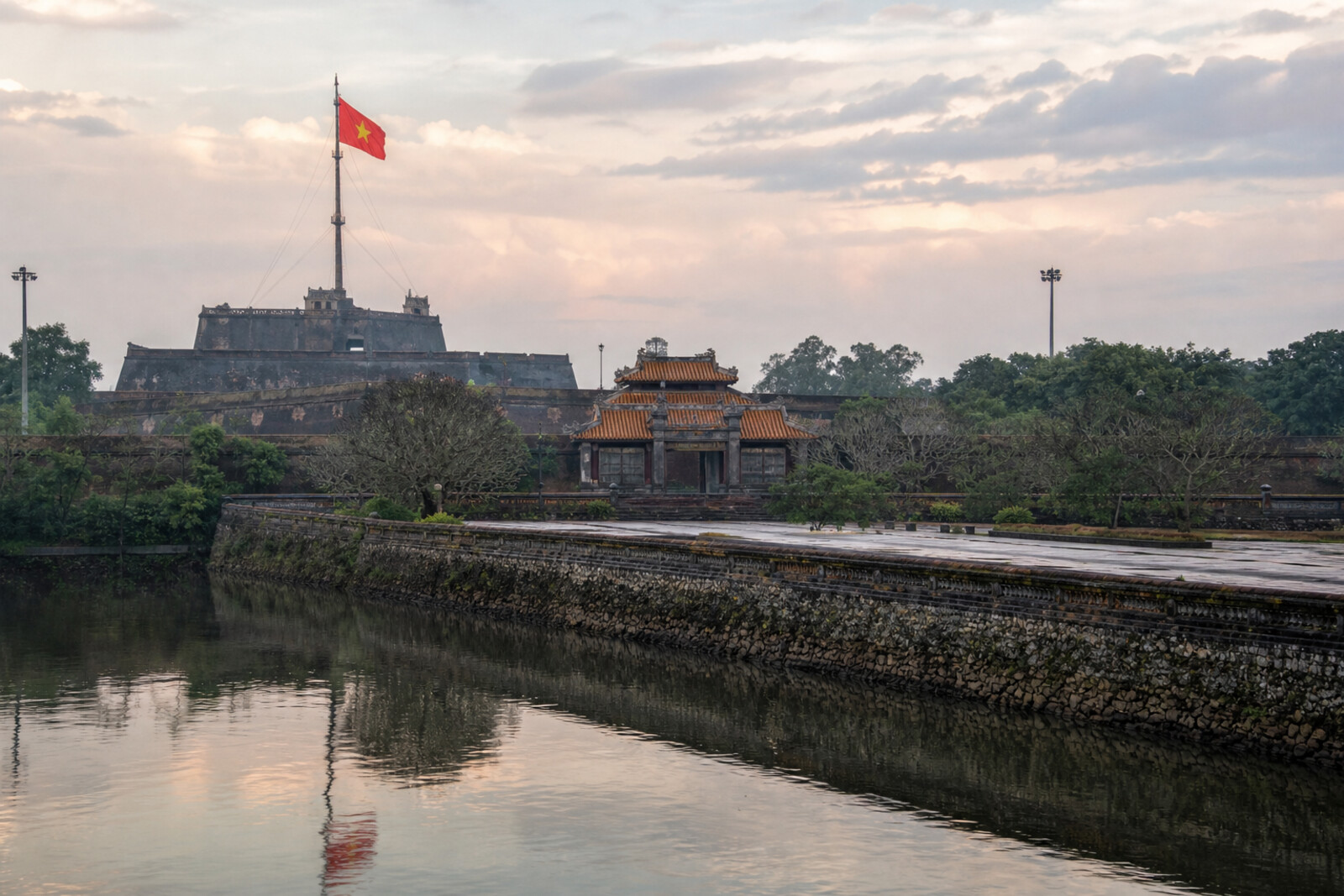
You will begin by the Perfume River, in front of light pavilions and the huge Flag Tower behind them. The route crosses the fortress wall, passes through the main gate of the citadel, and moves deeper into ceremonial courtyards, the ancestral temple, and the Forbidden Purple City. Then it heads east, toward Dong Ba Market.
At the riverside pavilion, the first question comes up: why did people travel across the country for an exam that no longer opened the way to government service? Ahead are a flag the size of a house, a sword and a seal, seven stone altars, and nine bronze vessels. One hall has to be found by its foundation.
The story follows human choices and the things left behind by them. No palace haze, no ready-made legends. By the end, you will be able to read southern Hue as a route of public power: from the place where the emperor's will was announced to the market the court once moved down to the river.
Why this order
At Phu Van Lau, a decision of the court first reached the city, while the Flag Tower on the same line enlarged that message into a flag visible from far away. That is why the pavilions lead to the Flag Tower. Beyond it, Noon Gate turned the sign of power into a controlled passage, and the Great Court of Audience carried on the same order in stone places assigned to officials. From the court, the route turns west to The Mieu Temple: after the ranks of the living, it becomes clear how monarchs were selected for posthumous veneration. The urns stand opposite the temple, expanding the dynastic order into images of the whole country. From there, the road returns to the center of the Forbidden Purple City, to Can Chanh Palace, where courtly order touched the emperor's private life. The eastern exit then leads to Dong Ba Market, ending the route where the court moved the everyday flow of goods and shoppers.
Those who want to understand how the citadel worked, not just see its palaces Those interested in the final decades of the Vietnamese monarchy Anyone drawn to stories grounded in documents, ceremonies, and visible objects
Those looking for a short overview of the main photo spots Those who do not want to spend much time inside the historical complex Those who find it difficult to hear about colonial subjugation, war, and executions
Before you go
The route includes open riverfronts, large courtyards, and stretches of stone paving, so bring water, comfortable shoes, and protection from sun or rain. Before you begin, check the current visiting arrangements for the citadel: restoration work may change access to individual passages, temple spaces, and the Can Chanh Palace area. Several key details are outdoors, so a closed interior does not always prevent you from hearing the story and understanding the place. Be restrained around the altars, follow local photography rules, and do not step past barriers for a closer angle.
When to go
The cooler part of the day is more pleasant for the river facade and spacious courtyards. At the beginning of the walk, leave time for distant views and the overall geometry of the fortifications; move more slowly around temple plaques and bronze reliefs, because their meaning lies in small distinctions. Arrive at Dong Ba Market without expecting quiet: the crowds and trading noise are an essential part of the ending.
Backup plan
If the weather makes it difficult to stay by the river for long, limit the first 2 stops to accessible exterior views and shift your attention to the sequence from Noon Gate to the urns. Cross open courtyards only on safe, non-slip surfaces, without trying to get closer to details during heavy rain. If access to Can Chanh Palace has changed, stay at the official boundary of the construction area: the foundation, stone elements, and break in the palace axis already offer enough material for the story. If the market is overcrowded or its approaches are flooded, finish the route on its outer side, preserving the river-and-city contrast of the final stop.
Route conditions
Surface. Paved — 1.9 km (data covers 45% of the route)
Stairs. Flights: 3, 85 m in total
Access. Wheelchair — no; stroller — limited (stairs)
Facilities. Toilets — 12; drinking water — 4
Elevation. Ascent — 19 m; descent — 15 m
OpenStreetMap extract of July 3, 2026: database data, not a check on the ground. Data © OpenStreetMap contributors, ODbL licence
Walk plan
Open in maps ↗- 1
Phu Van Lau and Nghinh Luong Pavilion
Here you will see how the court communicated its decisions to the city and why the old order ended in public view. - 2
Flag Tower
The flagpole will show why taking the high ground could become a message for all of Hue. - 3
Noon Gate
The main entrance belongs on the route as the place where a ceremony once revoked the privilege of the central passage. - 4
Great Court of Audience and Thai Hoa
The court will explain how a seven-year-old sovereign was placed at the head of an order controlled by adults. - 5
The Mieu Temple
This stop shows that the official list of ancestors was changed even after the monarchy had disappeared. - 6
Hien Lam Pavilion and the Nine Dynastic Urns
Here, dynastic order will extend beyond the family and become a bronze inventory of the country. - 7
Can Chanh and the Forbidden Purple City
The lost hall helps show how a bride’s personal condition became a decision for the entire court. - 8
Approach to Dong Ba Market
The final stop will explain why the main market left the fortress wall and became established by the bridge and the river.
Route features
Everything you need stays in the browser
Progress, saves and your trip plan are stored on this device.
Add Guide On Map to your home screen so the walk opens outside the browser.
How we handle sources, maps and corrections: our editorial standards