 Guide On Map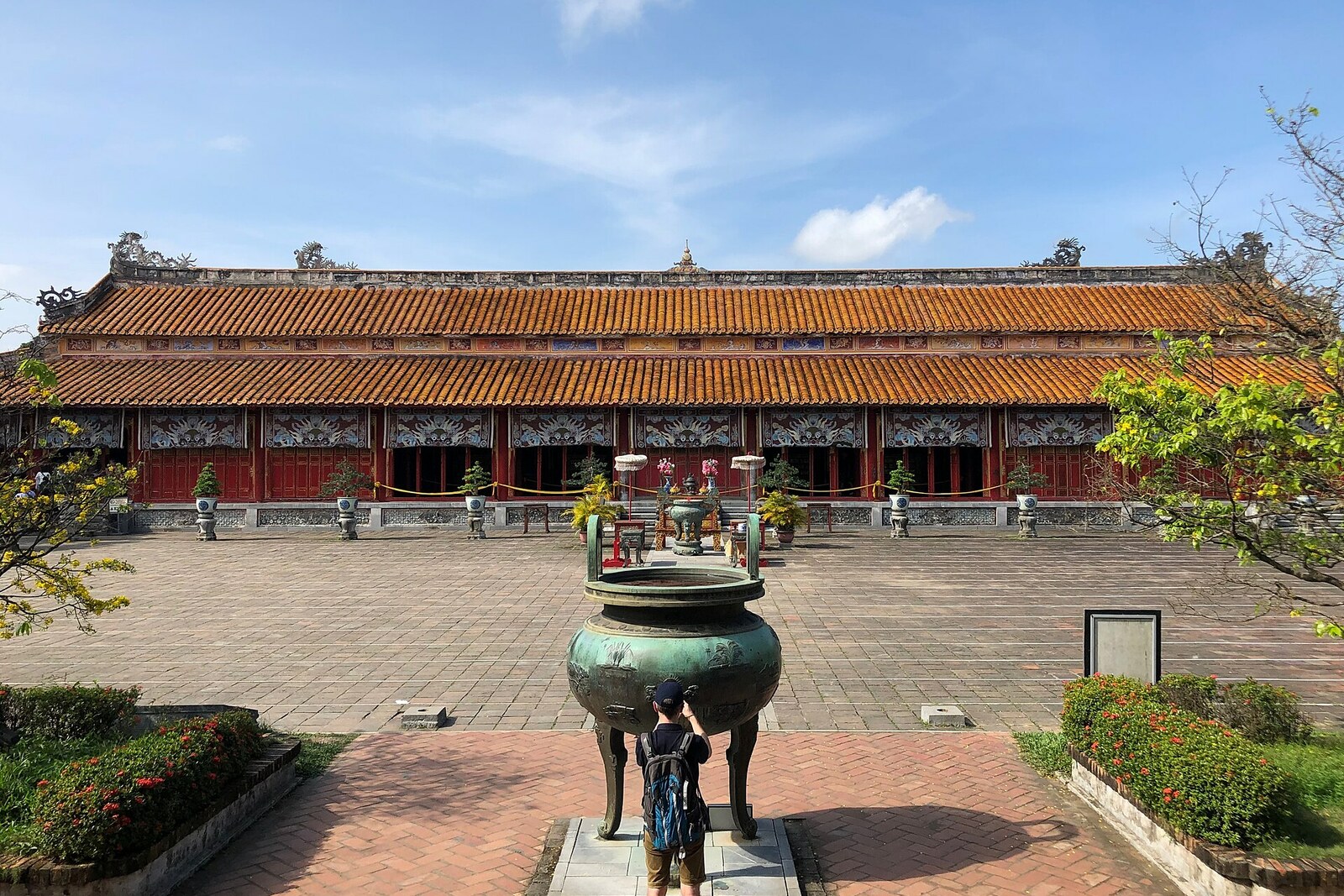
Look around first
What to notice
- The temple's long facade
- The central altar bay
- The hall's outer bays
- The enlarged side wing
The story of the place
Behind the long facade of The Mieu Temple stretches a hall divided into bays with altars for the memorial tablets of the Nguyen dynasty's sovereigns and their spouses. The sanctuary was built in eighteen twenty-one on Minh Mang's orders and dedicated to the founder of the ruling house; the central place was reserved for him and his two empresses. When later rulers died, their tablets were added to neighboring parts of the hall, and male courtiers came here for memorial rites. The outer bays and the enlarged side wing show that this temple's internal arrangement did not remain unchanged.
On January twenty-fifth, nineteen fifty-nine, the Nguyen Phuc clan council held an unusual ceremony here. Representatives of the imperial family's descendants sought places for three deceased monarchs—Ham Nghi, Thanh Thai, and Duy Tan. Their memorial tablets were brought into the hall and placed on new altars. Previously, the dynasty had not admitted these three to its own ancestor cult.
The temple's full name is The Mieu Temple. The To was the temple name of Gia Long, the founder of the Nguyen dynasty. After Gia Long's death, his son and successor Minh Mang ordered this sanctuary built in eighteen twenty-one. The tablets of Gia Long and his two empresses were placed in the central altar. As subsequent monarchs died, their tablets occupied neighboring bays. Here, male courtiers performed memorial ceremonies; women of the imperial house were sent to another sanctuary to worship the ancestors.
A place at such an altar was not granted automatically. By the end of the monarchy, thirteen Nguyen emperors had ruled Vietnam, yet The Mieu Temple contained only seven imperial altars. Duc Duc and Hiep Hoa were overthrown in eighteen eighty-three, declared deposed sovereigns, and excluded from the dynastic cult.
Ham Nghi, Thanh Thai, and Duy Tan lost their places here for a different reason. Each resisted French colonial control and lost his throne. Thirteen-year-old Ham Nghi left the captured citadel and called on his subjects to continue the struggle. Three years later, he was captured and sent to French Algeria. There, the former emperor lived on a pension assigned by the French administration; he was not allowed to return and died in exile. Thanh Thai was removed from the throne, and his son Duy Tan was exiled after an uprising was uncovered. Father and son ended up on the island of Réunion. At court, they were regarded as emperors who had left the country, and no memorial tablets were placed for them in this hall.
The monarchy ended in nineteen forty-five. Fourteen years later, the clan council decided that the resistance for which the three had been exiled should no longer deprive them of a place among the ancestors. The council did not move the old seven altars. Two outer bays were occupied for Ham Nghi and Duy Tan, while for Thanh Thai's altar, a wooden partition in the side wing was dismantled and the hall was enlarged.
Because of this, the present order matches neither the sequence of reigns nor seniority within the family. Khai Dinh's altar remained closer to the center than the altars of his uncle Ham Nghi and his older relative Thanh Thai. Duy Tan's tablet stands in the former outer bay, while the tablet of his father Thanh Thai stands beyond the place that was cleared for it in nineteen fifty-nine.
Useful on site
The courtyard is accessible with a ticket during the complex's opening hours; regular entry to the temple's interior has been suspended since 9 September 2025.
Checked: date not specified. Check the official source before visiting.Speak quietly, do not touch the altars, and follow the rules for photography and access inside the temple space.