 Guide On Map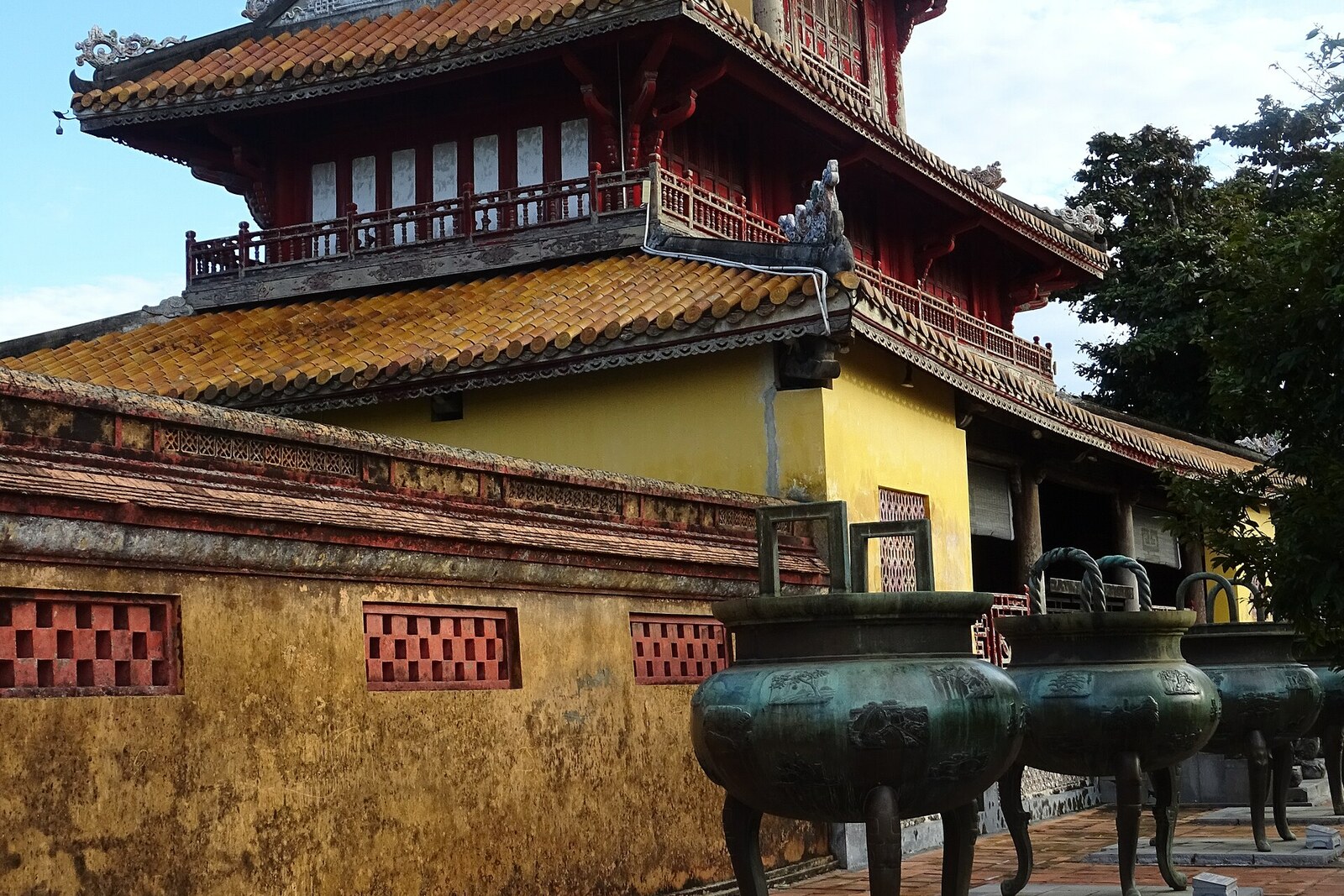
Look around first
What to notice
- Nine bronze urns
- The Cao Urn set forward
- Reliefs with names
- The three-tiered Hien Lam Pavilion
The story of the place
On March first, eighteen thirty-seven, Emperor Minh Mang entered this courtyard at the head of his courtiers. The Imperial Observatory chose an auspicious day, officials prepared a sacrifice, and nine newly completed bronze urns were set up in front of Hien Lam Pavilion.
Minh Mang was the second emperor of the Nguyen dynasty. His father Gia Long defeated his rivals in a long war, unified the country, and took the throne in eighteen oh two. The son inherited a different task: to turn the founder's victory into an order designed for descendants. When Minh Mang conceived the urns, only one deceased emperor, Gia Long, was venerated behind them in The Mieu Temple. The nine vessels represented not yet the past, but the future of the dynasty.
Minh Mang took the number itself from an ancient Chinese legend. According to it, Yu the Great ordered nine tripods cast, representing the nine regions of his country. Possessing them meant the ruler's recognized right to govern that entire expanse. Minh Mang repeated the old image but assigned it Vietnamese content. He personally gave the urns their names and chose the images through which Dai Nam as it was then was to be shown—this was the name of his state.
The finest bronze casters were assembled for the work. About twenty-two and a half tons of bronze went into the nine vessels. The craftsmen carved the designs into clay molds so that they would stand out in relief on the finished metal. The emperor required each image to be accompanied by its name: the viewer was meant to understand exactly which river, mountain, bird, or seashore lay before them. After the successful casting, Minh Mang granted the supervisors a month's salary and allocated three hundred quan—monetary units—to reward the craftsmen and workers. He attributed the success both to the casters' skill and to the help of the gods, so he instructed the Ministry of Rites to hold a thanksgiving sacrifice. The reliefs required several more months. Only then could the emperor conduct the ceremonial installation of the urns here.
The central Cao Urn was dedicated to Gia Long. It was placed about three meters in front of the others: even after death, the dynasty's founder led the ranks of his successors. The next urn, the Nhan Urn, later became associated with Minh Mang's own posthumous title. On its wall, among other images, appeared the Perfume River, flowing through Hue. In all, one hundred sixty-two images and inscriptions were cast on the nine vessels, from seas and major rivers to rice, ships, and weapons. The urns were left empty: they are ritual ding vessels, not funerary vessels.
Minh Mang built Hien Lam Pavilion earlier, in eighteen twenty-one to eighteen twenty-two. The word “hien lam” in its name refers to the glorification of merit. Emperors were venerated in The Mieu Temple, while high officials and military commanders who helped the Nguyen dynasty establish and retain itself were venerated in the side shrines near the pavilion. Minh Mang ordered that no structure within Hue Citadel should rise higher than this seventeen-meter pavilion.
Since the ceremony, the urns have not changed places, and their reliefs have not been altered or supplemented. The Cao Urn still projects three meters from the row, and the Perfume River remains on the Nhan Urn, chosen by Minh Mang for a bronze image almost two centuries ago.
Useful on site
Available with a ticket during Imperial City hours; use the ticket offices as a guide: in summer 06:30–17:30, in winter 07:00–17:00.
Checked: date not specified. Check the official source before visiting.Walk around the accessible part of the row without touching the bronze; to read the images, it is more useful to approach one urn at a time.