 Guide On Map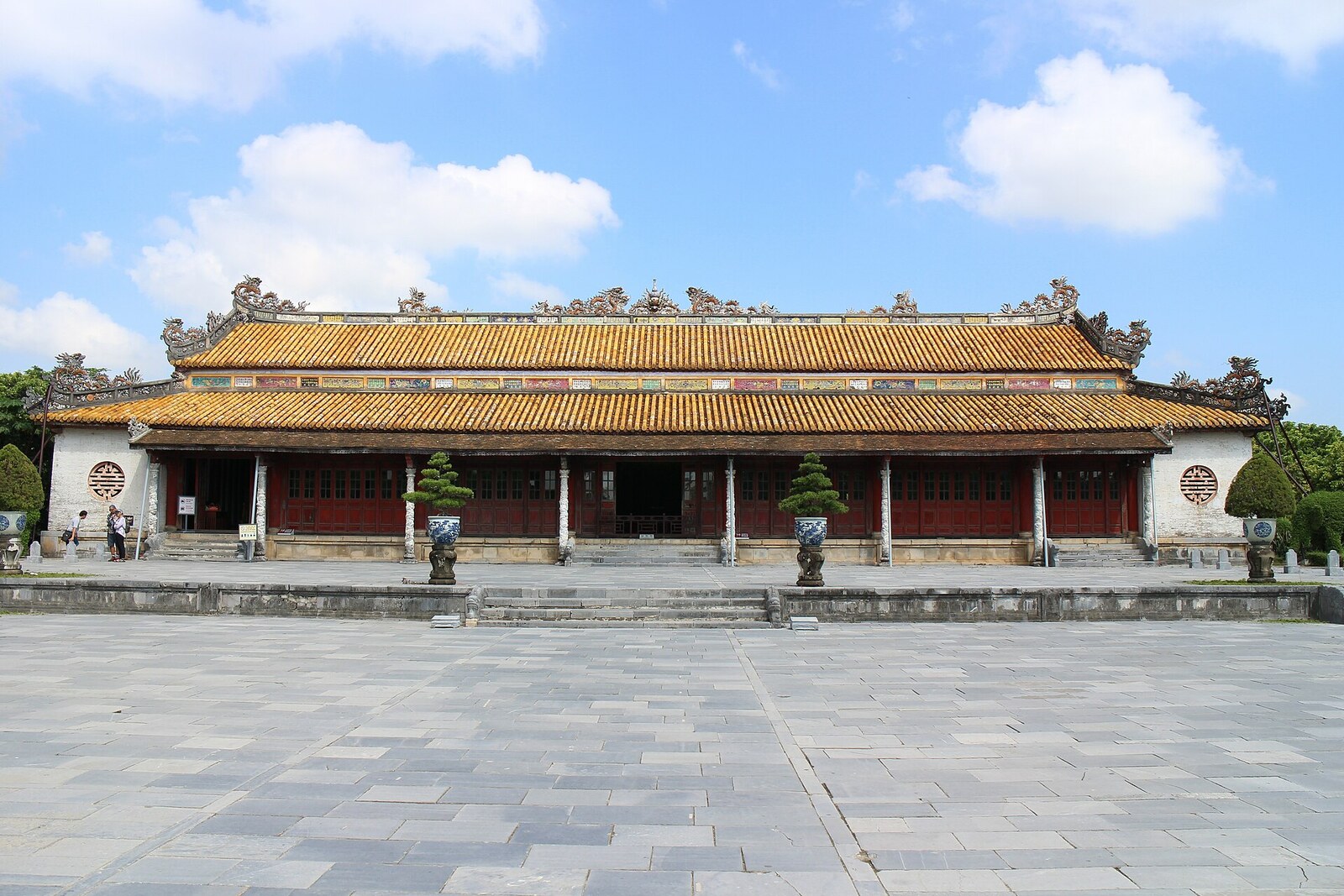
Look around first
What to notice
- Stone rank markers
- Upper and lower terraces
- Central aisle
- Imperial throne
The story of the place
Stone platforms in front of Thai Hoa still preserve the markers by which a courtier immediately knew where to stand and how close he was allowed to approach the ruler. This court hosted the ceremonies of the Nguyen dynasty: foreign envoys were received here, imperial birthdays were celebrated, and a grand audience was formed twice a lunar month. Deep inside the hall, the throne stood above everyone; princes and chief dignitaries remained near it, while officials in the court were divided by civil and military service, seniority, and the height of the terrace. The central aisle connected this entire formation with the sovereign's chair, and the stone beneath their feet turned court order into a precise arrangement.
On September fifth, nineteen oh seven, Paul Beau, governor-general of French Indochina, led the seven-year-old emperor Duy Tan to the throne at Thai Hoa. Only a few days before the ceremony, the boy was called Nguyen Phuc Vinh San. He was the fifth son of Emperor Thanh Thai and had not been expected to become the closest heir.
For more than a month, the French administration kept Thanh Thai under arrest in the palace and handed state affairs to the Council of Regency, placed under the supervision of the French resident. The former emperor was made to abdicate. A new sovereign was needed to preserve the dynasty, while regents could handle the affairs of a minor monarch. Thanh Thai's decree named Vinh San as heir. The boy was given the reign motto Duy Tan—“Renewal.”
The ceremony explains the layout of this court better than any plan. Thai Hoa means “Supreme Harmony.” Coronations were held here, foreign envoys were received, emperors' birthdays were celebrated, and grand audiences were held twice a lunar month. The sovereign sat inside on a raised platform. Only princes and the highest-ranking dignitaries were allowed near him. The other officials took their places outside: civil and military officials separately, senior ones on the upper terrace and junior ones below. Small stone markers in the court told each person his rank and exact place in the formation. At the master of ceremonies' command, the officials turned toward the hall and bowed.
At Duy Tan's coronation, this entire order served a decision made by adults without the seven-year-old sovereign's participation. In the morning, he was given the regalia and his new name was confirmed. In the afternoon, the boy thanked the French government for its support. Paul Beau announced that France recognized the new emperor and led him to the throne. The Council of Regency continued to manage affairs under the resident's control, while Thanh Thai was soon taken south under supervision.
Nine years later, it became clear that the chosen child had outgrown the role prepared for him. Tran Cao Van, organizer of an underground monarchist uprising, sought a sovereign who would support an action against the French protectorate. He planned to raise Vietnamese soldiers in Hue, recruited for dispatch to the European front of the First World War. Fifteen-year-old Duy Tan agreed to lead the uprising, risking the throne and the protected life the court provided for him.
The conspiracy was uncovered before the appointed hour. The soldiers were locked in their barracks, but Duy Tan and Tran Cao Van did not know this. On the night of May second to third, nineteen sixteen, the emperor secretly left the Forbidden Purple City. A few days later, he was captured south of Hue. The French administration stripped Duy Tan of his title and sent him to the island of Réunion in the Indian Ocean. Tran Cao Van and five of his companions were executed, and other participants were imprisoned. Duy Tan never again sat on the imperial throne.
That same dynastic throne still stands at the center of Thai Hoa. It was passed down to all thirteen Nguyen emperors. The stone markers in the court still arrange courtiers by rank, and at the end of the central aisle remains the chair to which Paul Beau once led a seven-year-old boy.
Useful on site
Use the ticket-office hours as a guide: 16 March–15 October 06:30–17:30; 16 October–15 March 07:00–17:00.
Checked: date not specified. Check the official source before visiting.Do not hurry straight to the hall: the layout is easier to read from the court if you compare the stones' positions with the central axis.