 Guide On Map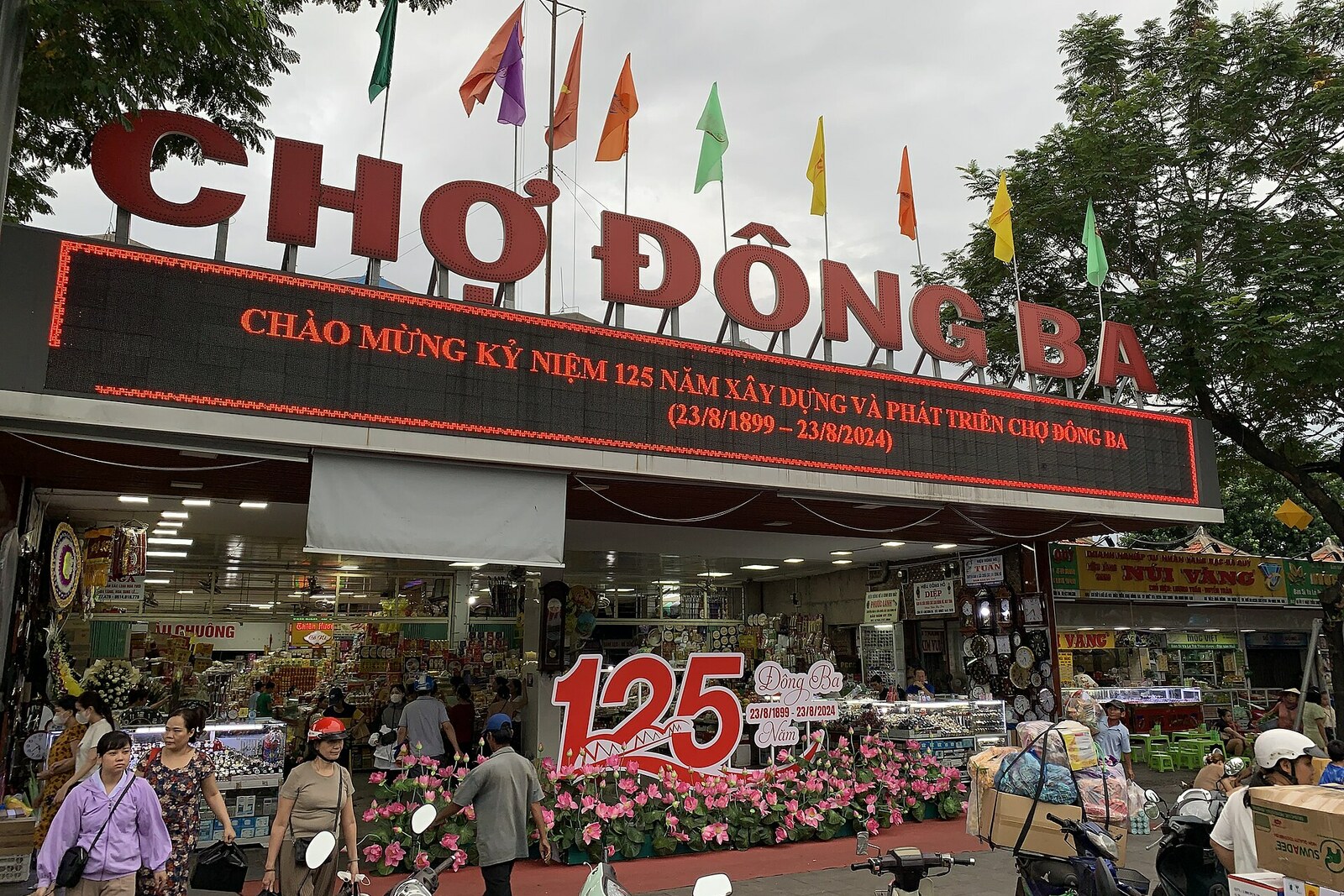
Look around first
What to notice
- Multistory building
- Main entrance
- Covered market rows
- The Perfume River by the market
The story of the place
The multistory building by the main entrance stands beside the covered market rows and the Perfume River. Here, vendors distribute food, fabrics, household goods, and craftspeople's products brought from Hue and the surrounding areas among the retail rows. The facade with several stories appeared after the major renovation of nineteen eighty-seven, while the name Dongba came from the eastern gate and street that existed before the current building.
In eighteen ninety-nine, Emperor Thanh Thai ordered Hue's main market moved from beneath the citadel's eastern gate to this vacant riverbank. He was then rebuilding the southeastern part of the capital: the iron Truong Tien Bridge was nearing completion nearby, boats arrived along the Perfume River, and the Dong Ba Canal connected this place with the trading port of Bao Vinh. The emperor brought waterways, city streets, and a crossing together at one point.
The merchants had to leave their familiar place by the fortress wall. The old market pavilion was given to a Franco-Vietnamese primary school, while forty-eight covered pavilions and a well were built here for the vendors. Hue residents made up a saying about it: Dong Ba Market was moved out to a wasteland, and Truong Tien Bridge was rebuilt in cement. Both changes were seen as a single remaking of the city.
Thanh Thai's calculation proved right. Boats were unloaded by the riverbank, roads converged at the entrance, and shoppers came across the new bridge from the southern side of the Perfume River. When large ships stopped calling at Bao Vinh, warehouses and shops there closed one after another. Trade moved closer to the bridge, and Dong Ba became Hue's main market. Its current operation grew from the same choice of location: food, fabrics, household goods, and craftspeople's products are brought here from the city and surrounding areas, and vendors distribute them among the retail rows.
The market's name is older than this riverbank. Originally, the eastern gate and the street beside it were called Dong Hoa—"Eastern Flower." Ho Thi Hoa was the first wife of the future Emperor Minh Mang. In eighteen oh seven, she bore him his eldest son and died thirteen days after giving birth. The son grew up and ascended the throne in eighteen forty-one under the name Thieu Tri. He posthumously raised his mother to the rank of empress, and courtiers prohibited the use of her personal name Hoa in place names.
An official attempt was made to rename the street and bridge Dong Gia. Residents did not accept the new name and began replacing the prohibited Hoa with the close-in-meaning word Ba, which also means flower. This is how Dongba appeared in everyday speech. The market received this local name at the eastern gate, and Thanh Thai moved it with the merchants to the river.
The multistory building in front of the entrance appeared after the major renovation of nineteen eighty-seven. Of Thanh Thai's market, what remains here is the location he chose and the name that Hue residents once preferred to a court decree.
Useful on site
The outdoor approach is open as an urban space; market sections and individual vendors operate on their own schedules.
Checked: date not specified. Check the official source before visiting.Do not block passageways or trading spaces; before taking close-up photographs of vendors, ask permission.