 Guide On Map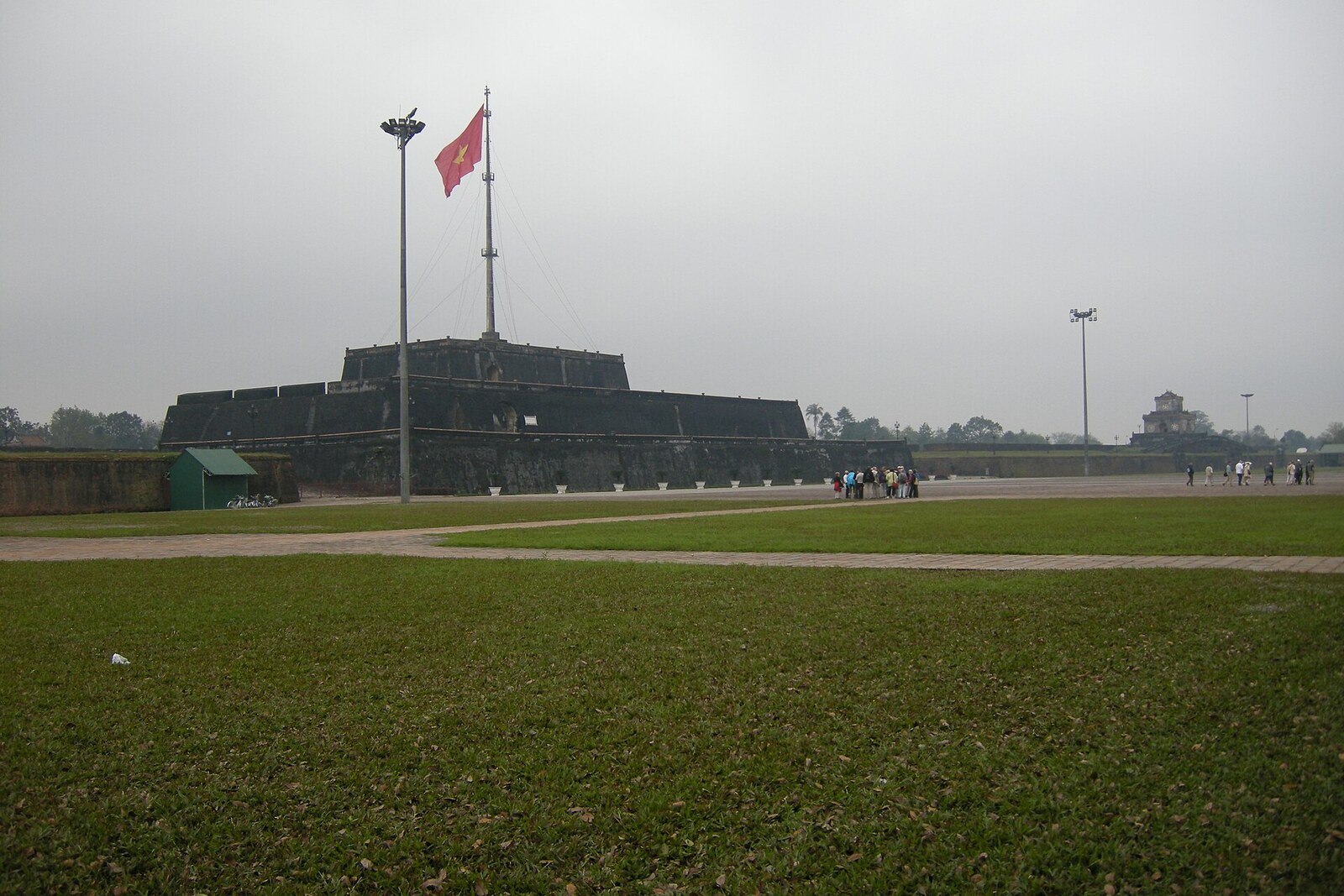
Look around first
What to notice
- Three broad tiers
- Concrete mast
- Hand winch
- Flag above the fortress wall
The story of the place
The Flag Tower rises in three broad tiers at the very center of the Citadel’s southern wall. A mast is fixed above them, visible from the river, Phu Van Lau, and the Ngo Mon palace gate. The platform was laid out under Emperor Gia Long for the city’s flag, which in the Nguyen dynasty told people of court ceremonies, the ruler’s journeys, and urgent news. The concrete mast replaced an earlier one destroyed by artillery, while the three tiers remain from the old structure.
At eight thirty on the morning of January thirty-first, nineteen sixty-eight, Nguyen Duc Thuan was raising a banner twelve meters long and eight meters wide on this mast. Thuan was a fighter in the Sixth Regiment of North Vietnamese forces. His group was assigned to take the Flag Tower and hoist the flag of the National Liberation Front of South Vietnam—an organization that fought against the government of South Vietnam and American troops.
He was about twenty-two years old. After training in Thuan’s sapper unit, he was kept on to train recruits, but in the spring of nineteen sixty-seven he was sent south. Before the offensive, his company spent a full month practicing climbing a seven-meter wall made of stacked logs, swimming, and operating on a model of Hue. The soldiers were not told which city the model depicted. On the morning before the battle, they were given an early New Year’s meal, and in the afternoon they were led to the Ke Van River.
The offensive began at two thirty in the morning on the first day of Tet. Military and administrative centers were attacked simultaneously in different cities of South Vietnam; in Hue, one target was the Imperial City. Thuan’s company crossed the river and headed for the Right Gate in the southern wall. One of his comrades was killed behind the gate. Two heavy machine guns fired from the upper platform of the Flag Tower. According to Thuan’s recollections, his group reached the second tier, caught one defender by surprise, and then forced four more to surrender. By five in the morning, three fighters controlled all three platforms and both machine guns.
The company commissar brought a folded red-and-blue flag with a yellow star in a backpack basket. One fighter covered his comrades, while Thuan and a third soldier fastened the banner to a rope as thick as a wrist and turned a hand winch. A helicopter appeared above the platform. Thuan later said that bullets chipped concrete near his feet and that the taut flag made the winch hard to turn. The banner nevertheless reached the top.
This is why the Flag Tower was built in the middle of the Citadel’s southern facade. Its name means “flag platform.” Emperor Gia Long ordered it built in eighteen oh seven: three broad tiers raised the mast above the fortress wall, directly on the line of the river, Phu Van Lau, and the Ngo Mon palace gate. Under the Nguyen dynasty, the flag informed the city of ceremonies, the emperor’s journeys, and urgent news. In nineteen sixty-eight, the same calculation turned the captured mast into a message visible far beyond the Citadel.
The red-and-blue flag remained at the top for twenty-five days. During that time, the battle for Hue moved into the streets and houses within the walls. On February twenty-fourth, the Second Battalion of the Third Regiment of the South Vietnamese First Division retook the southern part of the Citadel. The soldiers took down the National Liberation Front banner, tore it up, and raised a yellow flag with three red stripes. Thuan survived the battle; half a century later, he remained the only living member of that group of three.
The concrete mast here is only twenty years older than that battle: artillery destroyed the previous one, and the present mast was installed in nineteen forty-eight. The three tiers beneath it are the very platforms that Thuan’s group took from the bottom up. Today’s national flag has the same dimensions as the banner they raised: twelve meters by eight.
Useful on site
Open exterior viewing; visit in daylight.
Checked: date not specified. Check the official source before visiting.First, step back far enough to bring the base of the tower, the flag, and the wall into a single field of view.