 Guide On Map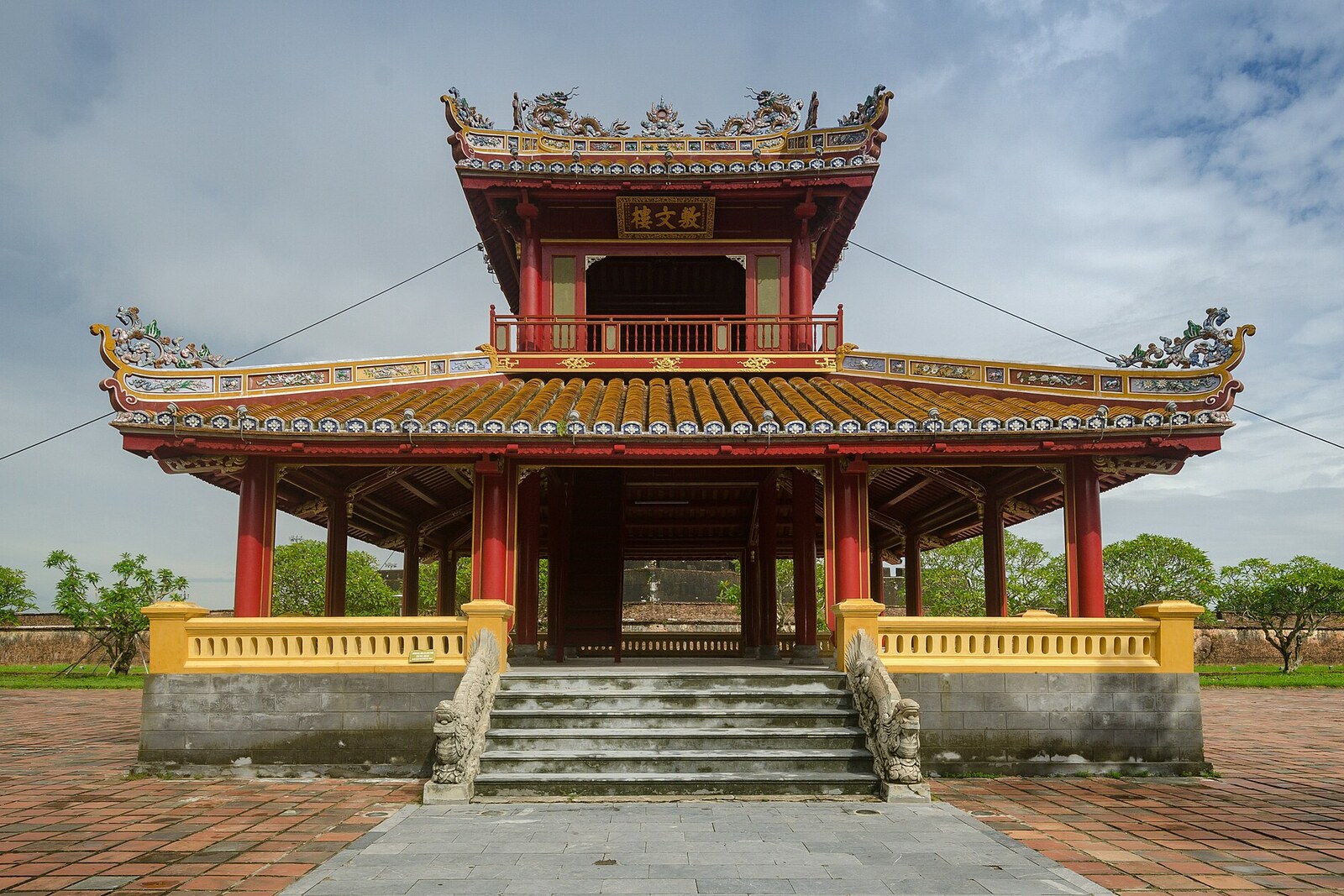
Look around first
What to notice
- The two-tiered roof of Phu Van Lau
- The open lower level
- Nghinh Luong Pavilion by the river
- The pavilion's dated crossbeam
The story of the place
Beneath the two tiers of Phu Van Lau's roof, an open space was left where court orders and lists of those receiving scholarly titles were placed in full view of townspeople. Such boards were kept here for three days, so that people had time to read the names. Nghinh Luong Pavilion stands right by the river: it was once a closed imperial landing, from which people boarded a boat after resting. Later, the pavilion was opened for festival performances and singing.
In the spring of nineteen nineteen, Emperor Khai Dinh held the last Confucian examination in Vietnam's history for future officials. He had already decided to close the old path to government service, but wanted to give one final chance to those who had spent years studying the old learning.
Applicants had to prove that they had also mastered the new age. Over four rounds, they wrote essays in Classical Chinese on the canons, the history of Vietnam, and current affairs; drafted decrees; solved geometry problems; worked with the Vietnamese Latin alphabet; and translated from French. The last requirement had a simple explanation: the country was under French colonial rule. Each participant paid for the journey to Hue, lodging, and food, and passing no longer gave an advantage in entering government service. People came for a title that still retained its former prestige, even as the profession connected with it was disappearing.
When the marking was finished, the examination board asked Khai Dinh to pass three more papers that had fallen just short of the required score. The emperor found that two equally strong papers lay alongside them and ordered all five accepted: otherwise, the decision would have been arbitrary. In all, twenty-three people received titles. Nguyen Phong Giai was placed first; seven participants became tien shi, holders of the highest scholarly degree, and sixteen were added to the supplementary list.
Their names were intended for Phu Van Lau. The name means “tower for displaying documents”: its lower level was left open so that imperial decrees and palace examination results could be posted there. A gilded board bearing the names was ceremonially brought from the palace under guard and left for three days, after which it was taken to the state academy. The winners' names were then carved on stone stelae. In nineteen nineteen, the board was brought out here for the last time: Khai Dinh announced that there would be no next examination.
Between Phu Van Lau and the river stands Nghinh Luong Pavilion—“the pavilion that welcomes coolness.” Its predecessor belonged to a closed river residence: here the emperor rested and boarded a boat. The first light pavilions were assembled at the beginning of the year and dismantled in autumn. In nineteen eighteen, the Ministry of Public Works completed another reconstruction and proposed a new purpose to Khai Dinh: during major festivals, performances and singing would be held here for townspeople. The emperor agreed. A private royal landing became a stage opened to the public on special days.
The crossbeam of Nghinh Luong Pavilion facing the river preserves the date of that reconstruction: an auspicious day in the second lunar month of the third year of Khai Dinh's reign. The gilded board from neighboring Phu Van Lau is not here: it remained in front of the pavilion for the required three days, while the stone preserved the names of the last group at the academy.
Useful on site
Open urban space; visit in daylight.
Checked: date not specified. Check the official source before visiting.View the pavilions from accessible paths, and do not cross barriers for the stelae or a view of the water.