 Guide On Map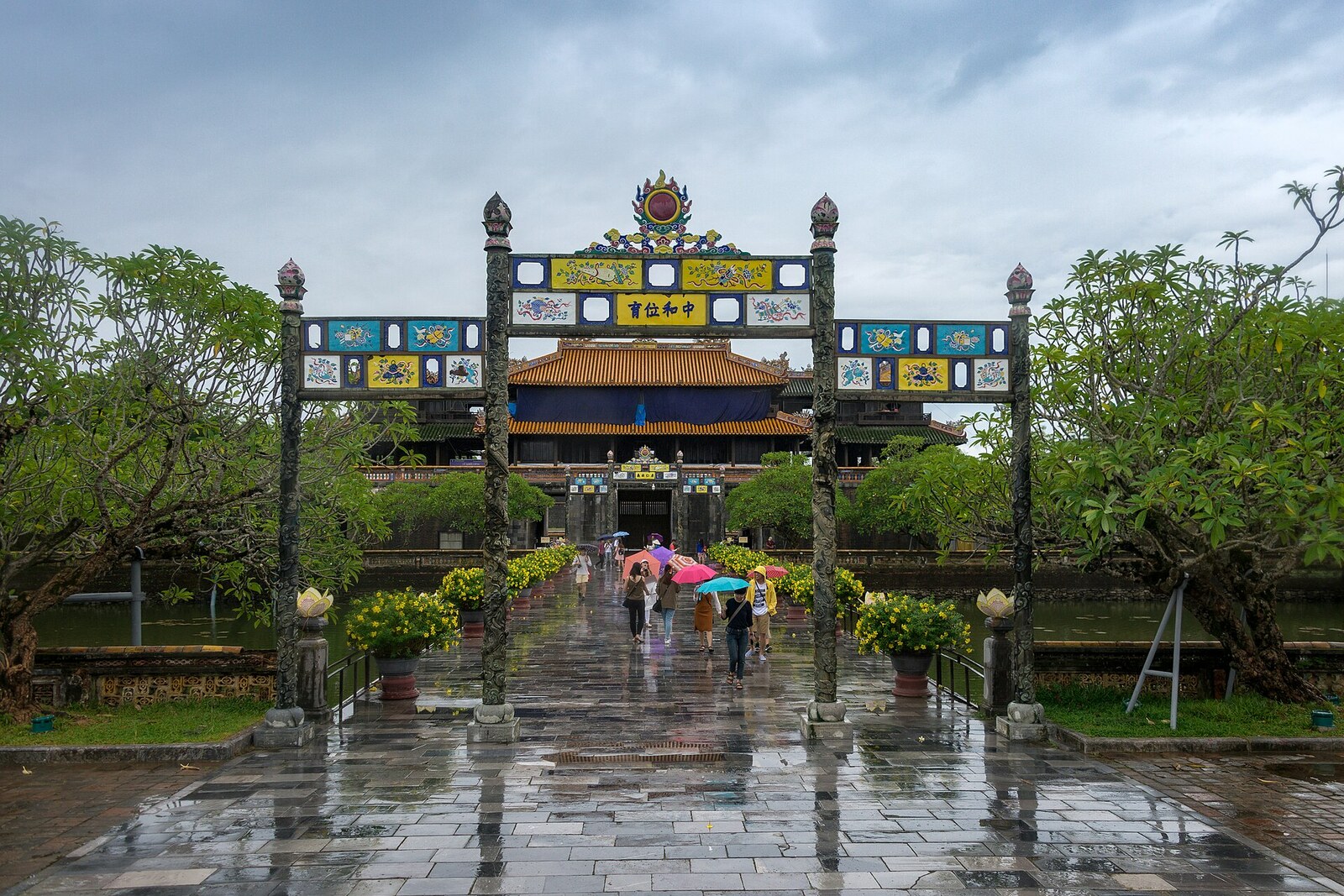
Look around first
What to notice
- Five passages
- Central yellow doors
- Five Phoenixes Pavilion
- Upper platform above the gate
The story of the place
On August thirtieth, nineteen forty-five, Bao Dai, the last emperor of Vietnam, stepped out onto Five Phoenixes Pavilion above Noon Gate. He wore a yellow ceremonial robe. A crowd of many thousands gathered before the gate, and people had arrived from Hanoi to accept his abdication. Bao Dai was no longer seeking to preserve the throne: before the ceremony, he asked representatives of the new government to guarantee his life.
Noon Gate was built specifically for public appearances by the emperor. Emperor Minh Mang ordered it built in eighteen thirty-three as the main southern entrance to the inner citadel. In the old circle of directions, the word “ngo” meant south and, at the same time, noon, so the name is translated as the South Gate, Noon Gate, or Meridian Gate. Five passages divided people by rank. The central yellow doors were opened for the emperor; courtiers used the adjacent passages, while soldiers, horses, and elephants used the outer ones. On ordinary days, the gate was kept closed. From the upper pavilion, decrees and calendars were proclaimed, envoys were received, and parades were watched.
In the summer of nineteen forty-five, this order lost its foundation. After Japan’s capitulation, the short-lived state that it had allowed Bao Dai to lead collapsed. On August twenty-third, the revolutionary committee occupied Hue’s institutions. Two days later, the emperor announced his intention to abdicate and asked the provisional government to send a delegation. According to the recollections of its member Nguyen Luong Bang, before appearing before the public, Bao Dai met with the delegation in the palace and asked whether they could save his head.
The delegation was led by Tran Huy Lieu, authorized to accept the abdication and the monarch’s insignia. His open car drove through the central passage of Noon Gate—the very passage that only the emperor had been allowed to use before. Bao Dai read a decree, then handed Tran Huy Lieu, with both hands, a jewel-encrusted sword and the square gold seal “Hoang de chi bao”—“The Emperor’s Treasure.” The seal confirmed state decisions, and the sword signified the right to command the army. Tran Huy Lieu accepted both objects and declared the monarchy abolished.
After the handover, one of the delegation’s members pinned a red badge with a yellow star to Bao Dai’s yellow robe. It has not been possible to establish exactly who did this: three participants later attributed the act to different people. The gesture itself is beyond doubt. From that moment, the former emperor was publicly called Citizen Vinh Thuy—his personal name. Soon he left for Hanoi and became the supreme adviser to the new government. Tran Huy Lieu took the seal and sword there and, on September second, presented them to those gathered in Ba Dinh Square.
Above the five passages of Noon Gate still stands Five Phoenixes Pavilion—the platform where Bao Dai read his abdication. The seal and sword were taken away from here, and their former owner left the Imperial City under the name Vinh Thuy.
Useful on site
Use ticket office hours as a guide: 16 March–15 October 06:30–17:30; 16 October–15 March 07:00–17:00.
Checked: date not specified. Check the official source before visiting.Do not treat the central passage as an ordinary entrance: use only the routes open under the current visitor plan.