 Guide On Map
Hanoi’s Power: From Thang Long to Ba Dinh
From the North Gate of the Hanoi Citadel to the mausoleum and One Pillar Pagoda
Guide On Map on your phone
Open the walk like a regular app
It takes about 10 seconds to install. No app store needed.
The whole path
Route map
About the walk
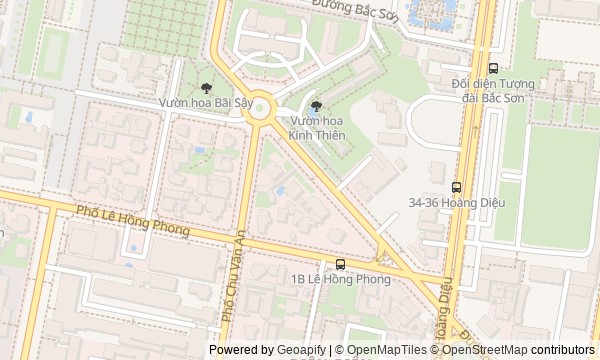
You will walk from the solitary North Gate of the Hanoi Citadel, through the former imperial center of Thang Long, to Ba Dinh Square. The route first cuts across the citadel: five palace arches, a tower above the terraces, and a staircase that now runs into someone else’s building. Then old walls give way to a concrete room, open excavations, and the government quarter. Layers of palaces will lie beneath your feet, while ahead are the places where power declared itself in public and made decisions for a person after death.
This story rests not on ceremonial rhetoric, but on decisions and their cost. You will spot two impact marks with white plaques, a flag that could not be raised at its appointed moment, and a clock stopped beside a bed. The answers will come at the stops themselves.
By the end of the walk, you will read this district through its surviving passages, empty foundations, and the decisions that turned palace land into the political center of modern Hanoi.
Why this order
The North Gate of the Hanoi Citadel sets out the citadel’s outer boundary and the cost of defending it. From there, Doan Mon Gate takes you inside the order of the palace, while the Hanoi Flag Tower farther south shows how an old fortification was folded into a new state ceremony. Returning through Doan Mon Gate to Kinh Thien Palace matters: after following the path from gate to throne, you arrive where military victory was turned into a legitimate title. The route then leaves the imperial core for House 67—from a public audience to the room where a personal refusal gave way to the doctors’ decision. The archaeological site continues the theme underground: the foundations found here forced a change to a state construction project. From the excavations, the road leads to Ba Dinh Square, where the state was first named in public, and the final walk to the mausoleum and pagoda reveals two different posthumous decisions—to preserve a person against his will, and to rebuild a destroyed pavilion around a surviving pillar.
Those who want to understand Hanoi’s history through people’s decisions Lovers of archaeology and surviving traces of rebuilding Those interested in the connection between the imperial city and the modern government quarter
Those looking for a walk through markets, cafes, and residential streets Those who do not enjoy long historical narratives Those who prefer to avoid subjects of war, death, and posthumous memory
Before you go
Much of the route runs through open courtyards and broad squares, so bring water, sun or rain protection, and comfortable shoes. Do not rush on the stairs or near the excavations: important details lie underfoot, and some sections read better from a distance. Access inside individual buildings, shelters, and the mausoleum may be regulated separately and can change regardless of access to the rest of the route. If you want to enter the mausoleum, check the visiting rules in advance and allow time for screening; seeing it from outside does not require structuring the whole walk around that entrance. Choose restrained clothing for religious and memorial sites, and be prepared to put your camera away where photography is restricted.
When to go
Allow about three hours for the route in sequence, with the final sites viewed from outside. If you spend time reading the excavation, enter the accessible rooms of House 67, and go through the separate procedure for visiting the mausoleum, you will need about 3.5 hours. Do not try to make up time by rushing: the walk draws its meaning from pauses before visible traces and empty spaces.
Backup plan
If the interior rooms of House 67 or the bunker are closed, look at the unassuming facade and picture the contrast between an ordinary working building and the protected headquarters beneath it; the transition from Kinh Thien Palace will still make sense. If the excavation is closed, use its boundary as a point for the story of capitals buried beneath the modern city, without trying to inspect layers from a restricted area. If entry to the mausoleum is not possible, finish the route outside: compare its heavy mass with the pagoda’s small pavilion, and remember that one structure preserves a body while the other preserves a reconstructed image. The closure of one site does not require changing the order of the stops.
Route conditions
Surface. Paved — 2.2 km (data covers 82% of the route)
Facilities. Toilets — 9; drinking water — 2
Elevation. Ascent — 18 m; descent — 24 m
OpenStreetMap extract of June 18, 2026: database data, not a check on the ground. Data © OpenStreetMap contributors, ODbL licence
Walk plan
Open in maps ↗- 1
North Gate of the Hanoi Citadel
Two shell holes link the surviving masonry to the choice made by the citadel’s defenders. - 2
Doan Mon Gate
Five passageways will show how court hierarchy was embedded in the architecture itself. - 3
Hanoi Flag Tower
The overnight climb explains why the main act of the ceremonial event took place without spectators. - 4
Kinh Thien Palace Platform
The surviving staircase marks the place where an unauthorized victory was turned into recognized rank. - 5
House 67
One room links wartime meetings with the final weeks of the president's life. - 6
Eighteen Hoang Dieu Archaeological Site
Here, the finds will prove more important than the construction site for which the archaeologists began their work. - 7
Ba Dinh Square
A temporary platform will help reconstruct the day when the republic first appeared before the city’s residents. - 8
Ho Chi Minh Mausoleum and the One Pillar Pagoda
Two neighboring monuments complete the route with stories of will, loss, and restoration.
Route features
Everything you need stays in the browser
Progress, saves and your trip plan are stored on this device.
Add Guide On Map to your home screen so the walk opens outside the browser.
How we handle sources, maps and corrections: our editorial standards