 Guide On Map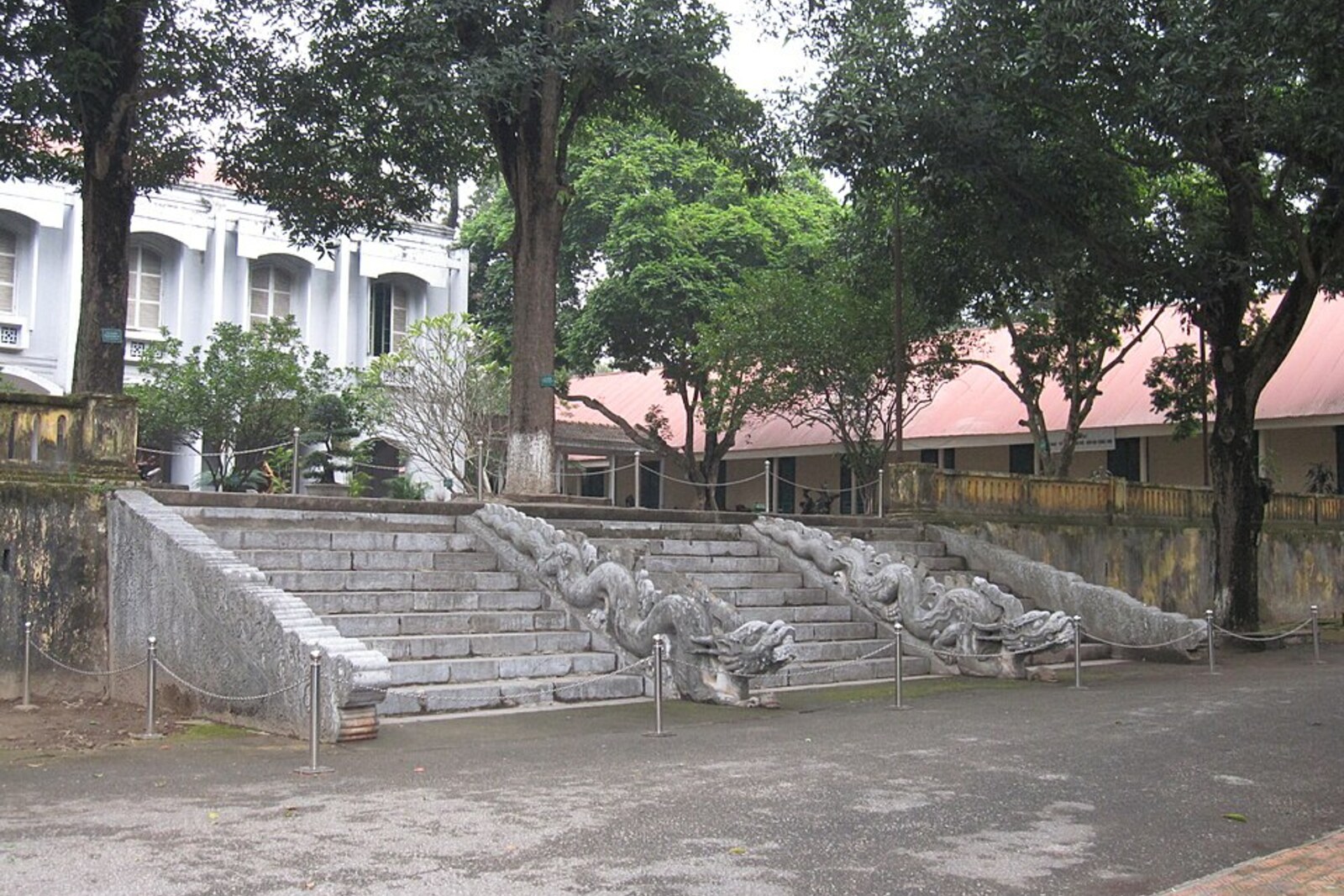
Look around first
What to notice
- Southern staircase
- Stone dragons
- Three passageways
- Building on the palace foundation
The story of the place
The Kinh Thien Palace Platform remains from the main hall of the imperial palace. Major court audiences took place here, although regular ceremonies had already ceased in the final years of the Le dynasty. The French military dismantled the wooden building in eighteen eighty-six and set up an artillery headquarters on its foundation; beyond the staircase stands the building that took the place of the former hall. Nine steps, three passageways, and stone dragons carved in fourteen sixty-seven preserve the entrance to the vanished palace.
In the summer of seventeen eighty-six, Nguyen Hue entered here through Doan Mon Gate with his commanders. He was two years away from the title of Quang Trung, emperor. He was still the commander of the Tay Son army—and a commander who had gone far beyond his orders.
His elder brother Nguyen Nhac, the leader of Tay Son, had sent him to retake the city of Phu Xuan from the Trinh lords and stop at the former border between north and south. Nguyen Hue led the army farther on, crushed the Trinh forces in ten days, and occupied Thang Long. His position rested on the victorious army and his brother's trust; now he was risking both.
The campaign was conducted under a promise to support the Le dynasty and remove the Trinh lords. For almost two centuries, the Le emperors had retained the throne while the Trinh lords controlled the army, appointments, and treasury from their own residence. By then, the Le dynasty's main palace hall had almost lost its former purpose. Kinh Thien Palace—“Reverence for Heaven”—had once hosted ceremonial audiences, but regular ceremonies here had ceased. In an account made on the eve of Tay Son's arrival, the old courtyard was described as overgrown with grass up to the knee and stained with horse dung; inside the hall stood altars to Heaven, Earth, and the dynasty's founder.
The seventy-year-old Emperor Le Hien Tong first received the victor privately in the residential Van Tho Palace. The northern official Nguyen Huu Chinh, who had become Nguyen Hue's adviser, explained to the commander that a private meeting proved nothing to the court. If he had truly returned the country to the Le dynasty, it had to be shown before all the dignitaries in the hall intended for such acts.
On the seventh day of the seventh lunar month, Le Hien Tong again convened a great audience here. The officials took their places by rank. Nguyen Hue came through Doan Mon Gate, made five full prostrations, and bowed three times before the emperor. He then submitted a report on the defeat of the Trinh lords and handed over lists of warriors and households. Such registers made it possible to recruit soldiers and collect taxes. The commander brought into the palace the papers without which the promised restoration of Le rule would have remained mere words.
Le Hien Tong issued a decree unifying the country, gave Nguyen Hue the highest military commander's rank, and granted him the princely title of Duke of Uy. A few days later, the emperor gave him his sixteen-year-old daughter Ngoc Han in marriage, sealing recognition through kinship. Le Hien Tong soon died. When Nguyen Nhac learned that his brother had occupied Thang Long on his own authority, he hurried north; forty-five days after Nguyen Hue entered the city, the brothers led the army south together. Ngoc Han left with her husband and later, when he became Emperor Quang Trung, received the title of Northern Empress.
The wooden hall where Le Hien Tong received Nguyen Hue no longer exists. The French military demolished it in eighteen eighty-six and set up an artillery headquarters on its foundation. Of the palace, the platform and southern staircase remain: nine steps, three passageways, and stone dragons carved in fourteen sixty-seven. On the day of that audience, they had already divided the approach to the throne for more than three centuries. Now the same passageways end at the building that took the place of Kinh Thien Palace.
Useful on site
The citadel is open daily 08:00–17:00; general adult admission is 100 000 dong.
Checked: July 1, 2026. Check the official source before visiting.Do not try to reconstruct one “correct” palace in your mind: view the foundation from several sides and leave room for different eras.